
Forex Risk Management: Proven Strategies to Protect Your Trading Capital (2025 Guide)
The forex market moves fast. Prices shift in seconds. Fortunes can swing within a single trading session. Yet most retail traders focus almost entirely on entries where to buy, where to sell while completely ignoring the one thing that separates long-term winners from those who blow their accounts.
That one thing is forex risk management.
According to industry data, over 70% of retail forex traders lose money. The traders who survive and thrive are not necessarily the ones with the best analysis. They are the ones with the best discipline. They treat every trade as a business decision, not a gamble. They know how much they are willing to lose before they ever place an order.
This guide covers everything you need to know about risk management forex professionals use every day. Whether you are a beginner or an experienced trader looking to sharpen your edge, these strategies will help you protect your capital, trade with confidence, and stay in the game for the long run.
What Is Forex Risk Management?
Forex risk management is the process of identifying, assessing, and controlling the financial risks that come with trading currency pairs. It is a structured set of rules and techniques designed to limit losses, preserve capital, and ensure that no single trade or even a series of bad trades can destroy your account.
Think of it this way. A surgeon does not walk into an operating room without a plan for every possible complication. A pilot does not take off without a safety checklist. In the same way, a serious forex trader does not open a position without knowing exactly how much they are prepared to lose if the trade goes wrong.
Risk management forex strategies are not about avoiding losses entirely; that is impossible. They are about controlling losses so that your wins can outpace them over time.
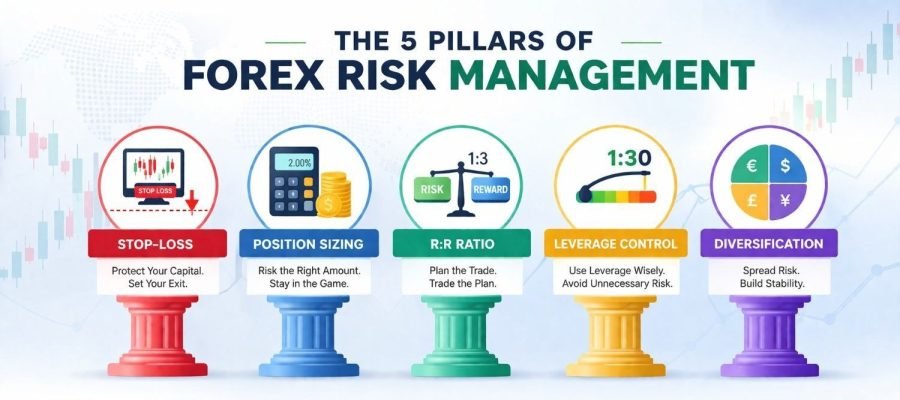
Fig 1.1 Forex Risk Management Infographic
Why Forex Risk Management Is Non-Negotiable
Many beginners underestimate risk until they experience their first major loss. By then, the damage is often serious. Here is why solid forex risk management matters from day one:
- The market is unpredictable. Even the best analysis can be wrong. News events, central bank decisions, and geopolitical shocks can reverse a trade instantly.
- Leverage amplifies both gains and losses. Forex brokers offer leverage of up to 1:500. Without proper controls, a 1% move against your position can wipe out 50% of your account.
- Emotions destroy discipline. Fear and greed push traders to hold losses too long and cut profits too early. Risk rules remove emotions from the equation.
- Consistency beats luck. A trader with a 40% win rate can still be profitable if their average win is larger than their average loss. Risk management makes that possible.
7 Core Forex Risk Management Strategies
1. The 1–2% Rule: Limit Your Risk Per Trade
This is the foundation of all risk management forex systems. Never risk more than 1% to 2% of your total account balance on a single trade.
For example:
- Account balance: $10,000
- Risk per trade at 1%: $100
If you lose 10 trades in a row which is rare but possible you have only lost $1,000. Your account is still alive, and you have the capital to recover.
Professional traders at hedge funds and proprietary firms almost universally apply this rule. It is not glamorous, but it is powerful.
2. Stop-Loss Orders: Your Safety Net
A stop-loss order automatically closes your trade when the price hits a predetermined level. It removes the need for you to watch the charts 24 hours a day. More importantly, it removes the temptation to “wait and see” when a trade turns against you.
How to place a stop-loss correctly:
- Base it on market structure place it beyond a key support or resistance level, not at an arbitrary pip distance.
- Use the Average True Range (ATR) indicator to measure recent market volatility, then place your stop outside of that range.
- Never move a stop-loss further away to avoid a loss. That defeats the entire purpose.
Example: You buy EUR/USD at 1.1000. You place a stop-loss at 1.0950. Your maximum loss is 50 pips, regardless of what happens after.
3. Take-Profit Levels: Lock In Your Gains
A take-profit order closes your trade automatically when the market reaches your profit target. It prevents you from getting greedy and watching a winning trade reverse into a loss.
When combined with a stop-loss, take-profit levels create a complete, emotion-free trade structure. Set your targets before you enter the trade, not in the heat of the moment.
4. Risk-Reward Ratio: Trade Smarter, Not More
The risk-reward ratio (R:R) compares your potential profit to your potential loss on any given trade. Most professional traders use a minimum ratio of 1:2, meaning they aim to make $2 for every $1 they risk.
Here is why this matters mathematically:
Win Rate | R:R Ratio | Result Over 10 Trades |
50% | 1:1 | Break even |
40% | 1:2 | +$400 profit |
33% | 1:3 | +$300 profit |
50% | 1:2 | +$1,000 profit |
You can be wrong more often than you are right and still make money if your risk-reward ratio is favorable. This is one of the most underutilized tools in forex risk management.
Trading Style | Recommended R:R Ratio |
Scalping | 1:1 to 1:1.5 |
Day Trading | 1:1.5 to 1:2 |
Swing Trading | 1:2 to 1:3 |
Position Trading | 1:3 or higher |
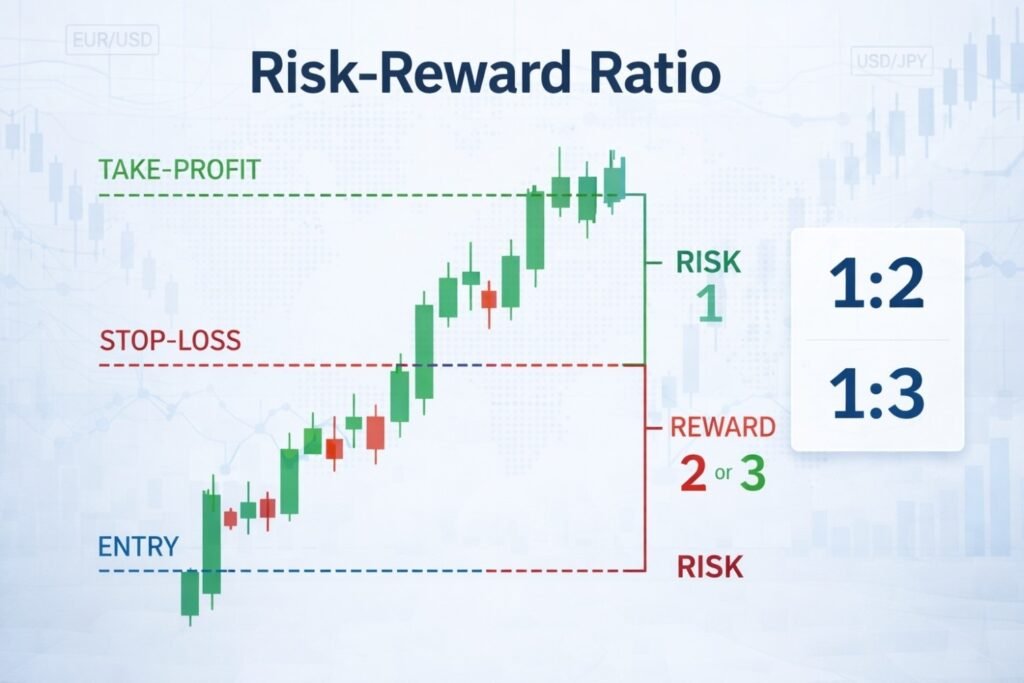
Fig 1.2 Risk Reward Ratio Forex Trading
5. Position Sizing: Calculate Before You Trade
Position sizing determines exactly how many lots or units you trade on each position. It connects your risk percentage to the actual dollar amount at risk, accounting for your stop-loss distance.
Position Sizing Formula:
Lot Size = (Account Balance × Risk %) ÷ (Stop-Loss in Pips × Pip Value)
Worked Example:
- Account: $10,000
- Risk per trade: 1% = $100
- Stop-loss: 50 pips
- Pip value (EUR/USD standard lot): $10 per pip
Lot Size = $100 ÷ (50 × $10) = 0.2 lots (mini lot)
Using a position sizing calculator takes the guesswork out entirely. Platforms like MetaTrader 4, MetaTrader 5, and tools on Myfxbook.com include built-in calculators.
6. Leverage Management: Use It Wisely
Leverage is the most dangerous double-edged sword in forex trading. Brokers advertise high leverage sometimes up to 1:500 as a selling point. But experienced traders know that higher leverage means higher risk.
Best practices for leverage control:
- Never use the maximum leverage your broker offers just because it is available.
- Calculate the leverage you actually need based on your position size and stop-loss.
- If you are a beginner, stick to leverage of 1:10 or lower until you develop consistency.
- Reduce position sizes during high-impact news events like NFP reports, Fed announcements, or central bank rate decisions.
The key rule: your leverage should be determined by your risk, not by how much profit you want.
7. Diversification: Spread Your Risk
Trading multiple currency pairs can reduce your overall risk but only if you do it correctly. Many traders make the mistake of opening 10 positions on highly correlated pairs (such as EUR/USD, GBP/USD, and AUD/USD simultaneously), thinking they are diversified. In reality, all three pairs often move in the same direction.
Smart diversification in forex:
- Trade pairs from different regions major pairs, commodity currencies, and Asian pairs.
- Avoid holding more than 2 to 3 highly correlated positions at the same time.
- Treat correlated positions as a single combined trade for risk calculation purposes.
- Limit total open risk across all positions to 5% to 10% of your account.
The Role of Trading Psychology in Risk Management
No discussion of forex risk management is complete without addressing the mental side of trading. Discipline breaks down under stress. Fear and greed override logic at the worst moments.
The most common psychological traps traders fall into include:
- Revenge trading trying to recover a loss immediately by placing bigger, riskier trades.
- Overtrading placing too many trades out of boredom or excitement.
- Moving stop-losses rationalizing why a losing trade will turn around, instead of accepting the loss.
- FOMO (Fear of Missing Out) chasing trades that have already moved, outside of your plan.
The solution is simple in theory, hard in practice: write a trading plan and stick to it. Your plan should define your risk per trade, your maximum daily loss limit, your acceptable leverage levels, and the conditions under which you will stop trading for the day.
Professional traders treat losses as business expenses, not personal failures. When you shift your mindset from outcome-focused to process-focused, your risk management forex discipline becomes automatic.
Common Forex Risk Management Mistakes to Avoid
Even experienced traders fall into these traps. Recognizing them early can save your account:
- No stop-loss on open trades. This is the single most dangerous habit in forex. Every trade must have a stop-loss with no exceptions.
- Risking too much per trade. Risking 5%, 10%, or more per trade is account suicide. Stick to 1–2%.
- Ignoring correlation. Treating EUR/USD and GBP/USD as completely separate risks when they move together.
- Trading without a plan. Entering trades based on gut feel with no defined exit strategy.
- Using excessive leverage. High leverage wipes accounts during normal market volatility, before a trade even has time to recover.
- Doubling down on losing trades. Adding to a losing position sometimes called “averaging down” can quickly destroy an account.
Forex Risk Management Tools Every Trader Should Use
Tool | Purpose | Examples |
Position Size Calculator | Calculates correct lot size based on risk % | Myfxbook, Babypips, MT4/MT5 built-in |
ATR Indicator | Measures volatility for stop-loss placement | Available on all major platforms |
Trading Journal | Tracks trades and reviews performance | Notion, Excel, Edgewonk |
Economic Calendar | Identifies high-impact news events to avoid | Forex Factory, Investing.com |
Risk-Reward Calculator | Visualizes trade potential before entry | TradingView tools |
Drawdown Tracker | Monitors account health over time | MT4 reports, custom spreadsheets |
Forex Risk Management: Quick Reference Table
Rule | Best Practice |
Max risk per trade | 1–2% of account balance |
Minimum R:R ratio | 1:2 |
Maximum daily loss | 3–5% of account balance |
Stop-loss | Always set before trade entry |
Leverage (beginners) | 1:10 or lower |
Correlated positions | Max 2–3 at a time |
Total open risk | 5–10% of account |
Wait. What is WordPress?
How long do I get support?
Do I need to renew my license?
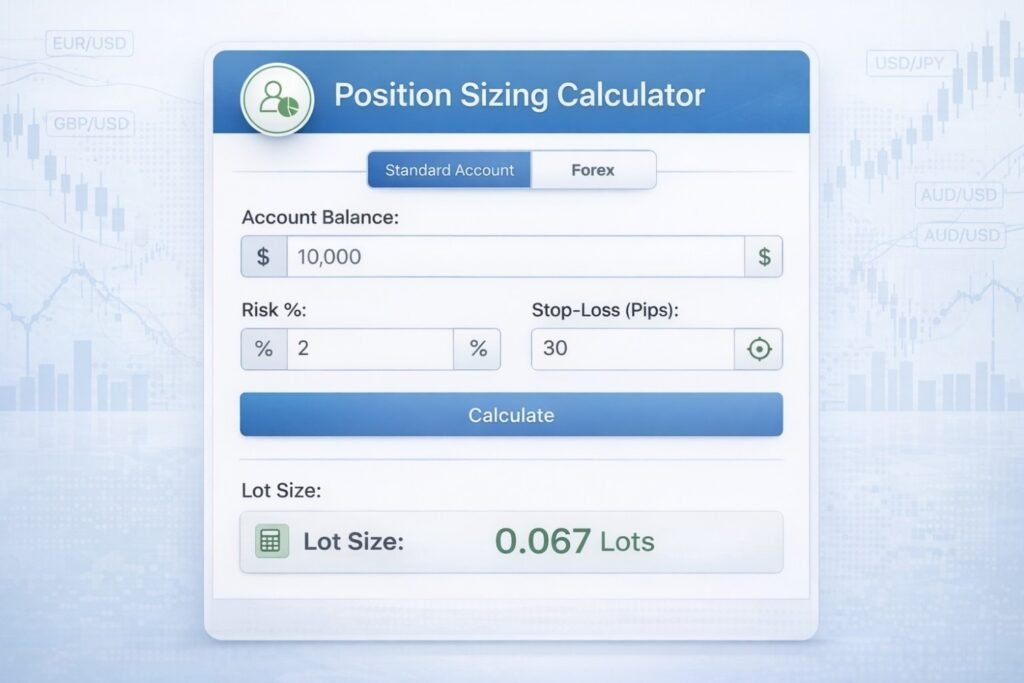
Fig 1.3 Position Sizing Forex Trading
What is the best risk management strategy for forex beginners?
How much should I risk per trade in forex?
What is a good risk-reward ratio in forex?
Is leverage dangerous in forex trading?
What is the difference between forex risk management and trading strategy?
What is the 5-3-1 risk rule in forex?
Final Thoughts
Forex risk management is not a strategy you apply once and forget. It is a discipline you practice on every single trade, every single day. The traders who last the ones who build real, sustainable wealth in the forex market are not necessarily the most brilliant analysts. They are the most disciplined risk managers. Start with the basics. Apply the 1–2% rule. Set stop-losses on every trade. Use proper position sizing. Respect your risk-reward ratio. Control your leverage. These are not complex techniques. But they are the techniques that separate account-blowers from account-builders. Apply these risk management forex principles consistently, and you give yourself the one thing every trader needs most: the ability to stay in the game long enough to win.