
Hedging Strategies Forex: Complete Professional Guide for Risk Control
Introduction: Understanding Hedging in Forex Trading
The Forex market is highly dynamic, where price movements can change within seconds due to global news, economic data, or geopolitical events. In such an unpredictable environment, traders often look for ways to protect their capital instead of exposing it fully to risk.
This is where hedging strategies forex become extremely important.
Hedging is a structured risk management approach where traders open positions to offset potential losses in existing trades. Instead of trying to eliminate risk completely, hedging focuses on reducing exposure and stabilizing outcomes during uncertain market conditions.
Professional traders, hedge funds, and institutional investors rely heavily on a forex hedging strategy to maintain balance in volatile markets.
What Are Hedging Strategies in Forex?
A forex hedging strategy is a method used to protect a trading position by opening an opposite or correlated position. This helps reduce the impact of adverse price movements.
For example, if a trader buys EUR/USD expecting the price to rise but fears short-term volatility, they may open a sell position to limit potential losses.
Unlike speculation, hedging is not about maximizing profit it is about capital protection and risk stabilization. It allows traders to survive market uncertainty without emotional decision-making.
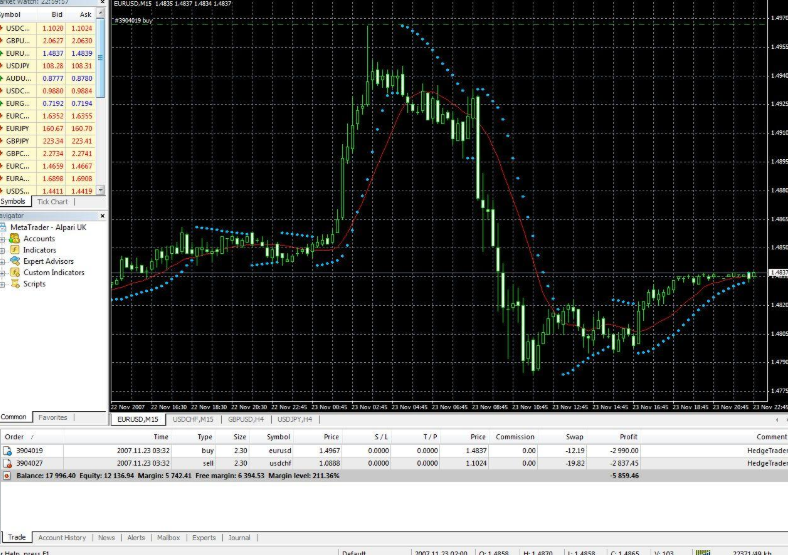
Fig 1.1 Forex trading platform showing hedging strategy forex example with buy and sell orders on EUR USD chart
Importance of Hedging Strategies Forex Traders Use
The Forex market is influenced by many unpredictable factors such as interest rate decisions, inflation reports, and global economic instability. Without a protective strategy, traders often face sudden drawdowns.
Using hedging strategies forex helps traders stay active in the market even during uncertain conditions.
One of the biggest advantages of hedging is psychological stability. When risk is controlled, traders make more logical decisions instead of emotional reactions. It also allows traders to hold positions longer without fear of sudden losses.
In professional trading, hedging is not optional—it is a core component of long-term survival.
Types of Forex Hedging Strategy Used by Traders
Direct Hedging Approach
One of the simplest forms of hedging is direct hedging. In this method, traders open both buy and sell positions on the same currency pair.
This creates a temporary lock on the trade, allowing traders to pause exposure while analyzing the market direction. It is often used during high volatility or news events when price movement becomes unpredictable.
Correlated Currency Hedging Strategy
Currencies often move in relation to each other. For example, EUR/USD and GBP/USD frequently show positive correlation.
Traders use this relationship in a forex hedging strategy by opening positions in correlated pairs instead of the same pair. This helps diversify risk and reduce dependency on a single trade outcome.
Understanding correlation is essential for advanced hedging because incorrect pairing can increase risk instead of reducing it.
Options-Based Hedging Strategy
Options trading provides another powerful hedging method. Traders buy options contracts to protect against unfavorable price movements.
For example, a trader holding a long position may purchase a put option to limit downside risk. This method is widely used by institutional traders because it provides structured protection with controlled cost.
Multi-Pair Hedging Strategy
In this approach, traders hedge exposure across multiple currency pairs instead of focusing on a single trade. This spreads risk across different markets and reduces dependency on one asset.
For instance, a trader may balance exposure between USD/JPY, EUR/USD, and GBP/USD depending on market conditions. This method is more complex but highly effective for portfolio management.

Fig 1.2 Forex hedging strategies forex risk management comparison showing risk vs reward balance in trading
Step-by-Step Example of Forex Hedging Strategy
To understand how hedging works in real trading, consider a simple scenario.
A trader enters a buy position on EUR/USD at 1.1000 expecting price growth. However, market uncertainty increases due to upcoming economic news. Instead of closing the trade, the trader opens a sell position at 1.0980.
Now both positions balance each other. If the market falls, losses from the buy trade are offset by gains from the sell trade. If the market rises, the hedge is adjusted or closed accordingly.
This approach allows traders to manage uncertainty without exiting the market completely.
Risk Management in Forex Hedging Strategy
Although hedging reduces risk, it does not eliminate it completely. Traders must understand cost factors such as spreads, swaps, and margin requirements.
A strong forex hedging strategy always includes proper position sizing. Over-hedging can lead to unnecessary complexity and reduced profitability.
Professional traders also combine hedging with stop-loss techniques to ensure complete risk control. The goal is not to avoid loss entirely but to manage it efficiently.
Common Mistakes in Hedging Strategies Forex Traders Make
Many traders misuse hedging by treating it as a guarantee against loss. One common mistake is opening too many opposite positions without a clear strategy.
Another mistake is ignoring transaction costs, which can slowly reduce profitability over time. Emotional hedging, where traders react without analysis, also leads to poor results.
Successful traders always apply hedging with a structured plan rather than impulsive decisions.
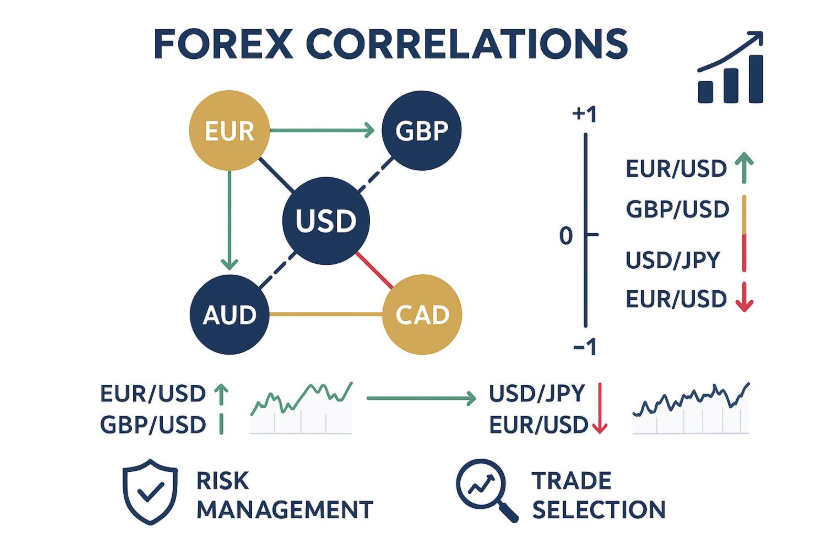
Fig 1.3 Forex currency correlation analysis showing hedging opportunities between major currency pairs
Advanced Insight: Dynamic Hedging in Forex
Professional traders often use dynamic hedging, where positions are adjusted based on market behavior. Instead of holding static hedges, they increase or reduce exposure depending on volatility.
For example, during high-impact news events, hedge positions may be increased temporarily. Once the market stabilizes, hedges are reduced or closed.
This flexible approach allows traders to stay aligned with market conditions while maintaining control over risk exposure.
Who Should Use Forex Hedging Strategies?
Not every trader needs advanced hedging techniques. However, it is highly beneficial for swing traders, part-time traders, and institutional participants who manage large positions.
Beginners can also benefit from simple hedging methods, but they must first understand basic trading principles before applying complex strategies.
FAQs
What is the purpose of hedging strategies forex?
Is a forex hedging strategy suitable for beginners?
Does hedging guarantee profit in Forex trading?
Which is the most effective hedging strategy forex traders use?
Can hedging replace stop-loss in Forex trading?

Fig 1.4 Professional forex trader using hedging strategies to manage market risk and protect trading capital
Conclusion
In conclusion, hedging strategies forex play a vital role in modern trading by helping traders manage uncertainty and reduce exposure to sudden market movements. A well-planned forex hedging strategy is not about eliminating risk completely but about controlling it in a structured and disciplined way.
Successful traders understand that survival in Forex depends more on risk management than aggressive profit-making. By combining hedging with proper analysis, position sizing, and emotional discipline, traders can build a more stable and long-term trading approach.
Ultimately, hedging is not just a technique it is a professional mindset that separates consistent traders from emotional ones in the Forex market.