

Economic Calendar
Here is what you need to know for Tuesday, April 28:
The US Dollar Index (DXY) is trading cautiously near the 98.50 level as markets prepare for a busy week of central bank meetings. The Federal Reserve (Fed), European Central Bank (ECB), Bank of Japan (BoJ), and Bank of England (BoE) are all expected to keep interest rates unchanged, with forward guidance taking the spotlight.
More info
Calendar Guide
Here is what you need to know for Tuesday, April 28:
United States – Economic indicators
The US economic calendar is the most important one since the country is the world’s largest economy. The most important indicators mainly impact the price of the US Dollar (USD), but they also affect other markets and currencies.
The organizations that publish the most meaningful indicators – The ones that carry the greatest impact in the markets – are the US Bureau of Labor Statistics (BLS), the US Bureau of Economic Analysis (BEA), the US Census Bureau and the Energy Information Administration (EIA). Of special interest are the Federal Reserve (Fed) interest-rate decisions.
Fed Interest Rate Decision
- FOMC Minutes
- Nonfarm Payrolls
- ISM Services PMI
- Retail Sales Control Group
- Consumer Price Index
Canada – Economic indicators
Canada is one of the world’s strongest economies, mainly due to its natural resources, technology, and industrial sectors. It is also a part of international trade agreements, such as the United States-Mexico-Canada Agreement (USMCA) or the Comprehensive and Progressive Agreement for Trans-Pacific Partnership (CPTPP).
Among the events with the greatest impact are announcements from the Bank of Canada (BoC), which is currently chaired by Tiff Macklem. Some of the most relevant indicators of Canada’s Economic Calendar include:
- BoC Interest Rate Decision
- BoC Monetary Policy Report
- Unemployment Rate
- Net Change in Employment
- Gross Domestic Product
United States – Economic indicators
The US economic calendar is the most important one since the country is the world’s largest economy. The most important indicators mainly impact the price of the US Dollar (USD), but they also affect other markets and currencies.
The organizations that publish the most meaningful indicators – The ones that carry the greatest impact in the markets – are the US Bureau of Labor Statistics (BLS), the US Bureau of Economic Analysis (BEA), the US Census Bureau and the Energy Information Administration (EIA). Of special interest are the Federal Reserve (Fed) interest-rate decisions.
Fed Interest Rate Decision
- FOMC Minutes
- Nonfarm Payrolls
- ISM Services PMI
- Retail Sales Control Group
- Consumer Price Index
Canada – Economic indicators
Canada is one of the world’s strongest economies, mainly due to its natural resources, technology, and industrial sectors. It is also a part of international trade agreements, such as the United States-Mexico-Canada Agreement (USMCA) or the Comprehensive and Progressive Agreement for Trans-Pacific Partnership (CPTPP).
Among the events with the greatest impact are announcements from the Bank of Canada (BoC), which is currently chaired by Tiff Macklem. Some of the most relevant indicators of Canada’s Economic Calendar include:
- BoC Interest Rate Decision
- BoC Monetary Policy Report
- Unemployment Rate
- Net Change in Employment
- Gross Domestic Product
Speech trackera
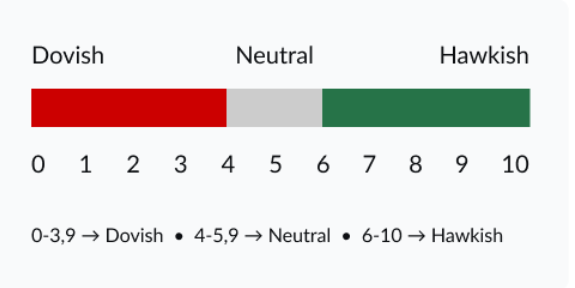
core of 0.0-3.9 is dovish, 4.0-6.0 is neutral and 6.1-10 is hawkish.
- Dovish speeches are usually: USD bearish, Gold bullish, Stocks bullish.
- Neutral speeches are usually: USD bearish, Gold bullish, Stocks bullish.
- Hawkish speeches are usually: USD bearish, Gold bullish, Stocks bullish.
Financial markets are highly sensitive to expected changes in interest rates by the Federal Reserve (Fed). When decision-makers at the Fed signal the path of interest is lower, their speech is dovish. Indications of higher interest rates are hawkish.
Why is there no Sentiment/Score in this speech?
Financial markets are highly sensitive to expected changes in interest rates by the Federal Reserve (Fed). When decision-makers at the Fed signal the path of interest is lower, their speech is dovish. Indications of higher interest rates are hawkish.
Why is there no Sentiment/Score in this speech?
Financial markets are highly sensitive to expected changes in interest rates by the Federal Reserve (Fed). When decision-makers at the Fed signal the path of interest is lower, their speech is dovish. Indications of higher interest rates are hawkish.
Why is there no Sentiment/Score in this speech?
Financial markets are highly sensitive to expected changes in interest rates by the Federal Reserve (Fed). When decision-makers at the Fed signal the path of interest is lower, their speech is dovish. Indications of higher interest rates are hawkish.