
Beneath every sharp, decisive move in the currency market sits a simple but powerful truth: large institutions cannot fill their enormous orders all at once, so they inevitably leave behind footprints on the chart. Order block forex trading is the disciplined practice of finding those footprints, the specific candles where institutional buying or selling originated, and using them as high-probability zones to enter trades. This guide explains clearly what an order block really is, how to build a reliable order block trading strategy from the higher timeframe down, how to identify a bullish order block with proper confirmation, and how to manage risk so the inevitable failed blocks cost little while the genuine ones pay handsomely. The aim is to replace vague, over-marketed smart-money hype with a clear, repeatable method you can actually trade with confidence.
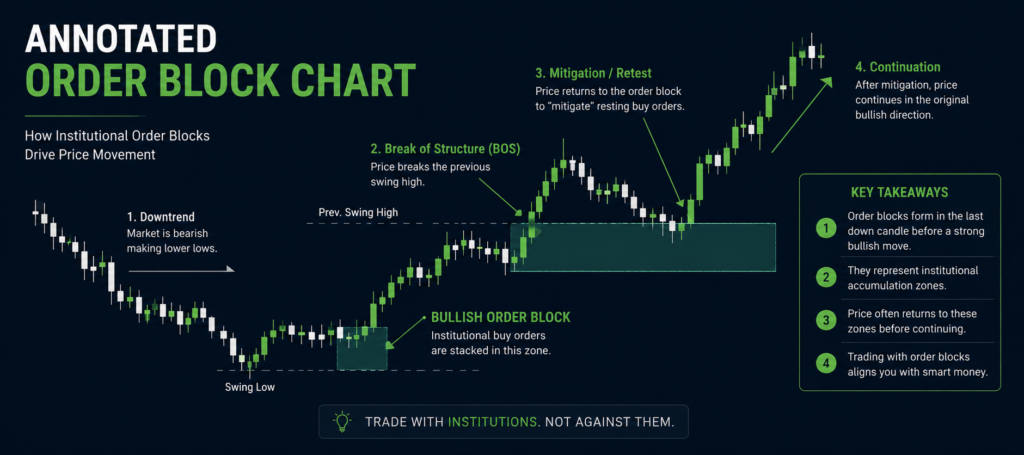
Fig 1.1 Order block forex chart origin candle
What Is an Order Block?
An order block is the last candle, or small cluster of candles, before a strong, decisive move away from a level, marking the area where institutional orders were placed before price exploded in one direction. When a large player accumulates a position, they cannot do so without leaving a trace; the consolidation or final opposing candle before the breakout reveals where that accumulation happened. Traders mark this candle as a zone, expecting that if price returns to it, the remaining institutional interest there may drive price away again in the same direction.
The logic mirrors supply and demand trading but with a sharper, candle-specific focus. Where supply and demand zones are often drawn around a base of consolidation, an order block zeroes in on the precise origin candle of an impulsive move. A bullish order block is typically the last down candle before a strong rally, the point where buyers overwhelmed sellers, while a bearish order block is the last up candle before a sharp decline. The move away must be impulsive and decisive for the block to carry weight, because a half-hearted move suggests no real institutional commitment.
It is worth being honest that order block trading sits within the broader “smart money concepts” school, which blends genuine market-structure insight with a fair amount of marketing. The useful core is real: large orders do leave footprints, and zones of prior imbalance do tend to attract reactions. But no candle is magic, and treating order blocks as guaranteed reversal points rather than probabilistic zones is the fastest way to lose money. The skill lies in selectivity and confirmation, not in mechanically buying every block you can draw.
How to Identify a Valid Order Block
Identifying a high-quality order block begins with the move that follows it. The strongest blocks are those followed by an impulsive, near-vertical departure with large candles and minimal pullback, often one that breaks a prior structural level, signalling genuine institutional commitment rather than ordinary noise. A block followed by a slow, overlapping drift is weak and unreliable. The quality of the departure is the single most important filter, because it is the evidence that real imbalance occurred at that candle.
The second consideration is location and context. An order block that forms at a significant level, a prior swing high or low, a higher-timeframe supply or demand zone, or a key round number, carries far more weight than one floating in the middle of a range. Context is what separates a tradeable block from a random candle, and the best setups stack several factors: an impulsive departure, a break of structure, and confluence with a higher-timeframe level all pointing the same way. The more independent reasons a block has to matter, the more reliable it tends to be.
Freshness matters too. A block that has not yet been retested since it formed is generally more reliable, because the institutional orders presumed to rest there are still intact. Each time price returns and trades through part of the block, some of that interest is consumed, weakening it for the next visit. Prioritising fresh, well-located blocks with strong departures, and ignoring stale or poorly located ones, is most of what separates consistent order block traders from those who draw zones everywhere and trade noise.
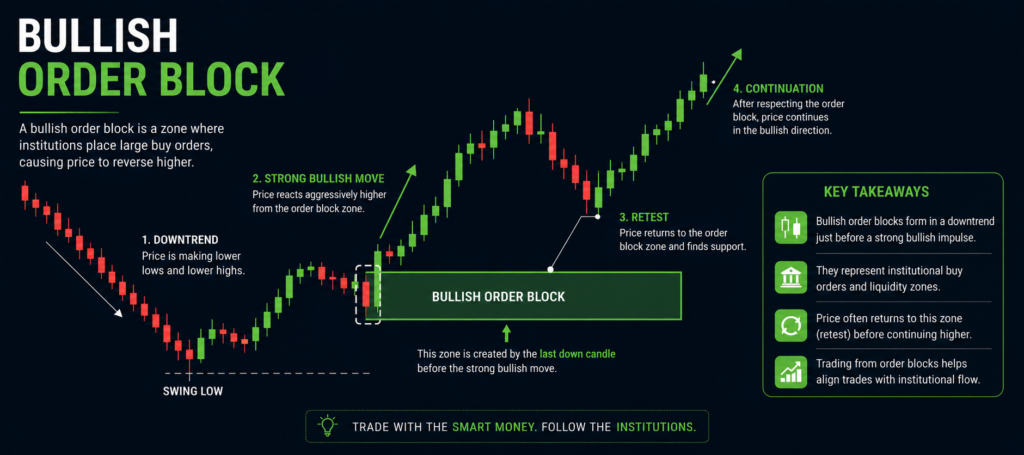
Fig 1.2 Bullish order block
Building an Order Block Trading Strategy
A sound order block trading strategy combines top-down analysis with patient, confirmed entries. The sensible workflow starts on a higher timeframe, where you identify the dominant trend and mark the significant order blocks aligned with it. Trading order blocks in the direction of the higher-timeframe trend dramatically improves the odds compared with fading a strong move, because you are positioning with institutional flow rather than against it. This top-down filter is the backbone of the approach.
With the relevant blocks marked, you drop to a lower timeframe to refine the entry when price returns to a block. Two broad approaches exist: a set-and-forget limit order placed at the block’s edge, which captures the best price and tightest stop but accepts that some blocks fail, or a confirmation entry that waits for price to enter the block and show a reaction, a strong rejection candle, a lower-timeframe shift in structure, or a momentum turn, before committing. The confirmation approach filters out many failed blocks at the cost of a slightly worse entry, and it is usually the wiser choice for all but the most experienced.
| Component | What to Do | Why It Matters |
|---|---|---|
| Higher-timeframe trend | Trade blocks with the trend | Aligns you with institutional flow |
| Block quality | Demand impulsive departure | Confirms real imbalance |
| Location | Require confluence with key levels | Separates signal from noise |
| Freshness | Prefer untested blocks | Orders likely still intact |
| Entry | Use confirmation over blind limits | Filters out failed blocks |
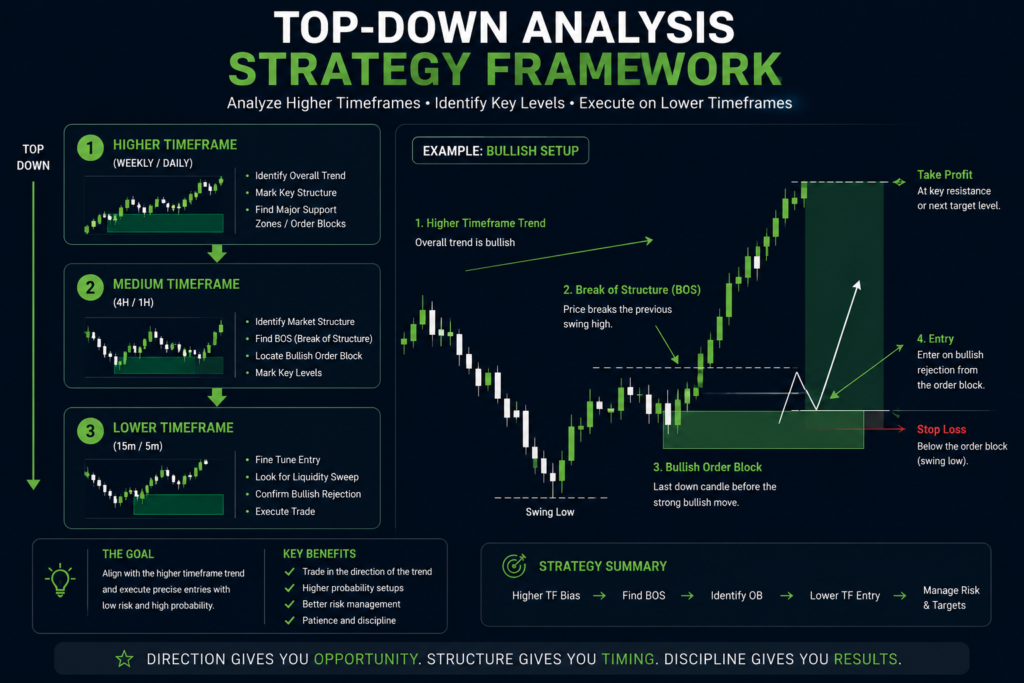
Fig 1.3 Order block trading strategy
What Top Traders and Research Say
The premise behind order block trading, that large orders leave detectable footprints, finds support in market-microstructure research. In their well-known study “Order Imbalance, Liquidity, and Market Returns,” Tarun Chordia, Richard Roll, and Avanidhar Subrahmanyam found that imbalances between buy and sell orders are strongly related to subsequent price movements, lending academic weight to the core idea that concentrated order flow drives price. While their work focused on equities, the principle that order flow leaves a measurable imprint applies broadly across liquid markets, including forex.
The discipline this style demands is captured by experienced traders. John Murphy’s classic Technical Analysis of the Financial Markets remains a foundational text on the support, resistance, and structure that order blocks build upon, grounding the modern terminology in long-established principles. And the trader Jesse Livermore’s observation that “markets are never wrong; opinions often are” is a useful corrective for order block traders, reminding them to trade the reaction price actually shows at a block rather than forcing a block to work because they are convinced it should.
Common Mistakes to Avoid
The most common mistake is drawing order blocks everywhere and treating each as a guaranteed reversal, which turns a probabilistic edge into random noise trading. The cure is ruthless selectivity: trade only fresh, well-located blocks with impulsive departures, aligned with the higher-timeframe trend, and ignore the rest. A trader who marks five blocks a day and trades them all will underperform one who waits for the single high-quality block that meets every criterion.
A second frequent error is entering blindly the moment price touches a block, with no confirmation, which exposes you to the many blocks that simply fail. Waiting for a reaction filters out a large share of losers. Equally damaging is neglecting risk management, because no block is certain; placing the stop just beyond the block where the idea is invalidated, and sizing so a normal losing streak cannot threaten the account, is non-negotiable. Finally, fighting the higher-timeframe trend by trading counter-trend blocks lowers the win rate for little reward and should be avoided by all but the most experienced.
Frequently Asked Questions
What is an order block in forex?
An order block in order block forex trading is the last candle, or small cluster, before a strong, impulsive move away from a level, marking where institutional orders were placed before price exploded. A bullish order block is typically the last down candle before a sharp rally, and a bearish one the last up candle before a sharp decline. Traders mark it as a zone, expecting that if price returns, the remaining institutional interest there may drive price away again in the same direction.
How do I identify a bullish order block?
A bullish order block is usually the last bearish candle before a strong, impulsive rally that ideally breaks a prior structural level, signalling that buyers decisively overwhelmed sellers at that point. To qualify as high-probability, it should be followed by a near-vertical departure with large candles, sit at a significant level or higher-timeframe demand zone for confluence, and ideally be fresh and untested. The quality of the impulsive move away is the most important filter, since a weak departure suggests no genuine institutional commitment.
How is an order block different from supply and demand?
Order blocks and supply and demand zones share the same underlying logic of institutional footprints, but order blocks focus more precisely on the specific origin candle of an impulsive move, while supply and demand zones are often drawn around a broader base of consolidation. In practice the two overlap heavily, and many traders use them together. Both rely on impulsive departures, confluence with key levels, and freshness, and both are probabilistic zones rather than guaranteed reversal points requiring confirmation before entry.
What timeframe is best for order block trading?
A top-down approach works best: identify the dominant trend and significant order blocks on a higher timeframe such as the four-hour or daily, then refine entries on a lower timeframe like the one-hour or fifteen-minute when price returns to a block. Higher timeframes produce more reliable, institutionally meaningful blocks, while lower timeframes contain more noise and weaker blocks. Trading lower-timeframe blocks in isolation, without higher-timeframe context, is a common source of false signals and frustration.
Do order blocks really work?
Order blocks identify high-probability reaction zones grounded in the genuine principle that large orders leave footprints, supported by microstructure research on order imbalance. However, they are not guaranteed reversal points; a meaningful share of blocks fail, and profitability comes from selectivity, confluence, confirmation, and disciplined risk management rather than from the blocks alone. Traders who treat them as certainties and trade every block they can draw tend to lose, while those who wait for fresh, well-located, trend-aligned blocks with confirmation can build a genuine edge.
Final Thoughts
Order block forex trading distils a genuine market truth into a practical method: large institutions leave footprints, and the candles where their orders originated tend to attract reactions when price returns. A disciplined order block trading strategy turns that truth into an edge by working top-down, marking only the significant blocks aligned with the higher-timeframe trend, demanding an impulsive departure and confluence with key levels, prioritising fresh blocks, and entering on confirmation rather than blind faith. Identifying a bullish order block, the last down candle before a decisive rally that breaks structure, becomes a repeatable skill rather than guesswork once you insist on quality over quantity. The microstructure research of Chordia, Roll, and Subrahmanyam grounds the premise, while Murphy’s structural principles and Livermore’s reminder to trade what price shows keep the method honest. The edge is real but probabilistic: some blocks fail, and success rests on selectivity, confirmation, stops placed just beyond the block, and the patience to wait for high-quality setups.