
Few chart patterns are as widely recognised, or as frequently misused, as the double top. A double top forex pattern marks the potential exhaustion of an uptrend, where price tries twice to break higher, fails on both attempts, and then reverses, while its mirror image, the double bottom pattern, signals a possible end to a downtrend. These remain among the most enduring and trusted forex reversal patterns precisely because they reflect a simple, repeatable battle between buyers and sellers at a key level. This guide explains how to identify them correctly, how to trade them with proper confirmation rather than anticipation, and how to manage risk so the inevitable failed patterns cost little. Done with discipline, a familiar shape becomes a genuine, repeatable edge rather than a hopeful guess.
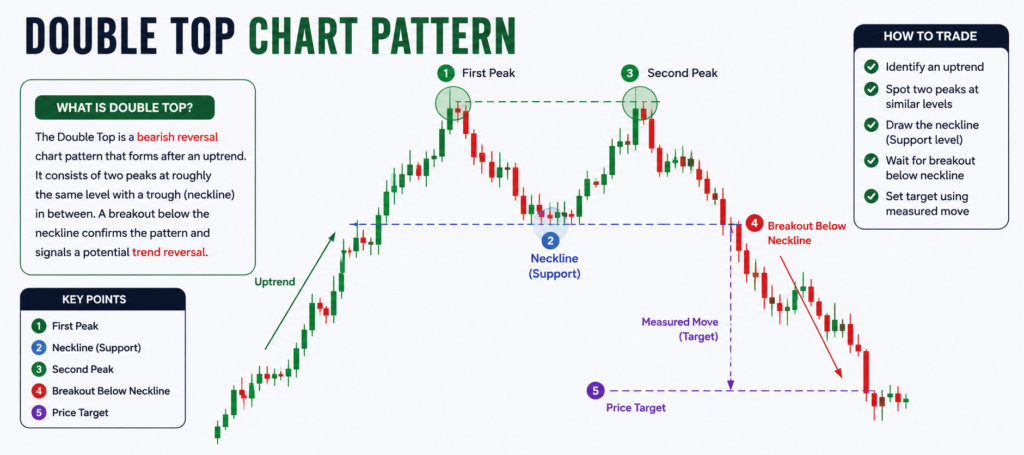
Fig 1.1 Double top forex chart
What Is a Double Top?
A double top forex pattern forms when price rises to a high, pulls back, rallies again to roughly the same high, and then fails to break above it, creating two peaks at a similar level separated by a moderate trough. The pattern resembles the letter M and represents a clear story: buyers pushed price to a resistance level, were rejected, tried once more, and were rejected again, revealing that demand has exhausted itself at that level. The failure to make a new high on the second attempt is the early warning that the uptrend may be ending.
The pattern is not confirmed merely by the appearance of two peaks, which is the single most important point and the one most beginners miss. The confirmation comes when price breaks below the trough between the two peaks, known as the neckline. Until that neckline breaks, you simply have a market that has paused at resistance, which could just as easily resume its uptrend. Trading the pattern before the neckline breaks is anticipation, not confirmation, and it is where most double top losses originate.
The double bottom pattern is the exact mirror image, forming a W shape at the end of a downtrend. Price falls to a low, bounces, falls again to roughly the same low, fails to break lower, and then reverses upward, with confirmation coming on a break above the neckline, the peak between the two lows. Everything that applies to trading double tops applies in reverse to double bottoms, so mastering one means mastering both. Together they are the most fundamental of the forex reversal patterns.
How to Identify a Valid Double Top
A high-quality double top has several characteristics worth demanding before you trade it. First, it should appear after a genuine, established uptrend, because a reversal pattern can only reverse an existing trend; a double top in a sideways range carries little meaning. Second, the two peaks should form at a similar level, not necessarily identical to the pip but close enough to represent the same resistance being tested twice. A second peak that is meaningfully lower can be even more telling, showing buyers losing ground.
Third, there should be a clear trough between the peaks, deep enough to define a meaningful neckline whose break carries significance. A shallow, barely-there trough produces a weak pattern. Fourth, and most importantly, the pattern requires a decisive break of the neckline to confirm, ideally on a strong close rather than a fleeting wick, signalling that sellers have genuinely taken control. The cleanest setups also show waning momentum on the second peak, with an indicator such as RSI making a lower high even as price matches the first peak, hinting at exhaustion before the neckline even breaks.
Context strengthens everything. A double top that forms at a significant higher-timeframe resistance level, a prior major swing high or a round number, is far more reliable than one in open space, because it represents exhaustion at a level that genuinely matters to the wider market. Stacking these factors, an established prior trend, twin peaks at meaningful resistance, momentum divergence, and a decisive neckline break, transforms a common shape into a high-probability setup.
How to Trade the Pattern
The disciplined way to trade a double top forex pattern is to wait for the neckline break before entering short, rather than anticipating the reversal at the second peak. The classic entry is on a confirmed close below the neckline, which signals that the pattern has completed and sellers are in control. More conservative traders wait for a retest, where price breaks the neckline, pulls back to it from below, and is rejected, offering a tighter, lower-risk entry at the cost of occasionally missing moves that do not retest.
The stop-loss placement follows naturally from the pattern’s structure. A logical stop sits just above the second peak, or above the neckline on a retest entry, because a move back above that level invalidates the reversal thesis. The profit target is conventionally measured by taking the height of the pattern, the distance from the peaks down to the neckline, and projecting it downward from the neckline break, giving a structured, objective target rather than a guess. This measured-move approach is one of the pattern’s most useful features.
| Element | Double Top | Double Bottom |
|---|---|---|
| Shape | M (two peaks) | W (two troughs) |
| Prior trend | Uptrend | Downtrend |
| Confirmation | Break below neckline | Break above neckline |
| Entry | On break or retest | On break or retest |
| Stop | Above second peak | Below second trough |
| Target | Pattern height projected down | Pattern height projected up |
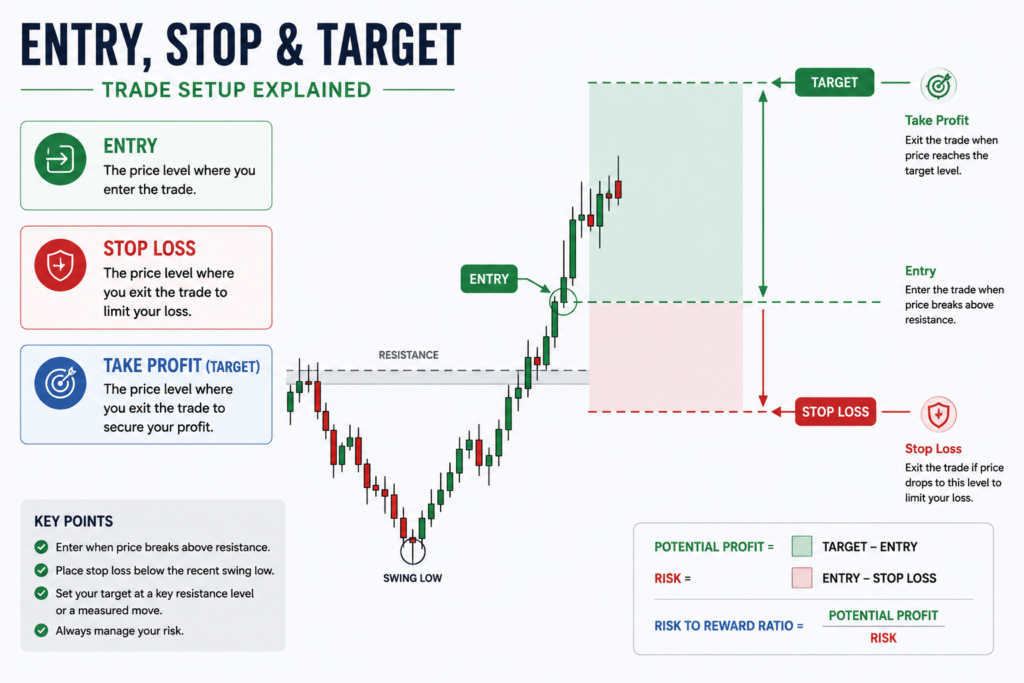
Fig 1.2 Double bottom pattern
What Top Traders and Research Say
Chart patterns have attracted both devoted followers and sceptics, and the research offers measured support. In the influential study “Foundations of Technical Analysis,” Andrew Lo, Harry Mamaysky, and Jiang Wang applied rigorous statistical methods to common technical patterns and found that several, including reversal formations, carry genuine, measurable informational value. This does not guarantee any single double top will work, but it lends credibility to the disciplined, confirmation-based trading of well-defined patterns rather than dismissing them as mere superstition.
The behavioural foundation is equally relevant. In their landmark work “Does the Stock Market Overreact?”, Werner De Bondt and Richard Thaler showed that markets systematically overreact and then reverse, which is exactly the dynamic a double top captures, an overextended trend exhausting and turning. The classic technical-analysis authority Thomas Bulkowski, who catalogued pattern performance extensively, has long emphasised that confirmation and context, not the shape alone, determine a pattern’s reliability, a reminder that the neckline break is the heart of the trade.
Common Mistakes to Avoid
The most damaging mistake is entering before the neckline breaks, anticipating the reversal at the second peak on the assumption that two peaks guarantee a turn. Many double tops fail and resolve as continuations, with price breaking to new highs, so trading before confirmation is trading hope. Waiting for the decisive neckline break filters out a large share of these false patterns and is the single most important discipline.
A second frequent error is ignoring the prior trend and context, drawing double tops in sideways ranges or away from significant levels where the pattern carries little meaning. Equally damaging is neglecting the measured-move target and risk management, since no pattern is certain; the stop above the second peak and a sensible position size are non-negotiable. Finally, forcing the pattern by seeing twin peaks that are not at a similar level, or that lack a meaningful trough, produces low-quality setups; demanding a clean, well-formed structure is what separates a tradeable edge from pattern-spotting wishful thinking.
Frequently Asked Questions
What is a double top in forex?
A double top forex pattern forms when price rises to a high, pulls back, rallies again to roughly the same high, and fails to break above it, creating two peaks in an M shape that signal possible exhaustion of an uptrend. It is confirmed only when price breaks decisively below the trough between the peaks, called the neckline. Before that break, it is simply a pause at resistance. The pattern reflects buyers being rejected twice at the same level, hinting that demand has run out.
How do I trade a double bottom pattern?
The double bottom pattern is the mirror image, a W shape at the end of a downtrend, traded long. Wait for price to fall to a low, bounce, fall again to roughly the same low, fail to break lower, and then break decisively above the neckline, the peak between the two lows, to confirm. Enter on the neckline break or on a retest of it from above, place the stop below the second trough, and project the pattern’s height upward from the neckline for the target.
How reliable are double tops and bottoms?
These forex reversal patterns are among the most reliable classical formations when traded with confirmation and context, and research on technical patterns lends measured support to their informational value. However, reliability depends heavily on demanding a genuine prior trend, twin peaks at a meaningful level, a clear neckline, and a decisive break before entering. Traded on the shape alone, without confirmation, many fail. The neckline break, sensible stops, and confluence with significant levels are what turn the pattern into a genuine edge.
Where do I place my stop and target?
On a double top, place the stop just above the second peak, where a move higher invalidates the reversal, or above the neckline on a retest entry. The target is conventionally the pattern’s height, the distance from the peaks to the neckline, projected downward from the neckline break, giving an objective measured move. The double bottom mirrors this: stop below the second trough, target the height projected upward. Always size the position so the stop distance represents a small, fixed percentage of your account.
Can beginners trade double tops?
Yes, double tops and bottoms are among the most beginner-friendly patterns because their structure and confirmation are clear and objective. The key discipline beginners must learn is patience: waiting for the neckline break rather than anticipating the reversal at the second peak, which is the most common and costly error. Starting on higher timeframes produces cleaner, more reliable patterns with less noise. With confirmation-based entries, sensible stops, and attention to the prior trend and context, beginners can trade these patterns effectively.
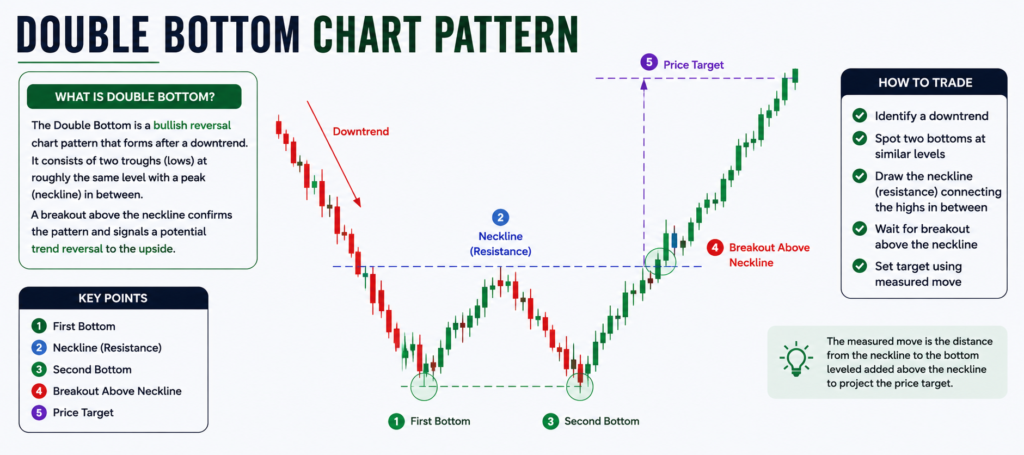
Fig 1.3 Double top forex entry, stop
Final Thoughts
The double top forex pattern, and its mirror the double bottom pattern, endure as cornerstones of technical trading because they capture a simple, repeatable truth: trends exhaust when buyers or sellers fail twice at the same level, and the failure signals a turn. The decisive lesson is that the pattern is confirmed by the neckline break, not by the appearance of two peaks, and trading before that break is where most losses originate. A high-quality setup demands a genuine prior trend, twin peaks at a meaningful level, momentum divergence, and a decisive neckline break, ideally with confluence at a significant higher-timeframe level, and it offers an objective measured-move target and a logical stop. The research of Lo, Mamaysky, and Wang lends credibility to disciplined pattern trading, while De Bondt and Thaler explain why these reversals occur and Bulkowski’s emphasis on confirmation keeps the method honest. As with all forex reversal patterns, the edge is probabilistic: trade the neckline break, not the hope.