
Introduction
A reliable prop firm list has become one of the most searched-for tools in modern trading, and for good reason. The proprietary trading industry has exploded, with new funding companies launching constantly, each offering different account sizes, rules, profit splits, and payout reputations. Sorting through them can feel overwhelming, especially when every firm markets itself as the best. What traders really need is not just names, but a framework for comparing options intelligently and spotting the firms worth trusting. Many people search for a complete list of all prop trading firms, while others want a practical prop firm directory they can return to. Because the landscape changes so fast, the most valuable skill is knowing how to evaluate any firm yourself. In this guide you will learn how to read a prop firm list critically, the categories that matter, the criteria that separate strong firms from weak ones, and how to build your own shortlist.
Why a Prop Firm List Needs a Framework, Not Just Names
The instinct when searching for a prop firm list is to want a definitive ranking, but a raw list of names is surprisingly unhelpful on its own. The industry moves quickly: firms change rules, adjust profit splits, launch and occasionally close, and payout reputations shift over months. A static list can be outdated within weeks, which is why a framework for evaluation outlasts any single ranking.
What truly serves a trader is the ability to assess any firm against consistent criteria. Instead of memorising names, you learn to ask the right questions about rules, costs, and reliability. This approach turns a list of all prop trading firms from an overwhelming jumble into a structured comparison you control. The names are the starting point; your evaluation framework is what actually protects your fee and matches you to a firm that suits your trading style.
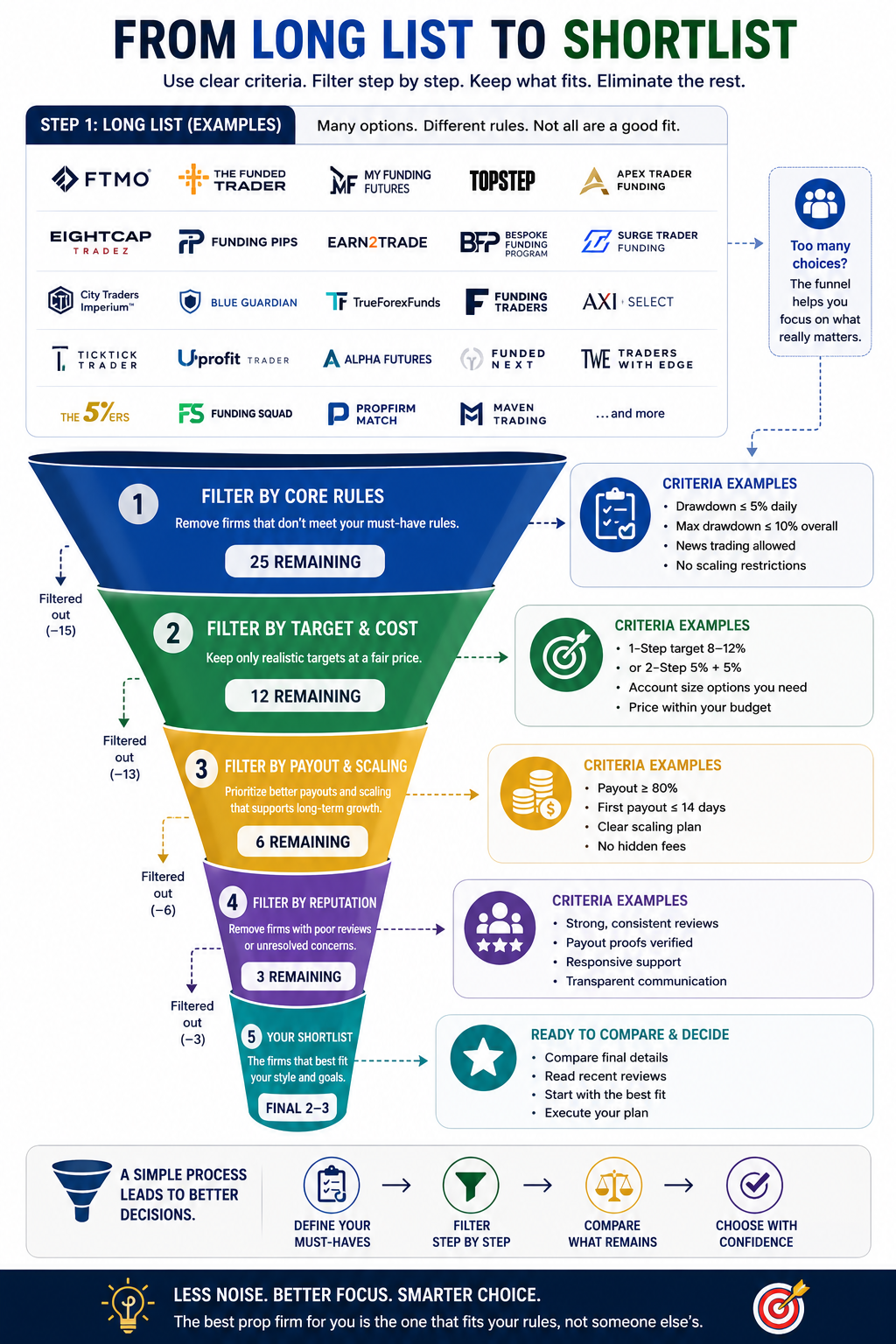
Fig 1.1Prop firm list funnel
The Main Categories on Any Prop Firm List
Before comparing individual firms, it helps to understand the broad categories any prop firm directory contains. The first division is by market: some firms fund forex and CFD traders, while others focus on futures. Choosing the right category first immediately narrows a long list to the firms relevant to what you actually trade.
The second division is by funding model. Two-step challenges are the most common and usually the cheapest, one-step challenges compress the process for a higher fee, and instant-funding firms skip evaluation entirely for the highest upfront cost. A third useful lens is trading style fit — some firms welcome scalpers and news traders, while others restrict them. Sorting any list of all prop trading firms into these categories first means you only compare firms that genuinely match your market, budget, and strategy.
| Category | Examples of What Varies | Why It Matters |
|---|---|---|
| Market focus | Forex/CFD vs futures | Match to what you trade |
| Funding model | Two-step, one-step, instant | Balances cost and speed |
| Style allowance | Scalping, news, weekend holds | Some firms restrict these |
| Account sizes | Small starter to large funded | Affects fee and income |
Criteria That Separate Strong Firms From Weak Ones
Once you have categorised a prop firm list, the real work is judging quality. The single most important factor is payout reputation — does the firm reliably pay traders who earn profits? Verified payout proof and consistent independent reviews matter far more than flashy marketing or large advertised account sizes. A firm that does not pay is worthless regardless of its other features.
Beyond payouts, weigh the rules against your strategy, the fee against the account size and profit split, and the platform and support quality. Transparent, clearly published rules signal a trustworthy operator, while vague or constantly changing terms are a warning sign. The best entries on any prop firm directory combine dependable payouts, fair and stable rules, reasonable costs, and a profit split that rewards your performance. Judging firms against these consistent criteria is what converts a list of names into a confident decision.
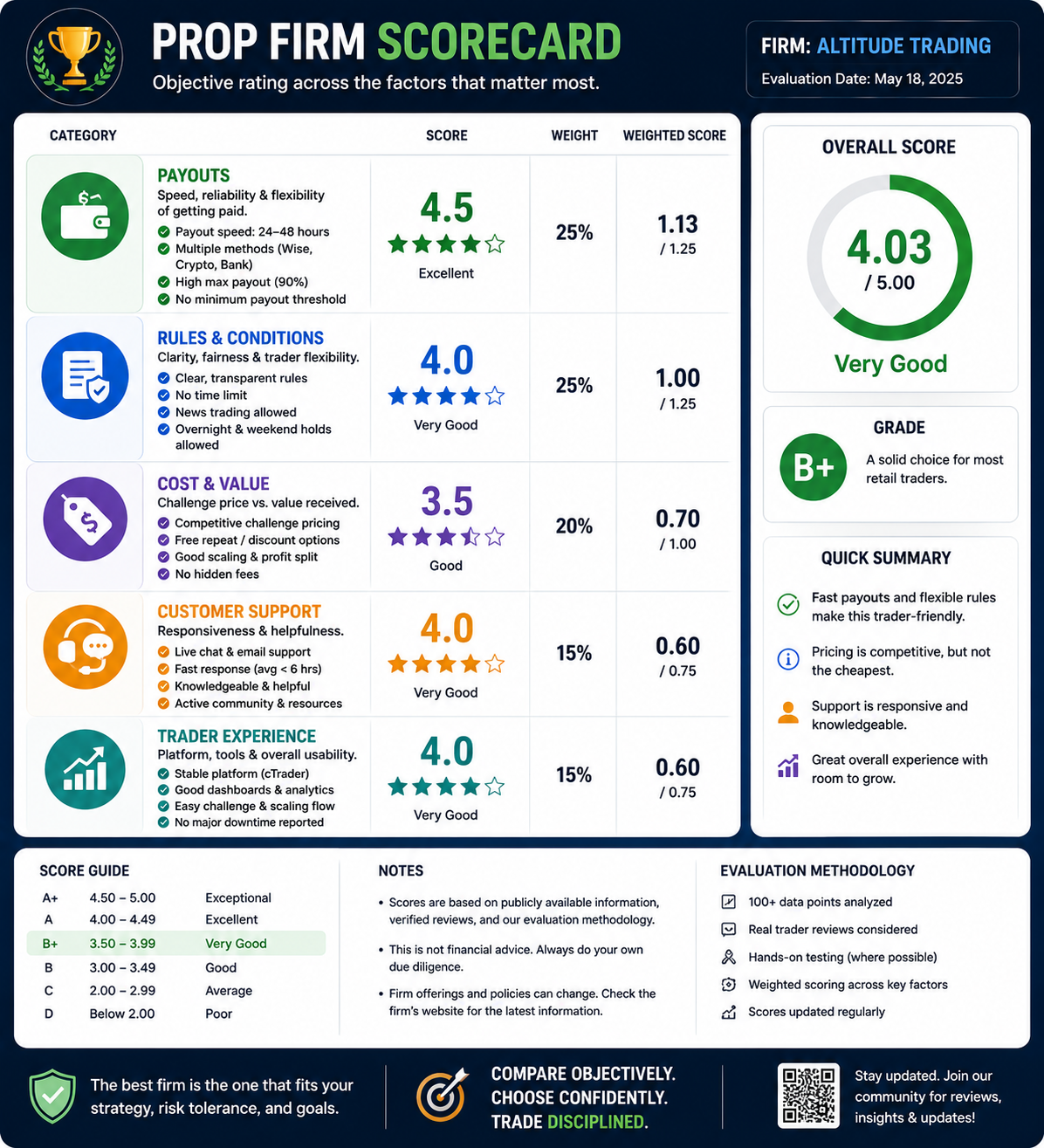
Fig 1.2 Prop firm evaluation scorecard
How to Build Your Own Prop Firm Shortlist
Rather than chasing the single best name, the smartest move is building a personal shortlist from any prop firm list you encounter. Start by filtering for your market and funding model, which eliminates most options immediately. Then check payout reputation, removing any firm without credible proof that it pays reliably.
From the survivors, compare the specific rules against your strategy — a scalper needs no scalping restriction, a swing trader needs weekend holding allowed, and a news trader needs that freedom too. Finally, weigh the fee against the account size and profit split to find the best value. This process typically narrows a sprawling list of all prop trading firms to two or three genuine candidates you can research in depth. Building the shortlist yourself ensures the firm you choose fits your style rather than simply topping someone else’s ranking.
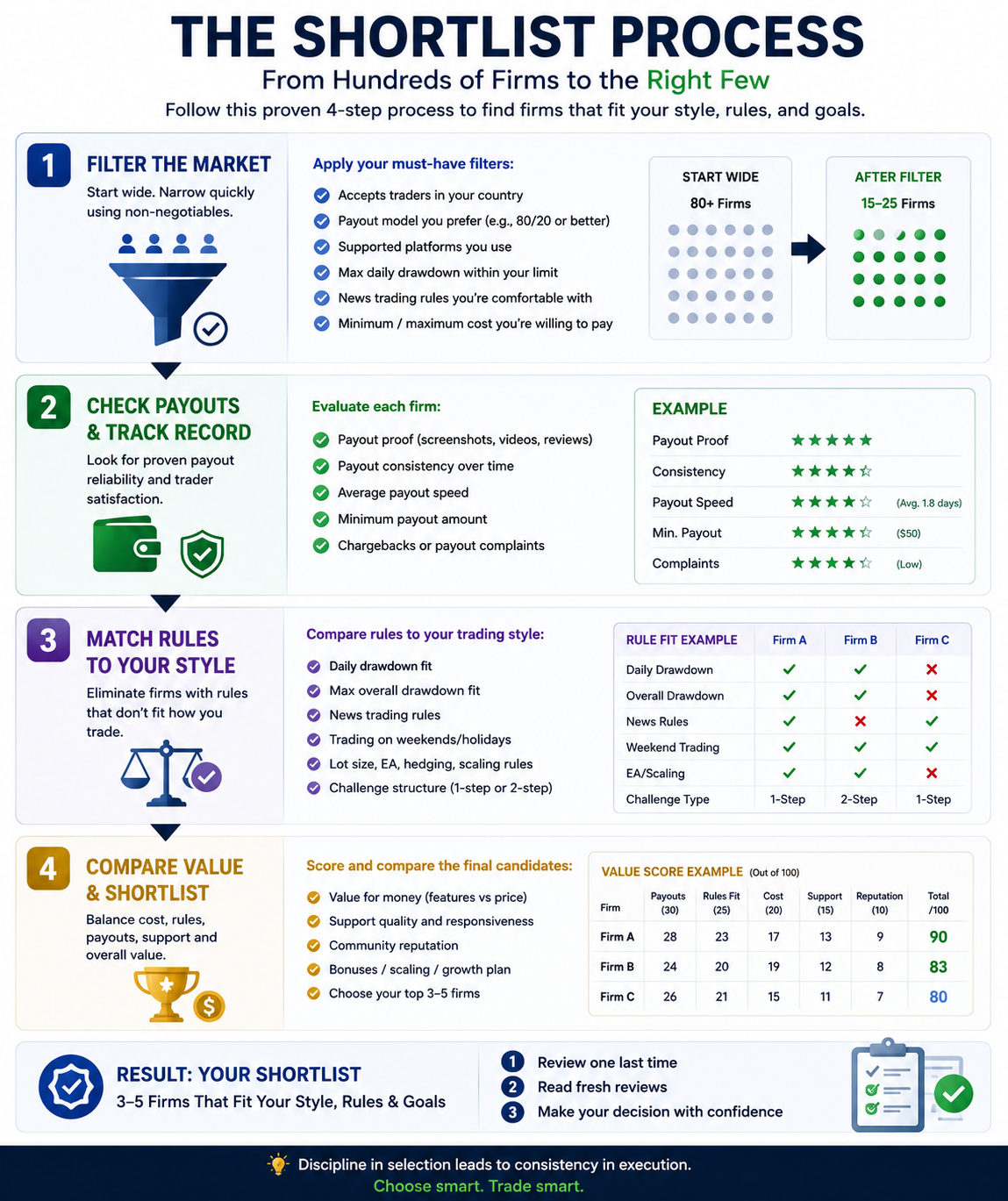
Fig 1.3 Prop firm shortlist process
What Top Traders and Research Say
Sound decision-making matters more than any single firm, and the literature reinforces caution and diligence. In Trading in the Zone, Mark Douglas stresses that consistent traders protect capital and remove emotion from decisions — the same disciplined mindset that should guide choosing a firm rather than chasing hype. Jack Schwager’s Market Wizards repeatedly shows that the best traders prized reliability and risk control above flashy opportunity.
Academic research keeps expectations grounded. The widely cited Barber and Odean study, “Trading Is Hazardous to Your Wealth,” found that the most active retail traders underperformed largely because of overtrading and costs — a reminder that the firm you pick should reward patience, not encourage reckless activity. As Warren Buffett advised, “Risk comes from not knowing what you’re doing.” Applied to any prop firm directory, that means understanding a firm’s rules and payout record before committing a single dollar.
Red Flags to Watch For on Any Prop Firm List
Just as important as finding strong firms is spotting weak ones, and certain warning signs appear repeatedly. The biggest red flag is a poor or unverifiable payout record — if traders struggle to withdraw earnings, no other feature compensates. Vague or frequently changing rules are another warning, since they let a firm move the goalposts after you pay.
Be wary too of firms that rely heavily on aggressive marketing and unrealistic income promises rather than transparent terms and genuine reviews. Hidden fees, unclear drawdown calculations, and confusing consistency rules also signal trouble. When scanning any prop firm list, treat these red flags as immediate disqualifiers. A trustworthy entry on a prop firm directory publishes clear rules, honours withdrawals, and earns its reputation from trader success rather than from collecting failed-challenge fees alone.
Frequently Asked Questions
How do I use a prop firm list effectively?
The best way to use a prop firm list is as a starting point, not a final answer. Filter the names by your market and funding model first, then check each firm’s payout reputation, match its rules to your strategy, and compare the fee against the account size and profit split. This framework turns a long, overwhelming list into a short, confident shortlist. Because the industry changes fast, learning to evaluate firms yourself outlasts any static ranking you might find online.
Is there a definitive list of all prop trading firms?
No single list of all prop trading firms stays definitive for long, because the industry evolves constantly — firms change rules, adjust profit splits, and launch or close regularly. Any list you find is a snapshot in time. That is precisely why a consistent evaluation framework matters more than a fixed ranking. Use lists to discover candidates, then judge each one against payout reputation, rule transparency, cost, and style fit. Your own up-to-date research protects you far better than an outdated directory.
How do I know if a prop firm on the list is legit?
Legitimacy comes down to payout reputation and transparency. On any prop firm directory, prioritise firms with verified payout proof and consistent independent reviews, and read the full rulebook before paying. Trustworthy firms publish clear, stable rules, honour withdrawals, and earn most of their income from successful traders rather than failed challenges. Treat poor payout records, vague terms, and unrealistic income promises as immediate red flags. Choosing a reputable firm is just as important as passing its evaluation.
Which category of prop firm is best for me?
The right category depends on what and how you trade. Start by choosing a firm that funds your market — forex and CFDs or futures — then pick a funding model that fits your budget and confidence, whether a cheaper two-step challenge or faster instant funding. Finally, confirm the firm allows your style, since some restrict scalping, news trading, or weekend holds. Sorting any prop firm list by these categories first ensures you only compare firms that genuinely match your trading.
How many prop firms are there in 2026?
There is no fixed number, because the industry is large and constantly changing, with new firms launching and others closing. This is why a precise list of all prop trading firms is impossible to maintain permanently. Rather than chasing an exact count, focus on building a personal shortlist of two or three firms that fit your market, style, and budget, and that have strong payout reputations. Quality and reliability matter far more than the sheer number of options available.
What is the most important factor when comparing prop firms?
Payout reliability is the single most important factor on any prop firm list. A firm can advertise large accounts, low fees, and generous splits, but if it does not reliably pay traders who earn profits, none of that matters. Always prioritise verified payout proof and consistent reviews, then weigh rule transparency, cost, and style fit. A trustworthy firm that pays dependably and publishes clear rules is worth far more than a flashy one with an unproven or troubled withdrawal record.
Final Thoughts
A useful prop firm list is not a static ranking to memorise but a starting point for intelligent comparison, because the industry simply moves too fast for any fixed directory to stay accurate. The traders who choose well are those who learn to evaluate firms themselves: filtering by market and funding model, then judging each candidate against the criteria that actually matter — above all, a verified record of paying traders reliably. From there, fair and stable rules, reasonable costs, a rewarding profit split, and genuine style fit separate the firms worth trusting from those to avoid. Treat any list of all prop trading firms as raw material, sort it into clear categories, apply consistent standards, and watch for the red flags of poor payouts and vague terms. Build your own shortlist of two or three strong candidates, research them in depth, and you will pick a funding partner that matches your strategy rather than simply topping someone else’s prop firm directory. Done this way, the overwhelming choice becomes a confident, well-informed decision.