
Introduction
Choosing your first market shapes your entire trading journey, and the forex vs indices trading debate sits at the heart of that decision. Both markets attract millions of retail traders, yet they behave very differently once real money is on the line. Forex pits one currency against another in the world’s deepest, most liquid arena. Indices instead bundle dozens of large companies into a single instrument that mirrors the broader economy. Each path offers genuine opportunity, but each also carries distinct risks, costs, and rhythms you must understand before you commit capital. This article breaks down how the two markets actually work, where they overlap, and where they diverge. By the end, you will have a grounded framework for deciding which market suits your style, schedule, and tolerance for risk.
New to the instrument? Start with our guide to what indices are in forex.
Too many newcomers pick a market for the wrong reasons. They follow a friend, chase a viral chart, or assume one instrument is simply easier than the other. That approach rarely ends well. The smarter move is to study how each market generates its moves, what drives its costs, and which trading styles it naturally rewards. When you understand those mechanics, the trading forex vs indices choice stops feeling like a gamble and starts feeling like a deliberate fit between you and the market. Keep that mindset as you read, because the goal here is not to crown a winner but to help you see yourself clearly in each option.
What You Are Actually Trading in Each Market
The first real difference between these markets is what changes hands. In forex, you trade one currency against another, always as a pair such as EUR/USD or GBP/JPY. Your profit depends on the relative strength of two economies, central bank policy, interest rate differentials, and global capital flows. When you go long EUR/USD, you are betting the euro will strengthen against the dollar.
Indices work on a different principle entirely. A stock index measures the combined performance of a basket of companies, so the S&P 500 tracks 500 large US firms, the Nasdaq 100 leans toward technology, and the Dow reflects 30 industrial heavyweights. When you trade an index through a CFD or future, you take a position on the collective direction of those companies rather than any single stock. This is the core of the trading forex vs indices distinction: forex is macro currency strength, while indices are aggregated corporate health. Understanding that contrast helps you read the news that matters for each instrument and avoid analysis built on the wrong drivers.
This difference also changes how you research a trade. A forex position invites you to study two countries at once, comparing growth, inflation, and rate expectations on both sides of the pair. A weak dollar story is only half the picture if the euro is weaker still. An index position pulls your attention toward corporate earnings, sector rotation, and the overall mood of equity investors. A single dominant company can tug an index in its direction, especially in a tech-heavy benchmark where a handful of megacaps carry outsized weight. Knowing which lens to apply keeps your analysis focused and prevents you from trading currencies as if they were stocks, or stocks as if they were currencies.
There is also a structural point worth noting. Because an index already blends many companies, it offers a built-in form of diversification within one instrument, smoothing out the shock of any single firm’s bad day. Forex offers no such cushion, since a pair is a direct two-sided bet with nothing in between. That structural contrast quietly shapes risk, and it explains why the same news headline can rattle an index gently while jolting a currency pair hard.
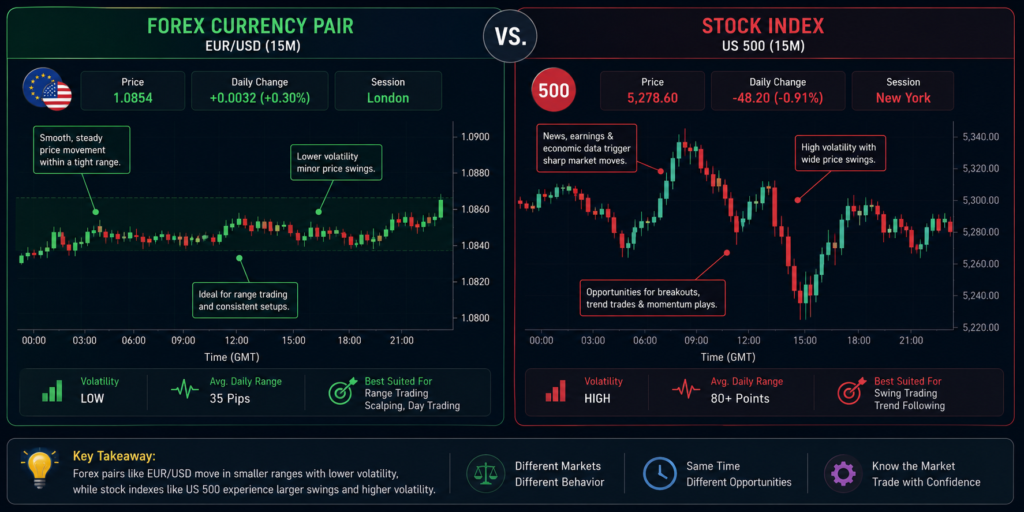
Fig 1.1 Forex vs indices trading comparison
Volatility, Liquidity, and the Pace of Each Market
Volatility defines how a market feels to trade day to day, and the two differ in meaningful ways. Major forex pairs tend to move in a relatively contained range, with the deepest liquidity on the planet smoothing out price action outside of major news events. That liquidity, exceeding several trillion dollars in daily turnover, means tight spreads and reliable order execution even on large positions.
Indices behave with a sharper edge. Because they aggregate equities, they react strongly to earnings seasons, economic data, and shifts in risk sentiment, often producing larger intraday swings than a typical currency pair. A surprise inflation print can send the Nasdaq 100 hundreds of points in minutes. That energy appeals to traders who want movement, but it punishes oversized positions and loose stops. When people ask should i trade forex or indices, volatility tolerance is often the deciding factor. If you prefer steadier conditions and value pinpoint execution, forex may suit you. If you can stomach faster, wider swings in exchange for richer intraday opportunity, indices may be the better fit. Neither is objectively safer; each simply rewards a different temperament and risk plan.
Liquidity deserves a closer look because it shapes far more than spreads. In forex, the sheer volume of participants, from central banks and corporations to hedge funds and retail traders, means orders fill quickly and slippage stays low under normal conditions. You can usually enter and exit a major pair at the price you expect, even with size. Indices enjoy strong liquidity too, but it concentrates around the home exchange’s open and close, then thins during quieter hours. Trading an index in a low-liquidity window can mean wider spreads and choppier fills, which quietly raises your real cost of doing business.
Pace ties these threads together. Forex can feel like a slow, grinding tide for hours, then turn fierce around a rate decision or jobs report. Indices often carry a more constant hum of movement during their cash session, with bursts of energy at the open. A scalper who thrives on frequent, smaller moves may love the steady tempo of a liquid pair, while a trader who wants decisive directional thrust may prefer the punch of an index at the bell. Matching your nervous system to that pace matters as much as any indicator, because a market that feels too fast or too slow for you will quietly erode your discipline.
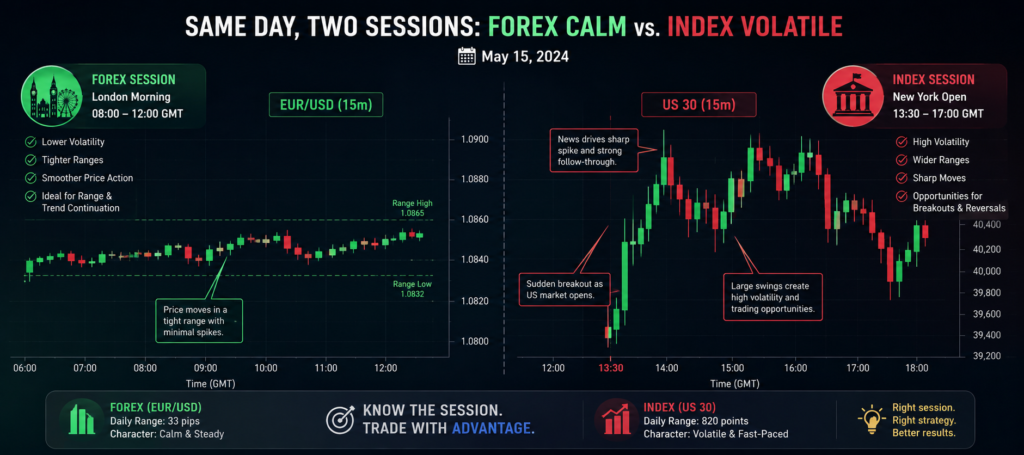
Fig 1.2 Volatility comparison in forex vs indices trading
Trading Hours, Leverage, and Cost Structure
Timing separates these markets just as much as price behavior. Forex runs effectively 24 hours a day, five days a week, rolling through the Sydney, Tokyo, London, and New York sessions. That continuous cycle suits traders with unusual schedules and lets you react to global events whenever they break. Indices, by contrast, are anchored to their underlying stock exchanges, so the most reliable liquidity arrives during their home session, even though many brokers offer extended hours through derivatives.
Leverage and costs also diverge. Forex brokers often provide high leverage on major pairs, which magnifies both gains and losses, while index leverage is typically more conservative because of the larger point values involved. Spreads on major currency pairs are usually razor thin, whereas index spreads can widen during volatile windows. The table below summarizes how the two markets compare across the dimensions that matter most when trading forex vs indices.
| Factor | Forex | Indices |
|---|---|---|
| What’s traded | Currency pairs (one currency vs another) | A basket of stocks as a single instrument |
| Volatility | Generally steadier, spikes on news | Often sharper intraday swings |
| Liquidity | Deepest in the world, very tight spreads | High but session-dependent |
| Trading hours | 24/5 across global sessions | Tied to underlying exchange hours |
| Leverage | Often high on majors | Typically more conservative |
| Best for | Macro thinkers, flexible schedules | Traders who want movement and equity exposure |
The session structure has practical consequences for how you plan your day. A part-time forex trader can choose the London or New York overlap for the richest action, knowing those windows reliably deliver volume and movement. An index trader, however, lives or dies by the cash session of the underlying market, so a US index trader’s prime hours cluster around the American open and the final hour before the close. If your free time never lines up with those windows, you may find yourself trading the quiet, expensive stretches where spreads widen and trends stall. Honest scheduling, then, is not a minor detail; it can decide whether a market is even practical for you.
Leverage and margin warrant equal caution on both sides. High leverage in forex is a double-edged tool: it lets a small account control a meaningful position, but it also lets a few bad ticks wipe out weeks of progress. Index products carry their own margin demands, and because each point can be worth a great deal, even a modest move against a large position cuts deep. Beyond spreads, both markets levy overnight financing on leveraged positions held past the daily rollover, which quietly eats into the returns of swing and position traders. Reading your broker’s full cost sheet, including swaps and commissions, gives you a truer picture than the headline spread alone, and it often reveals that the cheaper market depends entirely on how long you hold.
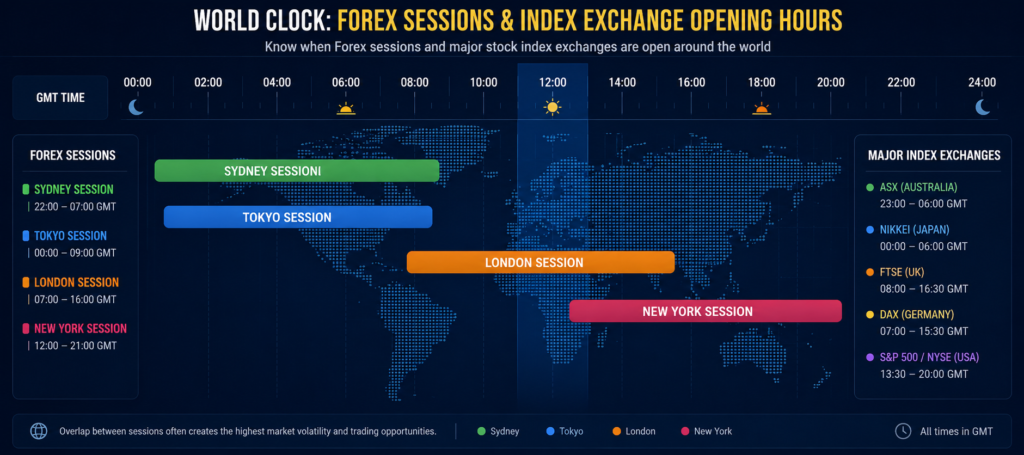
Fig 1.3 Trading hours comparison for forex vs indices trading
Matching the Market to Your Strategy and Schedule
The right choice depends less on which market is better and more on how each fits your life and method. Scalpers and high-frequency day traders often gravitate toward forex for its tight spreads and round-the-clock access, which let them enter and exit dozens of times without heavy friction. Swing traders who follow macro themes may also prefer currencies, since interest rate cycles and policy shifts unfold over weeks.
Indices reward a different approach. Traders who enjoy reacting to earnings, economic releases, and broad risk-on or risk-off moves find indices give them a single clean instrument to express a view on the whole economy. If your free time clusters around the US market open, an index like the S&P 500 may align naturally with your routine. There is also no rule forcing you to choose only one. Many experienced traders run both, using forex during quiet overnight hours and indices during active equity sessions. The key is honesty about your available time, your capital, and your emotional response to fast price changes, then building a focused plan around that reality rather than chasing whichever market looks exciting that week.
Capital and risk sit at the center of this match. A small account can absolutely start in either market, since micro lots in forex and flexible CFD sizing in indices both let you scale exposure down. The danger is not the size of the account but the temptation to overleverage it, stretching a thin balance across positions far larger than the account can absorb. A trader with limited capital often finds forex forgiving because tight spreads and small lot sizes allow precise, low-cost practice. A trader with more room and a higher risk appetite may welcome the larger point swings of an index, where a single well-timed move can deliver a meaningful result. Either way, position sizing should flow from your account and your stop distance, not from the excitement of the moment.
Your strategy’s time horizon should also steer the decision. A scalper needs the cheapest possible round-trip cost and deep, instant liquidity, which points toward major currency pairs during peak hours. A swing trader holding for days benefits from clear, sustained trends, and both markets can offer those, though forex trends often track slow-moving policy cycles while index trends can ride the momentum of an earnings season or a shift in sentiment. There is genuine value in combining the two as well. Currencies and equity indices do not always move in lockstep, so holding well-chosen positions in both can smooth the equity curve of a diversified plan, provided you never let breadth become an excuse for overtrading.
Reading the News That Moves Each Market
The drivers behind price are where these markets feel most distinct, and learning them is half the battle. Forex lives and breathes on macroeconomic data and central bank decisions. Interest rate announcements, inflation reports, employment figures, and shifts in monetary policy ripple through currency pairs almost instantly, because traders are constantly repricing the relative value of two economies. A single sentence from a central banker can reverse a pair’s trend, which is why disciplined currency traders watch the economic calendar as closely as the chart.
Indices respond to a broader and noisier mix of inputs. Corporate earnings dominate their attention during reporting season, when a wave of results can lift or sink an entire benchmark. Beyond earnings, indices react to the same macro data that moves forex, but they filter it through the lens of investor sentiment, asking not just what the data says but how much risk the market is willing to hold. That extra layer makes indices feel emotional at times, swinging on fear and greed as much as on numbers. When you weigh forex vs indices trading, ask yourself which kind of news you enjoy following, because you will be reading it daily. A trader energized by central bank theatre may thrive in currencies, while one who follows companies and market mood may feel more at home in indices.
What Top Traders and Research Say
Seasoned voices and academic research both reinforce the importance of process over market choice. In Technical Analysis of the Financial Markets, John Murphy stresses that the principles of trend, support, and resistance apply across instruments, meaning the same disciplined chart reading serves you whether you trade currencies or indices. That universality is reassuring for anyone agonizing over which market to pick.
Research urges caution on the behavioral side. Brad Barber and Terrance Odean’s landmark study “Trading Is Hazardous to Your Wealth” found that the most active retail traders consistently underperformed the market, largely because overtrading eroded returns through costs and poor timing. The lesson translates directly to the forex versus indices question: frequency and excitement do not equal profit. As Paul Tudor Jones put it, “The most important rule is to play great defense, not great offense.” Capital preservation, sensible position sizing, and a tested edge matter far more than whether your chart shows EUR/USD or the Nasdaq 100.
Frequently Asked Questions
Is forex or indices better for beginners? Neither is universally better, but many beginners find forex approachable because major pairs offer tight spreads, deep liquidity, and abundant educational material. Indices can suit beginners who prefer fewer instruments and a single way to trade the broader economy. The honest answer to should i trade forex or indices as a newcomer is to demo both, observe how each behaves, and choose the one whose pace and rhythm you can manage calmly with strict risk control.
Which is more volatile, forex or indices? Indices generally produce sharper intraday swings because they react strongly to earnings, economic data, and shifts in risk sentiment. Major forex pairs tend to move in steadier ranges thanks to enormous liquidity, though they can spike hard around central bank decisions. When trading forex vs indices, treat volatility as a feature to plan around, not a flaw, and size your positions accordingly.
Can I trade both forex and indices at the same time? Yes, and many experienced traders do exactly that. Forex offers opportunity around the clock, while indices come alive during their home exchange sessions, so the two can complement each other across a trading day. The risk is overtrading and splitting your focus, so most traders master one market first before adding the second to their routine with a clear plan.
Does forex or indices need more capital to start? Both markets are accessible with modest accounts because leverage and flexible position sizing let you trade small. Forex often allows micro lots, while index CFDs let you scale exposure down to fit a small balance. Regardless of which you choose in the forex vs indices trading decision, undercapitalizing and overleveraging is a common mistake, so trade conservative size relative to your account.
Which market has lower trading costs? Major forex pairs usually carry the tightest spreads, making them cost-efficient for frequent trading. Index spreads can be competitive too but may widen during volatile sessions, and overnight financing applies to both. Always compare your broker’s spreads, commissions, and swap rates on the specific instruments you plan to trade rather than assuming one market is always cheaper.
Final Thoughts
The forex vs indices trading decision is not about finding a secretly superior market, because both can be traded profitably and both can drain an undisciplined account. Forex offers unmatched liquidity, round-the-clock access, and steadier majors that reward macro thinking and patient execution. Indices deliver concentrated exposure to the broader economy, sharper intraday movement, and a single clean instrument for expressing a view on corporate health. Your edge comes from matching the market to your schedule, your capital, and your emotional response to volatility, then committing to a tested plan with strict risk management. Whether you ultimately land on currencies, indices, or a thoughtful blend of both, the principles that protect you stay the same: trade small relative to your account, respect your stops, and prioritize defense over chasing excitement. Master the process first, and the choice of market becomes a detail rather than a destiny.