
Introduction
The forex risk to reward ratio is the quiet engine behind every consistently profitable trading account, yet it is the concept most beginners overlook in their rush to find the perfect entry signal. Put simply, this ratio compares how much you stand to lose on a trade against how much you aim to gain, and it shapes whether your strategy can survive a long run of losing streaks. Many traders win more often than they lose and still drain their accounts, because their winners are tiny and their losers are huge. This guide flips that script. You will learn how the ratio actually works, why a strong risk reward setup lets you profit even with a low win rate, how to choose between 1:2 and 1:3 trades, and the practical mistakes that quietly sabotage otherwise solid plans. By the end, the math will feel less like theory and more like a daily decision filter.
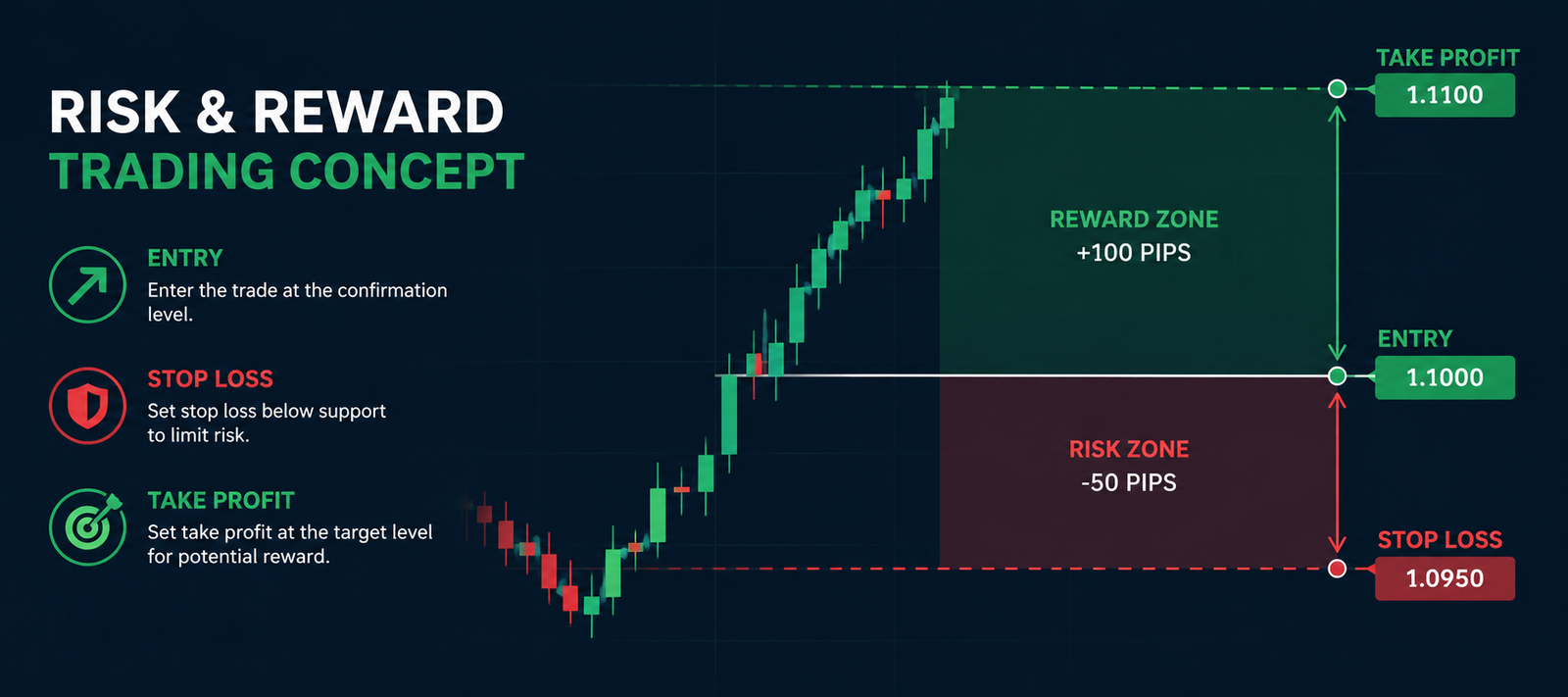
Fig 1.1 Forex risk to reward ratio diagram
What the Forex Risk to Reward Ratio Really Means
At its core, the forex risk to reward ratio measures the relationship between the money you risk and the money you target on any single trade. If you risk 20 pips to make 40 pips, your ratio is 1:2 — you stand to gain twice what you might lose. Expressed this way, the number becomes a planning tool you set before entering, not a hope you cling to afterward.
The reason this matters so deeply is that no trader wins every trade. Losses are a permanent feature of the market, not a sign of failure. A favourable ratio means each winner can cover several losers, which is what keeps an account afloat through inevitable rough patches. When you internalise that every trade is just one outcome in a long series, you stop fearing individual losses and start managing the bigger picture.
Why Win Rate Alone Is a Trap
Beginners obsess over win rate because being “right” feels good, but the market pays results, not pride. A trader who wins 70% of the time can still go broke if every loss is four times larger than every win. Conversely, a trader who wins only 40% of trades can be highly profitable when winners consistently dwarf losers. This is the counterintuitive truth that separates professionals from amateurs.
The bridge between these two numbers is expectancy — the average amount you can expect to earn per trade across many trades. Expectancy combines your win rate with your average win and average loss into a single figure. A positive expectancy means the strategy makes money over time even if it feels uncomfortable in the moment. Understanding this frees you from chasing a flawless hit rate and lets you focus on trades worth taking.
Fig 1.2 Best risk reward ratio for day trading
The Best Risk Reward Ratio for Day Trading
There is no universal magic number, but most experienced traders consider a minimum of 1:2 a sensible floor, and the best risk reward ratio for day trading often sits between 1:1.5 and 1:3 depending on style and market conditions. Faster intraday strategies sometimes accept slightly lower ratios because they win more frequently, while patient setups demand larger rewards to justify the wait.
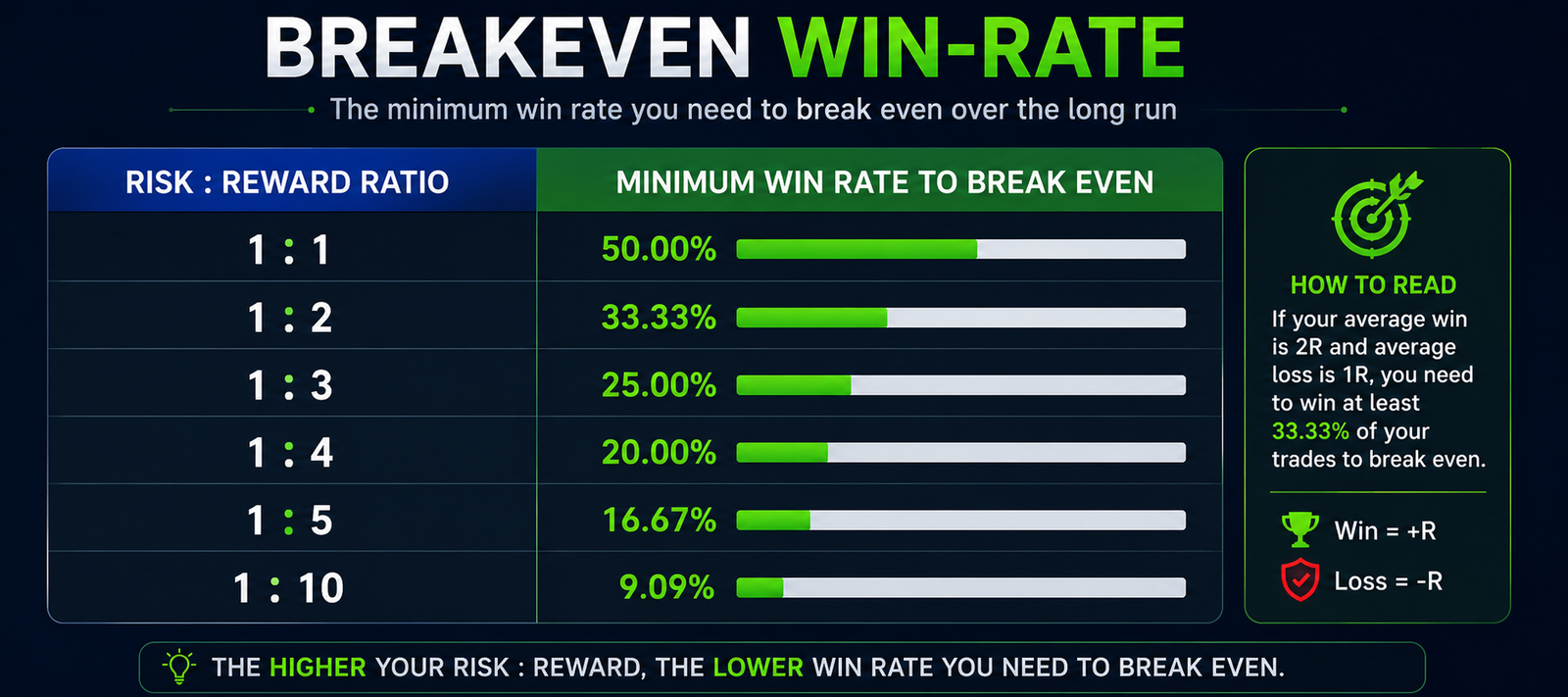
The key is alignment between your ratio and your realistic win rate. A scalper firing dozens of quick trades may thrive on tight reward targets and a high hit rate, whereas a swing-style intraday trader needs bigger winners because high-quality setups appear less often. Choosing a ratio in isolation is meaningless; it only makes sense alongside how frequently your edge actually pays off.
The table below shows the breakeven win rate required for common ratios, which makes the trade-offs concrete.
| Risk Reward Ratio | Breakeven Win Rate | Practical Profile |
|---|---|---|
| 1:1 | 50% | High accuracy required, thin margin |
| 1:1.5 | 40% | Balanced, beginner-friendly |
| 1:2 | 33% | Strong all-round standard |
| 1:3 | 25% | Fewer wins needed, demands patience |
| 1:4 | 20% | Trend trades, rare quality setups |
1:2 vs 1:3 Risk Reward Forex: Which Wins?
The 1:2 vs 1:3 risk reward forex debate comes down to a trade-off between hit rate and patience. A 1:2 approach is generally easier to achieve because the take-profit target sits closer to entry, so price reaches it more often. This produces a steadier equity curve and is gentler on a beginner’s psychology, since wins arrive frequently enough to maintain confidence.
A 1:3 approach demands more from the trader. Targets are further away, meaning a smaller share of trades reach the full goal, and you must resist the urge to close winners early. In exchange, each successful trade contributes far more to your bottom line, and you can remain profitable while winning only a quarter of the time. Neither is universally superior. New traders often start with 1:2 for emotional stability, then graduate toward higher ratios as their patience and trade-reading skills mature.
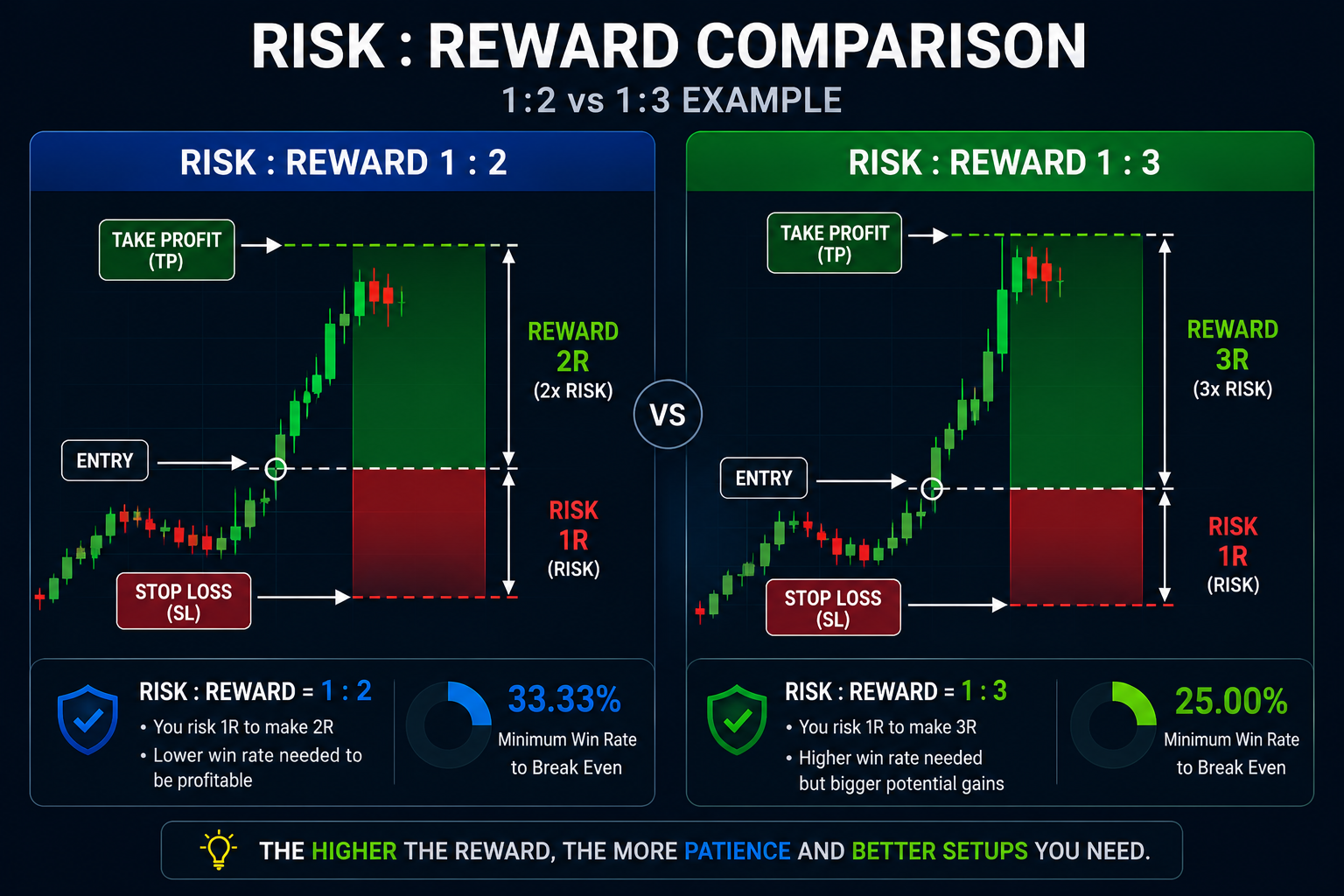
Fig 1.3 risk reward forex
How to Apply the Ratio in Real Trades
Putting theory into practice begins before you click buy or sell. First, identify a logical stop-loss level based on market structure — a point where your trade idea is clearly wrong, such as beyond a support or resistance zone. Only then do you measure the distance to a realistic target and confirm the ratio meets your minimum standard. If the reward does not justify the risk, the disciplined move is to skip the trade entirely.
Position sizing ties everything together. By risking a fixed small percentage of your account, often around one percent, on each trade, you ensure that no single loss can do serious damage. This combination of a fixed risk percentage and a favourable reward target is the mechanical foundation of long-term survival, and it removes emotion from the most important decisions.
What Top Traders and Research Say
The world’s best traders preach asymmetry relentlessly. Paul Tudor Jones distilled his entire philosophy into one line: “Don’t focus on making money; focus on protecting what you have.” His habit of seeking trades where the potential reward dwarfed the risk is precisely what the risk to reward ratio formalises for the rest of us.
Academic work explains why this is so hard emotionally. The prospect theory of psychologists Daniel Kahneman and Amos Tversky demonstrated that people feel the pain of a loss far more intensely than the pleasure of an equivalent gain. This loss aversion is exactly what tempts traders to snatch small profits quickly while letting losers run — the opposite of a healthy ratio. For a deeper treatment, Mark Douglas’s Trading in the Zone shows how reframing each trade as one event in a probabilistic series helps traders hold winners and cut losers without emotional interference.
Common Risk Reward Mistakes
The most frequent error is moving the stop loss further away to avoid being stopped out, which silently destroys the ratio you planned. A trade designed as 1:2 can quietly become 1:1 or worse the moment you widen the stop in panic. Equally damaging is closing winners too early out of fear, which starves your account of the large gains needed to offset losses.
Another subtle trap is forcing trades that do not offer enough reward simply because you feel the urge to be active. A great ratio on paper means nothing if you abandon it under pressure. Protecting the integrity of your planned risk and reward, trade after trade, is what turns a sound concept into real, compounding profit.
Frequently Asked Questions
What is a good forex risk to reward ratio?
A solid forex risk to reward ratio is generally 1:2 or better, meaning you target at least twice what you risk. This lets you stay profitable even when fewer than half your trades win. The ideal number depends on your strategy and win rate, so pair the ratio with realistic expectations. Avoid ratios below 1:1, since they force an uncomfortably high accuracy just to break even.
What is the best risk reward ratio for day trading?
The best risk reward ratio for day trading typically falls between 1:1.5 and 1:3, depending on how often your setups win. Faster strategies with high hit rates can use lower ratios, while selective setups need larger rewards. The right choice balances reward size against your realistic win rate so your expectancy stays positive. Test your approach on past data before committing real capital.
Is 1:2 or 1:3 better in forex?
In the 1:2 vs 1:3 risk reward forex debate, neither is universally better. A 1:2 ratio reaches its target more often, producing steadier results and suiting beginners. A 1:3 ratio wins less frequently but pays far more per win, demanding patience and discipline. Many traders start at 1:2 for emotional stability and shift toward 1:3 as their skills and trade selection improve over time.
Can I be profitable with a low win rate?
Yes. A strong forex risk to reward ratio allows profitability even with a win rate as low as 25 to 35 percent. Because each winner outweighs several losers, your overall expectancy can stay positive. The key is consistency: follow your stop losses, let winners reach their targets, and never widen stops to avoid losses. Profitability comes from the math across many trades, not from being right every time.
How does position sizing relate to risk reward?
Position sizing controls how much money the ratio actually risks. By risking a fixed small percentage, often one percent, per trade, you ensure no single loss is catastrophic while the favourable forex risk to reward ratio does the work of growing your account. Together they form a complete risk framework. Sizing keeps you in the game, and the ratio ensures your winners meaningfully outpace your losers over time.
Final Thoughts
The forex risk to reward ratio is not an advanced technique reserved for professionals; it is the foundational math that decides whether any strategy can survive the market’s inevitable losing streaks. When you commit to favourable ratios, respect your stop losses, and let winners run to their targets, you build a system where a modest win rate still produces steady growth. The traders who blow up accounts almost always do so by chasing high accuracy while ignoring the size of their losses, and that is a battle the math will eventually win against them. Decide your ratio before every trade, size your positions sensibly, and treat each outcome as one event in a long, profitable series. Master this single concept and you will already be ahead of most people who ever open a trading platform. This article is educational and not financial advice.