
Introduction
The infrastructure behind automated trading is changing fast, and forex virtual private server trends 2025 sit at the center of that shift. Traders no longer treat a VPS as a simple always-on box. They now treat it as a performance edge. Speed wins trades. Distance to the broker costs milliseconds. Those milliseconds move money. This article maps where forex VPS technology is heading this year, from ultra-low-latency hosting and colocation near broker data centers in London (LD4) and New York (NY4), to NVMe storage, faster CPUs, larger RAM pools for expert advisors, AI and machine-learning workloads, hardened DDoS protection, stronger uptime SLAs, greener data centers, and more flexible pricing. You will learn why latency matters for EAs and high-frequency strategies, how to read provider claims critically, and which trends actually affect your results. This is an educational landscape view, not trading advice.
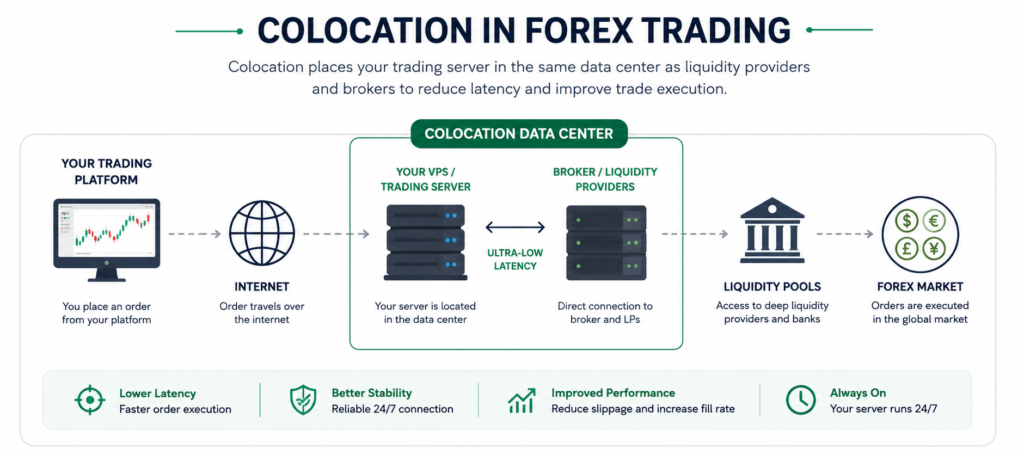
What a Forex VPS Is and Why It Matters in 2025
A forex virtual private server is a slice of a powerful physical machine, isolated for your exclusive use, that runs your trading platform around the clock. It stays online even when your laptop sleeps, your home internet drops, or a storm cuts your power. For automated traders, that persistence is not a luxury. It is the foundation. An expert advisor that misses a fill because the local machine rebooted has failed at its only job.
In 2025, the definition has narrowed in an important way. The market now distinguishes between generic cloud VPS products and purpose-built trading VPS offerings. The difference is location and tuning. A general VPS might sit anywhere. A trading-grade VPS sits as close as possible to the broker’s execution servers, on hardware tuned for fast, predictable order routing. That proximity is the single biggest driver behind every other trend discussed below. When you understand that latency is the product, the rest of the landscape comes into focus.
Ultra-Low-Latency Hosting Becomes the Headline Feature
Latency is the time it takes for your order to travel from your VPS to the broker and back. Lower is better. In 2025, providers compete almost entirely on this number. Marketing pages now advertise single-digit millisecond and even sub-millisecond round trips to specific broker venues. The reason is simple. Spreads tighten, slippage shrinks, and scalping or news strategies become viable only when the connection is fast and stable.
This focus reshapes the entire industry. Hosts publish latency maps showing measured times to popular brokers. They offer money-back guarantees if you cannot hit a target latency. They let you test ping before committing. The trend rewards transparency, because traders can now verify claims rather than trust them. The connection between this hosting race and best forex vps for high-frequency trading 2025 is direct: any provider that wants HFT customers must prove its latency, not merely promise it.
Colocation and Proximity to Broker Data Centers
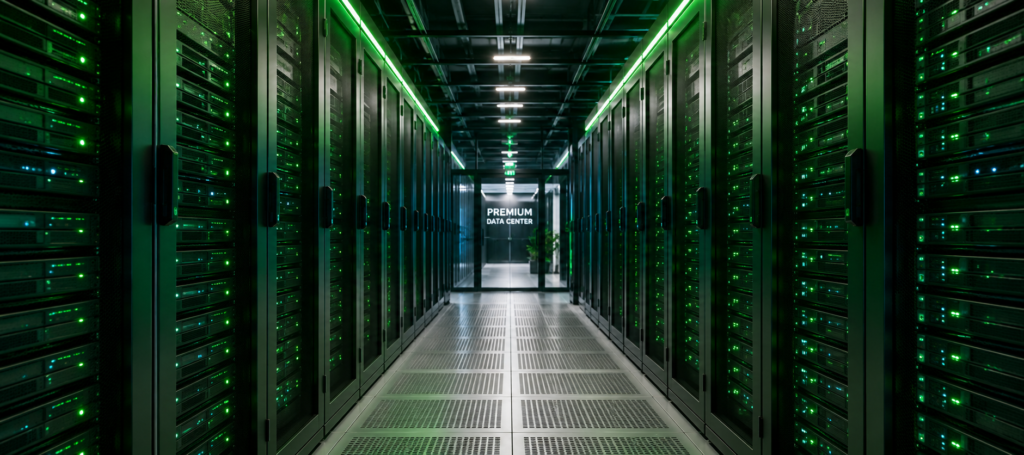
The clearest expression of the latency race is colocation. Brokers increasingly host their matching engines in named financial data centers. London’s LD4 facility in Slough and New York’s NY4 facility in Secaucus are the two most cited venues, both operated within the Equinix ecosystem. A forex VPS placed inside or adjacent to these buildings sits feet away from broker infrastructure, not continents.
In 2025, more retail-facing providers offer LD4 and NY4 locations as standard options rather than premium extras. This democratizes an advantage once reserved for institutional desks. Cross-connects inside the same facility reduce the physical distance a signal travels, which reduces latency to near its theoretical floor. For a trader running latency-sensitive automation, choosing the data center that matches the broker’s venue often matters more than any spec on the server itself. Proximity hosting is, in many ways, the defining forex virtual private server trends 2025 story.
NVMe Storage, Faster CPUs, and More RAM for EAs
Hardware refreshes drive the second wave of trends. Older trading VPS plans ran on SATA SSDs and modest processors. In 2025, NVMe SSDs are becoming the baseline. NVMe drives connect directly over the PCIe bus, slashing read and write times. Faster storage means platforms launch quicker, backtests complete sooner, and tick data writes without bottlenecks.
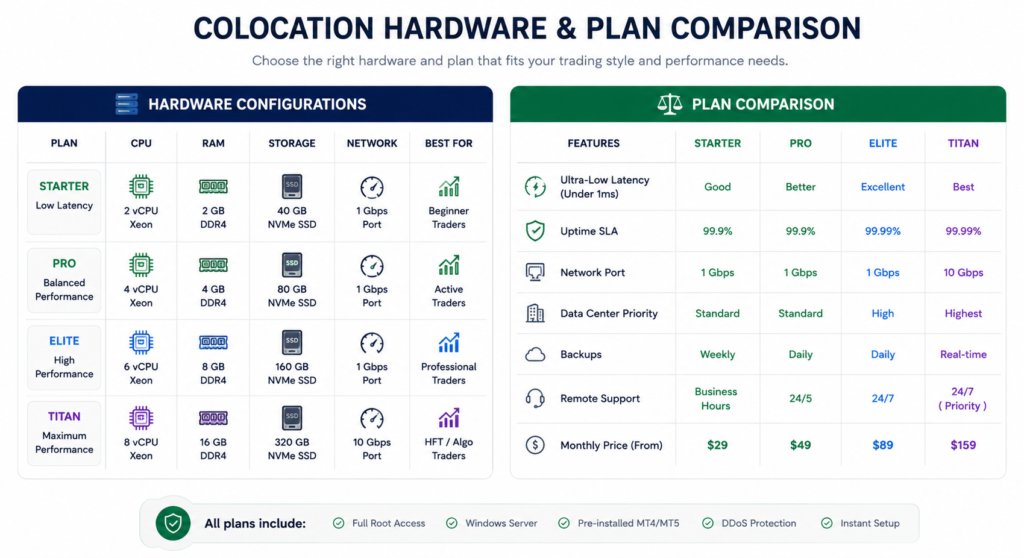
Processor clock speed matters more than core count for many EAs, because a single expert advisor often runs on one thread and benefits from raw per-core speed. Providers now highlight high-frequency CPUs to attract automated traders. RAM allocations are rising too. A trader running ten or twenty charts, several EAs, and multiple platform instances needs headroom. Plans that once shipped with two gigabytes now start higher. The table below summarizes how these tiers map to typical use cases.
| VPS Tier | Typical Specs (2025) | Indicative Latency to Broker | Best Suited For |
|---|---|---|---|
| Entry | 2 vCPU, 4 GB RAM, NVMe | 5-20 ms regional | A few EAs, single platform, swing trading |
| Standard | 4 vCPU high-clock, 8 GB RAM, NVMe | 1-5 ms in-region | Multiple EAs, scalping, several charts |
| Performance | 6-8 vCPU high-clock, 16 GB RAM, NVMe | Sub-1 ms colocated | News trading, dense automation, fast scalping |
| Colocation / HFT | Dedicated cores, 32 GB+ RAM, NVMe, LD4/NY4 | Sub-millisecond, cross-connect | High-frequency strategies, latency-critical EAs |
AI and Machine-Learning Workloads Enter the VPS
A newer trend is the arrival of AI and machine-learning workloads on trading infrastructure. Traders increasingly use models to filter signals, classify market regimes, or score trade setups before an EA acts. Running these models close to the trading platform reduces the round trip between prediction and execution.
This shift pushes some providers to offer GPU-equipped instances or higher-memory plans tuned for inference. GPUs accelerate the math behind neural networks, which makes near-real-time scoring feasible on the same infrastructure that hosts the platform. Most retail traders still run lightweight models on standard CPUs, so GPU plans remain a specialist offering. Still, the direction is clear. As model-assisted trading spreads, the line between a trading VPS and a compute server blurs. Expect more hybrid plans that pair low-latency order routing with the horsepower needed for analytics and machine learning.
DDoS Protection, Security, and Uptime Guarantees
Security has moved from a footnote to a selling point. A trading VPS holds credentials, strategies, and live connections to a broker. An outage during a volatile session can be costly. So providers now lead with network-level DDoS mitigation, isolated environments, encrypted access, and hardened operating system images.
Uptime guarantees have tightened in parallel. Reputable hosts publish service level agreements that commit to figures such as 99.9 percent uptime, with credits when they miss. Redundant power, multiple network paths, and failover systems back those promises. For an automated trader, uptime is not abstract. Every minute offline is a minute the EA cannot manage open positions. In 2025, savvy buyers read the SLA carefully, check whether maintenance windows count against uptime, and confirm how the provider handles emergencies. Security and reliability now sit alongside latency as core decision factors.
Why Latency Matters for EAs and High-Frequency Strategies
Latency deserves its own explanation, because it drives everything. When an expert advisor decides to trade, the order must reach the broker before the price moves. In fast markets, prices move in milliseconds. A slow connection means the EA gets a worse price than it expected, an effect called slippage. Over hundreds of trades, slippage erodes returns.
For high-frequency strategies, the stakes rise sharply. These systems may place and cancel many orders per second, hunting tiny, fleeting edges. They only work when the infrastructure responds almost instantly. This is precisely why the search for the best forex vps for high-frequency trading 2025 centers on measured latency, jitter, and consistency rather than headline specs. A stable two-millisecond connection often beats a faster but erratic one. Consistency, the absence of latency spikes, can matter as much as raw speed. Traders evaluating the best forex vps for high-frequency trading in 2025 should weigh predictability heavily, because an EA tuned to a stable connection misfires when latency jumps.
Greener Data Centers and the Sustainability Trend
Energy efficiency is rising on the agenda. Data centers consume large amounts of power, and operators face pressure from regulation, costs, and customers to run cleaner. In 2025, more hosting providers publicize renewable energy sourcing, efficient cooling, and improved power usage effectiveness.
For most traders, sustainability does not change latency or uptime directly. Yet it influences cost and brand choice. Efficient facilities often run modern hardware, which aligns with the NVMe and high-clock-CPU trend already underway. Some traders, and the institutions they may eventually work with, factor environmental credentials into vendor selection. The practical takeaway is modest but real: greener infrastructure tends to correlate with newer, better-managed facilities, which can mean a more reliable home for your automation.
Pricing Trends and Flexible Plans
Pricing is becoming more flexible and, in many segments, more competitive. The entry market has commoditized, pushing basic plan prices down while delivering better hardware than a year ago. At the same time, premium colocation and HFT-grade plans command a clear premium, reflecting the scarce value of sub-millisecond access inside LD4 or NY4.
Billing models are diversifying. Monthly, quarterly, and annual options sit alongside shorter trials and money-back windows tied to latency performance. Some providers bundle managed support, platform pre-installation, and monitoring into tiered packages. The net effect for buyers is choice. You can start small on an affordable NVMe plan and scale toward colocation as your strategy demands. The smart approach is to match the plan to the strategy, not to overpay for latency a swing trader will never use, nor to underpay and starve an HFT system of the speed it needs.
How to Evaluate a Provider in 2025
Evaluation has become more rigorous as marketing claims multiply. Start with location. Confirm that the provider offers a data center near your broker’s execution venue, ideally LD4 or NY4 if your broker resides there. Then test latency yourself during the trial, at the times you actually trade, because midday calm and news-hour chaos differ.
Read the uptime SLA and its fine print. Check the hardware generation, NVMe storage, CPU clock speed, and RAM allocation against your workload. Look for transparent latency reporting and independent reviews rather than testimonials alone. Verify security posture, including DDoS protection and access controls. Finally, weigh support quality, since a fast server with slow help during an outage is a poor trade-off. A short checklist helps keep evaluation disciplined:
- Confirm data center proximity to your broker, test real latency, read the SLA, verify NVMe and CPU specs, and check security plus support responsiveness.
Who Needs a Forex VPS and Operational Considerations
Not every trader needs a VPS, and honesty here builds trust. Discretionary traders who watch charts manually for a few hours and place occasional orders may run fine on a stable home connection. The case strengthens dramatically for anyone running automation. EAs, copy systems, and high-frequency strategies depend on constant uptime and low latency, which a home setup rarely guarantees.
Operational considerations matter beyond the purchase. You must maintain the platform, apply updates, monitor the EA, and watch for connection issues. A VPS reduces some risks but introduces others, such as dependence on a single provider or a misconfigured firewall blocking the broker. Treat the VPS as critical infrastructure. Keep backups of your settings, document your configuration, and monitor performance. The technology removes the excuse of a sleeping laptop, but it does not remove the trader’s responsibility to manage risk and oversee the system.
What Top Traders and Research Say
Credible sources ground these trends in established knowledge. Barry Johnson’s book Algorithmic Trading and DMA: An Introduction to Direct Access Trading Strategies remains a standard reference on how execution speed, market access, and infrastructure shape automated trading outcomes. It explains why proximity and latency are not marketing gloss but measurable forces on execution quality.
On the research side, the well-known study by Eric Budish, Peter Cramton, and John Shim, “The High-Frequency Trading Arms Race: Frequent Batch Auctions as a Market Design Response,” published in the Quarterly Journal of Economics in 2015, documents the so-called race to zero, the relentless competition to shave latency. Their work shows how speed advantages, even tiny ones, carry real economic value, which explains why colocation and low-latency hosting dominate the 2025 landscape.
A concise observation often attributed to the high-frequency trading world captures the spirit plainly: “In trading, speed is money.” The phrase is not advice. It is a reminder that infrastructure choices have consequences.
Frequently Asked Questions
What are the biggest forex virtual private server trends 2025?
The leading forex virtual private server trends 2025 are ultra-low-latency hosting, colocation near broker venues like LD4 and NY4, NVMe storage with high-clock CPUs, larger RAM for expert advisors, emerging AI and GPU workloads, stronger DDoS protection, tighter uptime SLAs, greener data centers, and more flexible pricing. Together they reshape how traders choose infrastructure.
Why does latency matter so much for a trading VPS?
Latency is the time your order takes to reach the broker and return. Lower latency reduces slippage and improves fills, especially for scalping and news trading. Consistency matters as much as raw speed, because latency spikes can cause an EA to misfire on time-sensitive trades.
How do I find the best forex vps for high-frequency trading 2025?
Focus on measured latency to your specific broker, not headline specs. Look for the best forex vps for high-frequency trading 2025 that offers colocation in the right data center, NVMe storage, high-clock CPUs, stable jitter, and a strong SLA. Always test latency yourself during a trial before committing.
Is colocation worth it for retail traders?
Colocation near LD4 or NY4 places your VPS feet from the broker’s matching engine, cutting latency to near its floor. It benefits high-frequency and latency-sensitive automation most. Swing and discretionary traders rarely need it, so match the plan to the strategy rather than overpaying.
Do I need a GPU VPS for AI trading models?
Most retail traders run lightweight models on standard CPUs, so a GPU is optional. GPU-equipped instances help when you run heavier neural networks for near-real-time inference. As model-assisted trading grows, more providers offer these hybrid plans, but they remain a specialist choice in 2025.
What should I check before buying a forex VPS in 2025?
Confirm data center proximity to your broker, test real latency at your trading hours, read the uptime SLA, verify NVMe storage, CPU clock, and RAM, and assess DDoS protection and support quality. These checks separate genuine trading-grade hosting from generic cloud servers.
Final Thoughts
The story of forex virtual private server trends 2025 is a story about distance, speed, and reliability. Latency now defines the product. Colocation near LD4 and NY4 brings traders closer to broker engines than ever. NVMe storage, faster CPUs, and larger RAM pools give expert advisors room to run, while AI workloads, hardened security, stronger SLAs, greener facilities, and flexible pricing round out a maturing market. The trend toward the best forex vps for high-frequency trading in 2025 rewards traders who verify claims, test latency, and match infrastructure to strategy rather than chasing headline numbers. Treat your VPS as critical infrastructure, evaluate providers with discipline, and keep oversight of your automation. For more trend breakdowns, comparisons, and educational guides on trading infrastructure, visit forexmarkettrendss.com and keep your edge sharp.