
Introduction
If you have spent any time on a trading platform, you have probably seen tickers like US30, NAS100, or DAX sitting right next to EUR/USD and GBP/JPY. That overlap raises a fair question, and understanding what are indices in forex is the first step toward trading them with confidence. While the foreign exchange market deals in currency pairs, most brokers also let you trade stock market indices through derivative contracts, side by side in the same account. This guide explains exactly what an index represents, how index trading sits alongside currency trading, and why so many forex traders add them to their watchlists. We will walk through the major global indices, compare them with currency pairs, look at trading hours, and break down what actually moves these markets. By the end, you will know how to approach indices as a practical, well-informed trader.
What an Index Actually Is
A stock market index is a single number that measures the combined performance of a chosen group of companies. Think of it as a scoreboard for a slice of the economy. Instead of tracking one share, an index bundles many of them into a basket and reports how that basket moves as a whole. When you hear that “the market was up today,” the speaker almost always means an index rose, not that every stock gained.
The companies inside an index are selected by rules. Some indices include the largest firms on an exchange. Others focus on a sector, like technology, or a theme, like sustainability. The S&P 500, for example, tracks 500 large American companies. The FTSE 100 tracks the 100 biggest firms listed in London. Because the basket is broad, an index smooths out the noise of any single company and gives a cleaner read on overall sentiment.
This is where the indices meaning in forex becomes important. In a forex context, you are rarely buying the actual basket of shares. Instead, you trade a derivative that mirrors the index price. Your broker quotes a buy and sell price, and your profit or loss tracks the index move. You never own a single share, yet you gain full exposure to the rise or fall of that market. That structure is what makes indices feel so natural alongside currency pairs.
Indices are also weighted, and the weighting method shapes how the number behaves. Many headline indices are market-capitalisation weighted, meaning larger companies push the index more than smaller ones. A few, like the Dow Jones, are price weighted, so a high-priced stock carries more influence regardless of company size. Knowing the weighting helps you understand why one earnings report can swing an entire index.
How Index CFDs Are Traded Alongside Forex
The reason indices show up on forex platforms is the contract for difference, or CFD. A CFD is an agreement to exchange the difference in an asset’s price between the time you open and close a trade. You do not take delivery of anything. You simply settle the price change in cash. This is the same mechanism that lets you trade currencies without ever holding physical money, which is why forex brokers can offer both products under one roof.
Trading an index CFD feels almost identical to trading a currency pair. You pick a direction, set your position size, and manage the trade with stop-loss and take-profit orders. If you expect the index to rise, you go long. If you expect a fall, you go short, and shorting is just as easy as buying. That flexibility appeals to traders who want to profit in both rising and falling markets without the restrictions that can apply to short selling individual shares.
Leverage is another shared feature. Just as you can control a large currency position with a modest deposit, index CFDs let you control sizeable exposure with margin. Leverage magnifies gains, but it magnifies losses just as quickly, so position sizing matters enormously. A disciplined trader treats leverage as a tool to be respected, not a shortcut to fast money.
Many traders pair index analysis with technical tools they already use on currency charts. A volume indicator forex users rely on, such as On Balance Volume, can be applied to index charts to gauge whether a move has real participation behind it. Rising prices on expanding volume suggest conviction, while a rally on thin volume often warns of a weak, fadeable move. Because the indicator logic transfers cleanly between currencies and indices, the learning curve for an existing forex trader is short.
Major Global Indices You Should Know
Most brokers offer a core set of indices that represent the world’s largest economies. Getting familiar with this short list covers the vast majority of trading activity and helps you decide which markets suit your style and schedule.
| Index (Common Ticker) | What It Tracks | Region |
|---|---|---|
| S&P 500 (US500/SPX500) | 500 large-cap US companies, broad benchmark | United States |
| Dow Jones (US30) | 30 major US industrial and blue-chip firms | United States |
| Nasdaq 100 (NAS100) | 100 large non-financial, tech-heavy US firms | United States |
| DAX (GER40/DE40) | 40 leading German companies | Germany |
| FTSE 100 (UK100) | 100 largest firms on the London Stock Exchange | United Kingdom |
| Nikkei 225 (JP225) | 225 top companies in Japan | Japan |
The American indices are the most widely traded. The S&P 500 is the global benchmark for risk sentiment, so when traders talk about “the market,” they usually mean this one. The Dow Jones, or US30, is a smaller, blue-chip gauge that moves on big industrial and consumer names. The Nasdaq 100, or NAS100, is technology heavy and tends to be the most volatile of the three, which makes it a favourite among active traders who want bigger intraday ranges.
In Europe, the DAX represents Germany’s industrial powerhouse and reacts strongly to manufacturing data and European Central Bank policy. The FTSE 100 leans toward energy, mining, and financial firms, and because many of its members earn revenue abroad, it often moves inversely to the pound. Over in Asia, the Nikkei 225 anchors the trading day and reflects Japanese exporter health, which keeps it closely tied to the yen.
Indices vs Currency Pairs: Key Differences
Although they live on the same platform, indices and currency pairs behave in distinct ways, and understanding the contrast sharpens your decisions. A currency pair is always a relative trade. You are buying one currency while selling another, so EUR/USD reflects the euro’s strength against the dollar. An index, by contrast, is an absolute measure of one market’s collective value. There is no second leg to weigh.
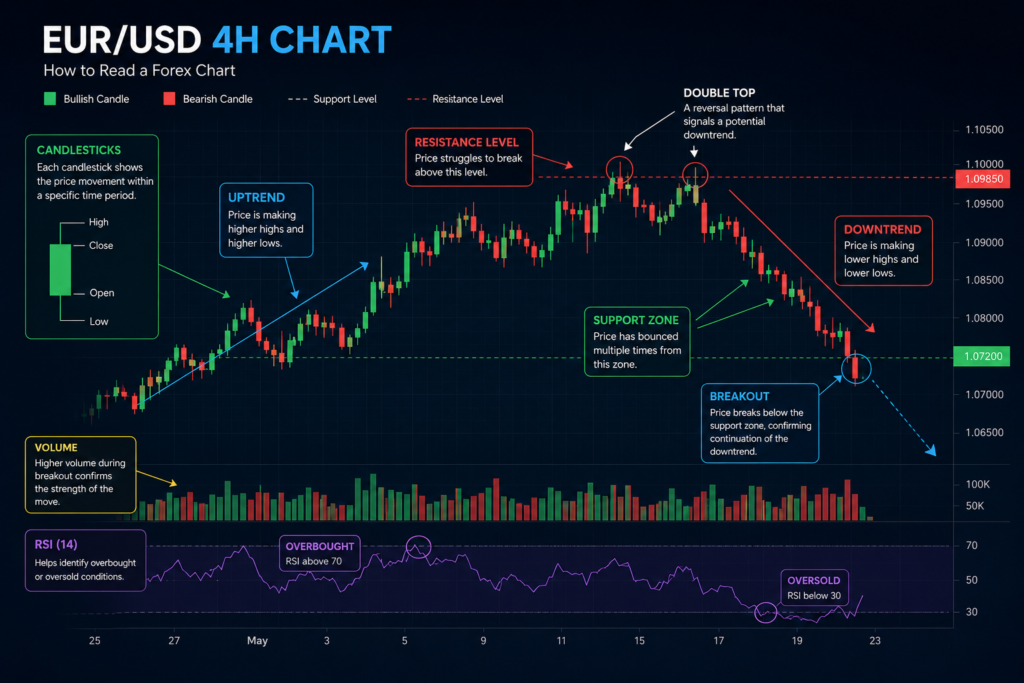
Volatility profiles differ too. Major currency pairs often trade in tight, liquid ranges, with central bank policy and macro data driving the bigger moves. Indices can show sharper bursts, especially around the opening bell of their home exchange or during earnings season, when a cluster of company results lands at once. The Nasdaq 100, in particular, can deliver dramatic swings that some forex traders find appealing and others find daunting.
Drivers also vary. Currencies respond heavily to interest rate expectations, inflation prints, and relative economic strength between countries. Indices respond to corporate earnings, sector rotation, and broad risk appetite, though they certainly react to interest rates as well. Because of this, an index can rise even while a related currency falls, giving traders diversification within a single account.
Finally, the trading rhythm is different. Forex runs continuously across global sessions, while an index is most active when its underlying exchange is open. That distinction shapes how and when you plan your trades, which leads naturally to the topic of trading hours.
Understanding Index Trading Hours
One of the first surprises for new index traders is that these markets are not open around the clock in the same uniform way forex feels. The underlying stock exchanges have fixed sessions. The New York Stock Exchange and Nasdaq operate during US daytime hours, the London Stock Exchange during UK hours, and the Tokyo exchange during Asian hours. Liquidity and clean price action concentrate during these windows.
That said, most brokers offer index CFDs with extended hours that stretch well beyond the cash session. Through index futures pricing, you can often trade US indices nearly around the clock on weekdays, with only short daily breaks for settlement. This extended access lets traders react to overnight news, such as an earnings release after the US close or a geopolitical headline during the Asian session.
The catch is that quality of execution changes with the clock. During the home session, spreads tighten and volume swells, so price moves are orderly and easier to read. Outside those hours, spreads can widen and moves can become choppy on thinner participation. This is exactly where a volume indicator forex traders trust earns its keep, because it reveals whether an off-hours move has genuine backing or is just a low-liquidity drift. Smart traders match their activity to the sessions where liquidity is deepest and signals are most reliable.
It also helps to know your overlaps. When the London and New York sessions overlap, European and American indices can move together on shared macro news. Aligning your screen time with these high-activity windows usually produces the most tradeable conditions.
What Moves Indices
Indices respond to a web of forces, and reading them well means watching more than a single chart. The largest driver is corporate earnings. Because an index is a basket of companies, the collective health of those firms sets its long-term direction. Strong earnings seasons tend to lift indices, while a run of disappointments drags them down. Since heavily weighted companies count for more, a single mega-cap miss can move an entire index.
Monetary policy is the second great lever. When central banks cut interest rates, borrowing becomes cheaper and future profits look more attractive, which generally supports indices. When they raise rates to fight inflation, the opposite often happens. Traders therefore watch central bank meetings, inflation reports, and employment data closely, because these releases reshape expectations for the whole market in an instant.
Risk sentiment ties everything together. In calm, optimistic conditions, money flows into equities and indices climb. When fear spikes, whether from geopolitical conflict, a banking scare, or a sudden growth worry, investors retreat to safety and indices fall, sometimes sharply. This mood shift is why indices can gap at the open after major weekend news.
Sector composition matters as well. A technology-led index like the Nasdaq 100 lives and dies by the fortunes of a handful of giant tech firms, so it can diverge from a more balanced index on any given day. Volume confirms the story behind these moves. Applying On Balance Volume or a similar volume indicator forex users favour helps you judge whether buyers or sellers are truly in control, separating durable trends from fragile ones.
How to Start Trading Indices
Getting started is straightforward, but a methodical approach pays off. Begin by choosing a regulated broker that offers both forex and indices, so you can keep currencies and indices in one funded account. Check the spreads, margin requirements, and trading hours for the specific indices you want, because conditions vary between providers.
Next, build a simple plan around one or two indices rather than spreading yourself thin. Many beginners start with the S&P 500 because it is liquid and well behaved, then graduate to the more energetic Nasdaq 100 once they are comfortable. Learn the typical daily range of your chosen index so your stop-loss and take-profit levels make sense for its volatility.
Practice on a demo account before risking real capital. A demo lets you rehearse order entry, test how leverage affects your position, and confirm that your strategy survives contact with live prices. Track every demo trade as if it were real, and only move to a funded account once your process is consistent.
Finally, make risk management non-negotiable. Decide in advance how much you are willing to lose on any single trade, usually a small percentage of your account, and let position sizing follow from that limit. Combine clean technical reading with awareness of the economic calendar, respect leverage, and you will be trading indices with the same discipline that separates durable forex traders from short-lived ones.
What Top Traders and Research Say
Serious index traders ground their decisions in tested ideas rather than hunches. A classic starting point is John J. Murphy’s Technical Analysis of the Financial Markets, widely regarded as a definitive reference on chart reading, trend analysis, and the role of volume across markets, including stock indices. Its frameworks transfer directly to index CFD charts, which is why so many platform traders keep it on the shelf.
For a contrasting, evidence-based perspective, Burton Malkiel’s A Random Walk Down Wall Street makes the case that broad indices are extraordinarily hard to beat over the long run, drawing on decades of academic research into market efficiency. Even active traders benefit from understanding this body of work, because it explains why disciplined risk management and humility matter so much when trading the very indices Malkiel studies.
On the research side, the work behind the efficient market hypothesis, most associated with economist Eugene Fama, who was awarded the Nobel Memorial Prize in Economic Sciences in 2013, remains foundational to how we think about index pricing and information flow. It is a genuine pillar of modern finance, not a marketing claim.
A fitting reminder comes from Warren Buffett, who advised, “Be fearful when others are greedy and greedy when others are fearful.” That short line captures the sentiment-driven nature of indices better than any indicator alone.
Frequently Asked Questions (FAQs)
Q: What are indices in forex, in simple terms?
In forex platforms, indices are derivative products that track the price of a basket of stocks, such as the S&P 500 or DAX. You never own the underlying shares. Instead, you trade an index CFD whose value rises and falls with the market. This is the core of the indices meaning in forex, letting you gain broad market exposure right beside your currency trades.
Q: How are indices different from currency pairs?
A currency pair measures one currency against another, while an index measures the combined value of many companies. Indices often react to earnings and risk sentiment, whereas currencies respond more to interest rates and relative economic strength. Both can be traded long or short with leverage, so the tools overlap even though the underlying drivers differ.
Q: Can I use a volume indicator forex traders rely on for indices?
Yes, and many do. A volume indicator forex users apply to currency charts, such as On Balance Volume, works equally well on index charts. It helps confirm whether a price move has real participation or is fading on thin trade. Volume confirmation is especially useful during extended, lower-liquidity index hours.
Q: What are the best indices for beginners to trade?
The S&P 500 is a popular first choice because it is liquid and relatively orderly. The Dow Jones offers blue-chip exposure, while the Nasdaq 100 is more volatile and better suited once you have experience. Starting with one well-understood index beats jumping between many at once.
Q: When is the best time to trade indices?
Liquidity is deepest during the home exchange’s session, so US indices trade best during US hours and the DAX during European hours. The London and New York overlap is particularly active. Although CFDs allow extended access, spreads can widen outside core hours, so timing matters.
Final Thoughts
Indices give forex traders a powerful way to broaden their horizons without ever leaving their trading platform. By understanding what an index represents, how index CFDs mirror those baskets, and why earnings, interest rates, and sentiment move them, you can approach these markets with genuine confidence rather than guesswork. The major global indices each carry their own personality, from the steady S&P 500 to the energetic Nasdaq 100, and matching your style to the right market and the right session is half the battle. Layer in solid risk management, a trusted volume indicator, and an eye on the economic calendar, and indices become a natural, rewarding extension of your forex toolkit. Treat them with the same discipline you bring to currencies, keep learning, and let your edge compound over time.