
Introduction
Every year, thousands of traders lose their savings to fraudulent brokers that look polished and convincing. Learning the red flags forex trading platform scams rely on is the single most powerful skill you can build before you deposit a single dollar. Scammers thrive on excitement, urgency, and the promise of fast money, and they hide behind slick websites and fake testimonials. This article breaks down exactly how these schemes operate, the warning signs that separate a con from a legitimate broker, and the verification steps that protect your capital. You will learn how fraudsters misuse white label technology, how regulation works across major regions, and what the rules look like for traders in India. By the end, you will know how to check a license, recognize manipulation tactics, and walk away before it costs you. Read on to trade smarter and safer.
How Forex Platform Scams Actually Operate
Forex fraud rarely looks like fraud at first. The most damaging operations invest heavily in appearances: a professional website, a live-looking price chart, glowing reviews, and a friendly “account manager” who answers every message within minutes. The goal is to lower your guard. Scammers understand that retail traders are drawn to the promise of financial freedom, so they package their pitch around lifestyle imagery and screenshots of supposed profits. Behind the scenes, however, there is no real market execution. Many fraudulent platforms simply display numbers on a dashboard while your money sits in the operator’s pocket.
The mechanics usually follow a predictable arc. First comes contact, often through social media ads, dating apps, messaging groups, or unsolicited calls. Next comes a small, easy win. The operator lets you deposit a modest amount, then shows your balance climbing. This early “profit” is the hook, and it is entirely fabricated. Encouraged by success, you deposit more. When you finally try to withdraw, the trouble begins. Suddenly there are taxes to pay, verification fees, or a minimum balance you must maintain. Each new demand is a fresh way to extract money, and the withdrawal never arrives.
Some schemes go further by impersonating real, regulated firms. Others run a churning model where a fake “broker” encourages constant trading to generate hidden commissions. A few operate as outright Ponzi structures, paying early participants with deposits from later victims until the whole thing collapses. Recognizing these patterns early is the foundation of protecting yourself, because once funds leave your account through these channels, recovery is difficult and often impossible.
The Biggest Red Flags You Must Never Ignore
The clearest warning sign is the absence of credible regulation. A legitimate broker proudly displays its license number, regulator, and registered entity, and that information checks out when you verify it. A scam either claims no regulation, hides behind a vague offshore “license,” or invents a registration that does not exist. Treat any platform that cannot prove who oversees it as a serious threat to your money.
Guaranteed returns are the second unmistakable red flag. No honest broker or trader can promise profit, because currency markets move on factors no one fully controls. When a platform advertises “30% monthly returns,” “risk-free trading,” or “guaranteed daily income,” it is selling a fantasy designed to bypass your judgment. The same applies to unrealistic bonuses. Offers like “deposit 500 dollars and get 2,000 dollars free” almost always come with withdrawal conditions engineered to trap your capital inside the system.
Withdrawal problems deserve special attention because they are the moment most victims realize the truth. If a platform delays payouts, invents surprise fees, demands additional deposits before releasing funds, or simply stops responding, you are almost certainly dealing with fraud. Pressure tactics are equally telling. A relentless account manager who urges you to act now, deposit more, or borrow money is using urgency to override caution. Legitimate firms never rush you, never request remote access to your computer, and never ask you to pay a third party to “unlock” your own balance. Add fake or clone brokers and cloned websites to this list, and you have the core profile of a dangerous operator.
| Scam Red Flag | What a Legitimate Broker Does |
|---|---|
| No regulator named, or a fake license number | Displays a verifiable license and regulated entity |
| Guarantees profits or “risk-free” returns | States clearly that trading carries real risk of loss |
| Blocks or delays withdrawals, adds surprise fees | Processes withdrawals on stated, transparent terms |
| Pressures you to deposit quickly or borrow money | Lets you decide at your own pace, no urgency |
| Offers bonuses with impossible unlock conditions | Keeps promotions transparent and optional |
| Requests remote access to your device | Never asks for control of your computer |
| Funds go to a personal or third-party account | Holds client funds in segregated bank accounts |
How to Verify a Broker’s License the Right Way
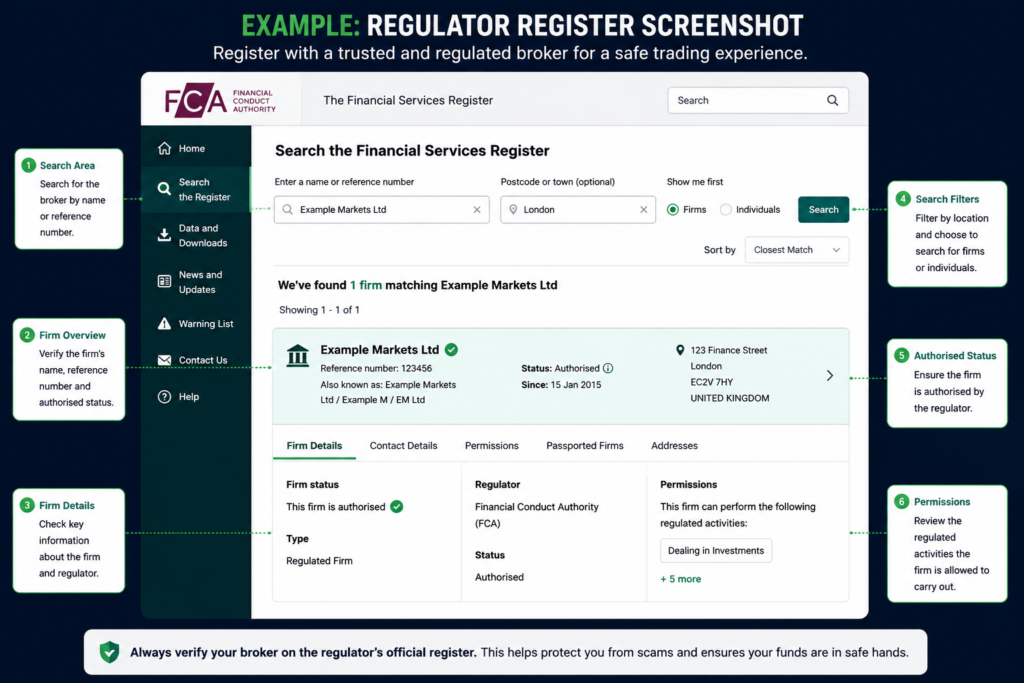
Verification is your strongest defense, and it takes only a few minutes. Never trust a license number printed on a broker’s own website at face value. Scammers copy real numbers or fabricate convincing ones. Instead, go directly to the regulator’s official site and search its public register yourself. Type the company name and license number into the regulator’s database, then confirm that the address, website domain, and contact details match exactly. A clone operation will often use a name that is almost identical to a real firm, with a slightly different spelling or web address.
Cross-check several details rather than relying on one. Confirm the legal entity name, the country of registration, the regulatory status, and any warnings attached to the firm. Most major regulators publish blacklists or warning lists naming companies that operate without authorization, and these are invaluable. If the broker claims oversight in one country but pressures clients from another, ask why. Genuine firms are transparent about which entity serves which region and which protections apply to you specifically.
Pay attention to client-fund handling as well. Reputable brokers keep customer money in segregated accounts separate from company operating funds, and many regulated jurisdictions require negative balance protection so you cannot lose more than you deposit. Ask how funds are held, request the segregation policy in writing, and verify the banking arrangement. If answers are vague, evasive, or contradictory, walk away. The few minutes spent verifying a license can save you years of regret, and no profit opportunity is worth skipping this step.
What a White Label Forex Trading Platform Is
A white label forex trading platform is a ready-made trading system that one company builds and licenses to another, which then rebrands it as its own. This is a completely legitimate and widespread business model. A technology provider develops the platform, liquidity connections, and back-office tools, and a broker pays to put its own logo, colors, and name on top. Many respected, fully regulated brokers run on white label infrastructure because it is faster and cheaper than building everything from scratch. The model itself is not a scam, and most traders use white label platforms every day without issue.
The problem is that the same convenience attracts bad actors. Because a white label solution lets almost anyone launch a professional-looking brokerage quickly, fraudsters use it to create an authentic-feeling front with minimal effort. They acquire a polished platform, design a credible brand, and present themselves as an established firm even though they hold no real license and provide no genuine market access. To an inexperienced trader, the interface looks identical to that of a trusted broker, which is precisely the point.
This is why the technology behind a platform tells you very little about its trustworthiness. A beautiful, fast, feature-rich trading dashboard does not prove a broker is honest. The real questions remain unchanged: who regulates this firm, where are client funds held, and does the company appear on any warning list? Judge the operator behind the software, not the software itself. When you separate the platform from the entity running it, marketing polish loses its power to deceive, and the genuine warning signs become much easier to see.
The Regulatory Landscape for Forex Trading Platforms in India
Rules around forex trading platforms in india are stricter and more specific than many newcomers expect, which is exactly why scams targeting Indian residents are common. Two authorities matter most: the Reserve Bank of India (RBI) and the Securities and Exchange Board of India (SEBI). Under Indian regulations, residents may legally trade forex only through authorized entities and only in permitted currency pairs, primarily those involving the Indian rupee, on recognized exchanges. Trading other currency pairs through unauthorized offshore platforms generally falls outside the legal framework set by the Foreign Exchange Management Act (FEMA).
The RBI has repeatedly cautioned the public against unauthorized electronic trading platforms and even publishes an “Alert List” naming entities not authorized to deal in forex or to operate electronic trading platforms for currency transactions. SEBI oversees the recognized exchanges where permitted currency derivatives trade. Together, these rules mean a flashy international platform promising unrestricted access to dozens of exotic pairs is, for an Indian resident, both a legal risk and a likely scam vector. Fraudsters frequently exploit the confusion by claiming “RBI approval” they do not have.
If you are in India, the safest path is to deal only with brokers and platforms operating within the SEBI and RBI framework and to verify their authorization directly with the regulator. Be deeply skeptical of any service that encourages you to bypass these rules or to move money abroad through informal channels. The presence of clear, well-publicized national regulation is a gift to consumers, because it gives you an authoritative source to check against. Use it, and let it guide every decision about where your capital goes.
| Region | Primary Regulator |
|---|---|
| United Kingdom | FCA (Financial Conduct Authority) |
| Australia | ASIC (Australian Securities and Investments Commission) |
| European Union (Cyprus) | CySEC (Cyprus Securities and Exchange Commission) |
| India | SEBI and RBI |
| United States | CFTC and NFA |
Common Tactics Fraudsters Use to Build False Trust
Scammers are skilled psychologists. They know that trust, not technology, is what gets people to deposit. One favorite tactic is social proof manufactured from nothing: fake reviews, paid testimonials, doctored profit screenshots, and staged “community” chats where supposed members celebrate withdrawals. Another is the relationship play, sometimes called romance or “pig butchering” fraud, where a friendly contact builds rapport over weeks before ever mentioning trading. By the time money enters the picture, you feel you are dealing with a friend rather than a stranger.
Impersonation is another powerful weapon. Fraudsters clone the names, logos, and even the precise wording of regulated firms, then register look-alike domains. They may send official-looking documents, fake regulatory certificates, and convincing emails. Some run a second-stage “recovery scam,” contacting earlier victims while posing as authorities or lawyers who can retrieve lost funds for an upfront fee, doubling the damage. The lesson is that polish and confidence are not evidence of legitimacy. The more emotionally compelling the pitch, the more rigorously you should verify before acting.
How to Protect Yourself and Trade Safely
Protection starts with a simple habit: verify first, deposit later, always. Before funding any account, confirm the broker on the official regulator register, read the warning lists, and search independently for complaints using the exact legal entity name. Keep your skepticism highest when an opportunity arrives unsolicited, sounds too good to be true, or comes with pressure to move quickly. Real markets reward patience, not haste, and any platform that punishes caution is showing you who it really is.
Beyond verification, practice basic operational discipline. Start with the smallest amount the platform allows and test the full withdrawal process early, before you commit anything meaningful. Never grant remote access to your computer, never share one-time passwords, and never pay a third party to release your own funds. Keep records of every communication, transaction, and document, because clear records help both your decision-making and any future report. If something feels wrong, trust that instinct and stop.
- Verify the license directly on the regulator’s official register before depositing.
Finally, know where to turn if you are targeted. Report suspected fraud to your national financial regulator and to local law enforcement, and warn others by leaving honest, factual reviews. Be wary of anyone promising guaranteed recovery, as that is frequently a follow-up scam. The combination of independent verification, small initial tests, and steady emotional control defeats the overwhelming majority of schemes. Staying safe is less about being an expert trader and more about refusing to skip the boring, essential checks.
What Top Traders and Research Say
Seasoned market participants consistently emphasize discipline and psychology over hot tips. In his widely read book Trading in the Zone, Mark Douglas argues that consistent results come from managing your own mindset and expectations rather than chasing certainty, a message directly relevant to anyone tempted by a “guaranteed profit” pitch. The academic record reinforces this caution. The well-known study “Trading Is Hazardous to Your Wealth” by Brad Barber and Terrance Odean found that the most active individual traders tended to earn the lowest net returns, underscoring how unrealistic the promises of scam platforms truly are. Regulators echo this with frequent public warnings that the large majority of retail traders lose money. As Warren Buffett famously put it, “Risk comes from not knowing what you’re doing.” Verification is how you reduce that risk.
Frequently Asked Questions (FAQs)
What are the most common red flags forex trading platform scams show? The clearest signs are no verifiable regulation, guaranteed or risk-free returns, blocked or delayed withdrawals, surprise fees, and high-pressure account managers. Fake or clone brokers copy real firms to appear trustworthy. Unrealistic bonuses with impossible unlock conditions are another reliable warning. If any of these appear, treat the platform as dangerous and verify everything before depositing.
How do I verify whether a forex broker is legitimate? Go straight to the regulator’s official website and search its public register yourself, rather than trusting a license number shown on the broker’s site. Confirm the legal entity name, domain, and address all match. Check regulator warning lists and blacklists, and ask how client funds are held. Reputable brokers use segregated accounts and answer these questions clearly.
Is a white label forex trading platform a scam? No. A white label forex trading platform is legitimate technology that one company builds and licenses to another, and many regulated brokers use it. The risk is that fraudsters can launch a polished, professional-looking brokerage on the same technology without real regulation. Judge the company behind the platform, not the interface, and always confirm its license independently.
What are the rules for forex trading platforms in india? Forex trading platforms in india are governed mainly by SEBI and the RBI under FEMA. Residents may legally trade only permitted currency pairs through authorized entities on recognized exchanges. The RBI publishes an alert list of unauthorized platforms. Be skeptical of any offshore service claiming “RBI approval” or offering unrestricted access to exotic pairs, as these are common scam signals.
Can I recover money lost to a forex scam? Recovery is difficult once funds leave your account, but you should still act. Report the fraud to your national regulator and to local law enforcement, and keep all records and communications. Avoid anyone promising guaranteed recovery for an upfront fee, as this is usually a second scam targeting previous victims. Acting quickly improves your limited chances.
Final Thoughts
Forex fraud succeeds because it sells emotion, urgency, and the dream of easy money, but it cannot survive a few minutes of careful verification. Once you understand how these schemes operate, the red flags forex trading platform scams depend on become obvious: missing regulation, guaranteed returns, blocked withdrawals, relentless pressure, fake bonuses, and clone brokers. You now know that a white label forex trading platform is legitimate technology that fraudsters sometimes misuse, so the brand on the screen never proves trustworthiness. You also know the regulatory framework that governs forex trading platforms in india through SEBI and the RBI, and how to check any broker against an official register. Protect yourself by verifying first, testing withdrawals early, refusing pressure, and trusting your instincts when something feels wrong. The discipline that keeps your money safe is the same discipline that makes a better trader. Stay cautious, stay informed, and never deposit before you verify.
For more trusted, beginner-friendly guides on safe trading and avoiding fraud, visit forexmarkettrendss.com.
Disclaimer: This content is for educational purposes only and is not financial advice. Always verify a broker’s regulation independently before investing.