
Introduction
Leverage is one of the most misunderstood tools in currency trading, and choosing the best leverage for forex can shape your entire trading career. Many newcomers chase the highest ratio a broker offers, believing bigger leverage means bigger profits. In reality, the smartest traders treat leverage as a risk dial, not a profit accelerator. This article explains what leverage and margin actually are, how leverage amplifies both gains and losses, and why the ideal setting is usually far lower than what brokers advertise. We will explore regulatory caps across major jurisdictions, position sizing, margin calls, and the link between leverage and survival. By the end, you will understand how to pick a sensible ratio for your experience level, protect your capital, and trade with discipline rather than gambling on outsized exposure that wipes accounts out.
What Leverage and Margin Actually Are
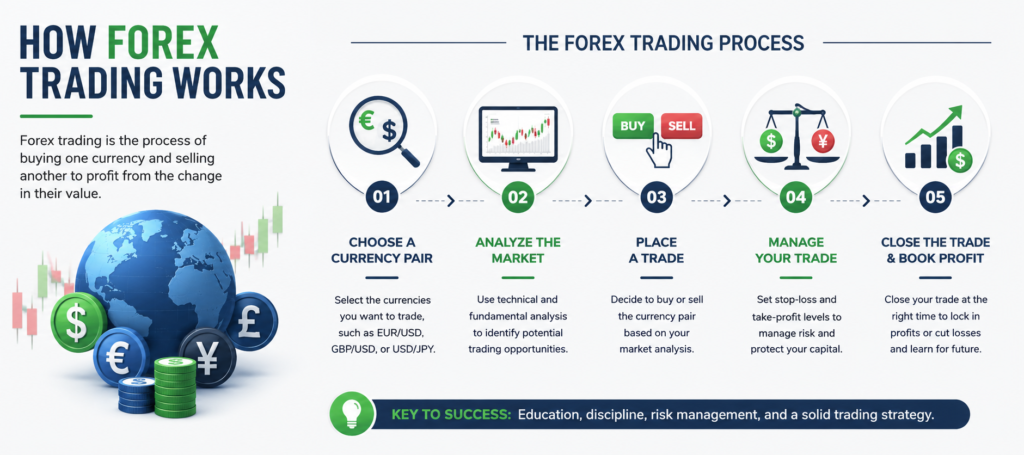
Leverage lets you control a large position with a small amount of capital. When a broker offers a ratio of 1:100, you can command one hundred dollars of currency exposure for every dollar you commit. That committed amount is called margin. Margin is not a fee or a cost; it is collateral the broker sets aside while your trade stays open. Once you close the position, the margin returns to your account, adjusted for profit or loss.
Understanding the relationship between leverage and margin is the foundation of everything that follows. Higher leverage means lower margin requirements, which means you can open larger positions with the same balance. This feels empowering, and that feeling is precisely the trap. The arithmetic that lets a small deposit control a big position works identically in both directions. A modest favorable move multiplies into a meaningful gain, and a modest adverse move multiplies into a painful loss.
Brokers express margin as a percentage. A 1:100 ratio corresponds to a one percent margin requirement, while 1:30 corresponds to roughly 3.3 percent. The lower the margin percentage, the more exposure your account can carry at once. Many traders never calculate this consciously. They simply accept the highest leverage available and open positions sized by emotion rather than math. That habit is the single biggest reason retail accounts fail.
How Leverage Amplifies Gains and Losses
Imagine a trader with a one thousand dollar account who uses 1:100 leverage to open a one hundred thousand dollar position, a standard lot. Each pip on a major pair is worth about ten dollars. A favorable move of twenty pips earns two hundred dollars, a twenty percent gain on the account in minutes. The same twenty pips moving against the trader erases two hundred dollars just as fast. A move of one hundred pips, which happens regularly during news events, would wipe the entire balance.
This symmetry is the heart of leverage. It does not create an edge. It only magnifies whatever edge, or lack of edge, you already have. A trader without a tested strategy who increases leverage simply loses money faster. A disciplined trader who keeps leverage modest gives their strategy room to breathe through normal market noise.
The dangerous illusion is that high leverage offers a shortcut to wealth on a small account. It can, occasionally, produce a spectacular winning streak. But the same exposure that delivers those wins guarantees that one bad cluster of trades ends the account. Survival, not speed, is what separates traders who last from those who flame out within months.
What the Best Leverage for Forex Actually Means
Here is the truth that broker marketing rarely states plainly. The best leverage for forex is not the highest number on offer. It is the ratio that lets you size positions sensibly while keeping risk per trade small and consistent. Leverage availability and leverage usage are two completely different things. A broker may grant you 1:500, but nothing forces you to deploy it. A skilled trader with a 1:500 account might effectively use the equivalent of 1:5 on any given trade by keeping position sizes tiny relative to equity.
Think of leverage as the maximum ceiling, not the target. Your real exposure is determined by how large a position you open, not by the ratio printed on your account. This distinction reframes the entire question. Instead of asking which leverage is best, ask how much you are willing to lose on a single trade, then size your position to respect that limit. The leverage ratio becomes almost irrelevant once your risk per trade is controlled.
This is why experienced professionals shrug at headline leverage figures. They know that risk control happens at the position-sizing level. The number that matters is not 1:30 or 1:500. It is the percentage of your account you put at risk each time you click buy or sell.
Good Leverage for Forex by Trader Type
What counts as good leverage for forex depends heavily on who you are. A complete beginner should treat leverage with deep caution. Low effective leverage, achieved through small position sizes, gives a new trader the chance to make inevitable early mistakes without destroying their account. Many seasoned mentors suggest beginners keep effective exposure modest, often the equivalent of 1:10 or lower, regardless of the headline ratio the broker provides.
An intermediate trader who has survived a year, kept records, and developed a repeatable process can responsibly use somewhat higher leverage. They understand drawdowns emotionally and mechanically, and they size positions from a tested risk model rather than from hope. Even so, restraint pays. The traders who blow up are almost never the ones using too little leverage.
Experienced professionals may operate accounts with high available leverage, but their actual usage is disciplined and dynamic. They scale exposure to volatility, conviction, and account equity. The table below summarizes sensible starting points. These are educational guidelines, not prescriptions, and your own risk tolerance should always lead.
| Experience Level | Suggested Effective Leverage | Typical Risk Per Trade | Primary Goal |
|---|---|---|---|
| Beginner | 1:5 to 1:10 | 0.5% to 1% | Survival and learning |
| Intermediate | 1:10 to 1:20 | 1% to 2% | Consistency |
| Experienced | 1:20 to 1:50 (situational) | 1% to 2% | Optimized returns |
| Aggressive (high risk) | Above 1:50 | Variable | Speculation only |
Leverage Ratios, Margin, and Risk at a Glance
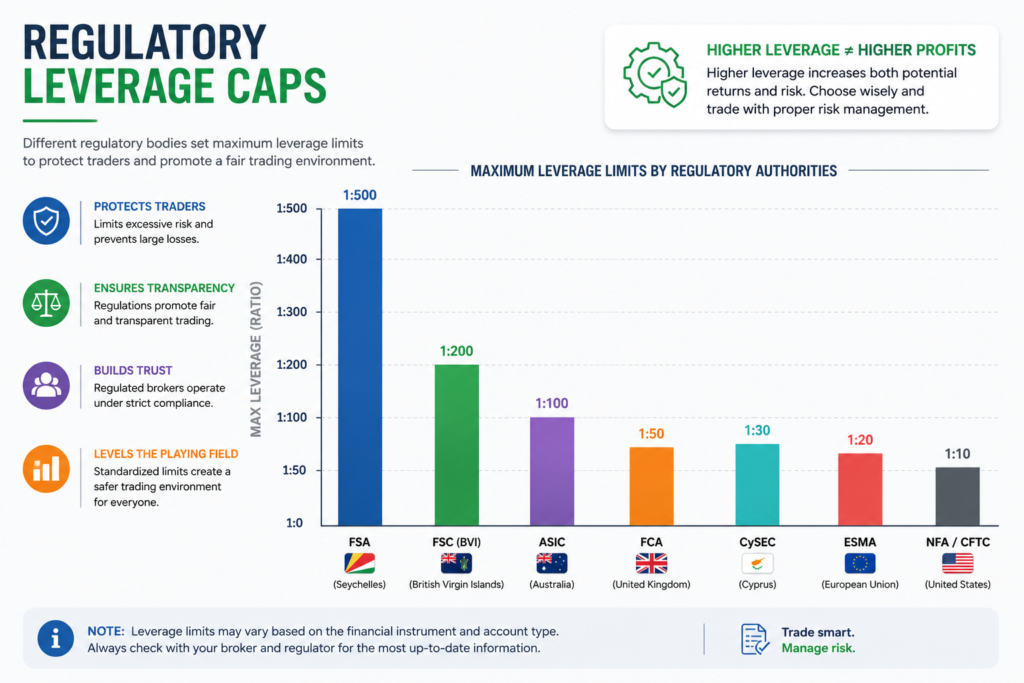
To make the trade-off concrete, it helps to see how leverage ratios map to margin requirements and relative risk. The higher the ratio, the less margin you tie up, and the more dangerous an oversized position becomes. The table below illustrates the relationship for a standard one hundred thousand dollar position.
| Leverage Ratio | Margin Required | Capital Efficiency | Relative Risk |
|---|---|---|---|
| 1:10 | $10,000 | Low | Low |
| 1:30 | $3,333 | Moderate | Moderate |
| 1:50 | $2,000 | Higher | Elevated |
| 1:100 | $1,000 | High | High |
| 1:500 | $200 | Very high | Severe |
Notice how the margin required collapses as leverage rises. At 1:500, a mere two hundred dollars controls a full standard lot. That efficiency is seductive, but it leaves almost no buffer. A small adverse move consumes your margin and triggers a forced exit. The same position at 1:10 leaves a far larger cushion to absorb volatility. This is the quiet argument for lower ratios that broker advertising never makes.
Regulatory Leverage Caps Around the World
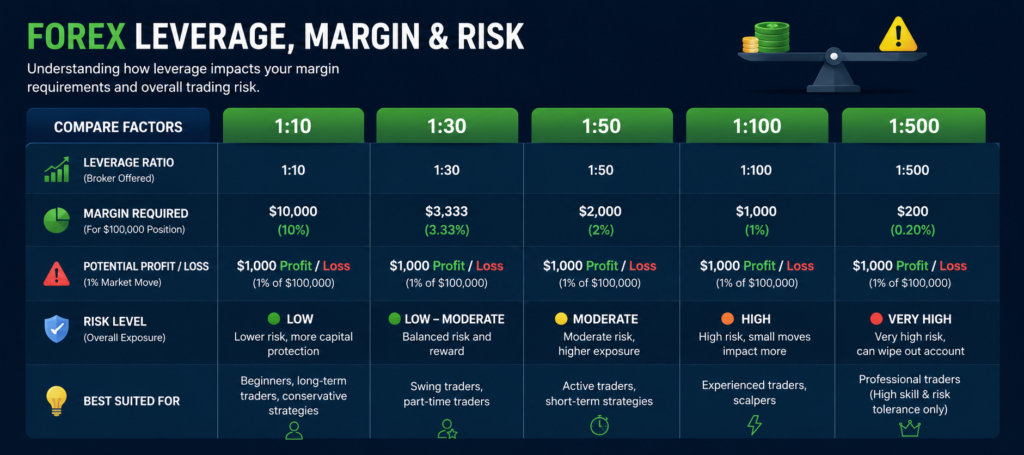
Regulators have studied retail trading outcomes closely, and their leverage caps reflect a sobering conclusion. Most retail traders lose money, and excessive leverage accelerates those losses. In Europe, ESMA limits major currency pairs to 1:30 for retail clients, with tighter caps on more volatile instruments. The United Kingdom mirrors this approach. In Australia, ASIC moved from permissive limits to a 1:30 cap for major pairs after observing widespread retail harm. The United States is even more conservative, capping forex leverage at 1:50 for majors through the CFTC and NFA framework.
Offshore brokers, registered in lightly regulated jurisdictions, frequently advertise 1:500 or higher. These ratios are legal where the broker is licensed, but they exist largely because regulators in those regions impose few constraints. The marketing pitch is freedom and opportunity. The practical reality is that such leverage hands inexperienced traders enough rope to ruin themselves quickly. The fact that respected regulators independently converged on caps near 1:30 should tell you something important. They are not trying to limit your profits. They are trying to limit the carnage their data consistently reveals.
Choosing a regulated broker also brings protections beyond leverage caps, such as segregated client funds and, in many regions, negative balance protection. These safeguards matter more than the headline ratio. A slightly lower leverage ceiling from a trustworthy, well-regulated broker is far better than an extreme ratio from an opaque offshore operation.
Position Sizing and Risk Per Trade
If leverage is the ceiling, position sizing is where you actually control risk. The professional approach starts with a fixed percentage of account equity to risk on each trade, commonly one percent or less. From that number, and the distance to your stop loss, you calculate the correct position size. The leverage ratio simply needs to be high enough to permit that position. It never dictates how large the position should be.
Consider a five thousand dollar account risking one percent, or fifty dollars, per trade. If your stop loss sits fifty pips away on a major pair where each pip is worth ten dollars per standard lot, you would trade one tenth of a standard lot, a mini lot, so that a fifty pip loss equals exactly fifty dollars. Notice that leverage never entered this calculation directly. Risk per trade and stop distance did all the work. This is the mindset that separates traders who endure from those who gamble.
When you size every position this way, a losing streak becomes survivable. Ten consecutive losses at one percent each leaves you down roughly ten percent, painful but recoverable. The over-leveraged trader risking ten or twenty percent per trade can be destroyed by a single bad week. Consistent, modest sizing turns trading from a coin flip into a process you can repeat for years.
Margin Calls and Stop-Outs
When trades move against you, your usable margin shrinks. Brokers monitor your margin level, expressed as equity divided by used margin. As that ratio falls toward a defined threshold, the broker issues a margin call, warning that your account can no longer support its open positions. If the situation worsens and equity hits the stop-out level, the broker automatically closes positions, starting with the worst, to prevent your balance from going negative.
High leverage makes margin calls and stop-outs far more likely. Because high leverage lets you open larger positions on the same balance, your margin buffer is thinner and ordinary volatility can trigger a forced liquidation. A trader using modest leverage rarely brushes against these limits because their positions are small relative to equity. The stop-out is the market’s blunt reminder that leverage is borrowed risk, and the broker always collects first.
The single short list worth keeping in mind, your core defenses against forced liquidation:
- Keep position sizes small relative to equity, set protective stop losses, avoid trading through high-impact news with full exposure, and maintain a comfortable free-margin cushion at all times.
Why the Best Leverage in Forex Is Often Lower Than Brokers Offer
By now the central message should be clear. The best leverage in forex is usually well below the maximum on offer because real edge comes from risk control, not from amplified exposure. Brokers profit when you trade more, and higher leverage encourages larger, more frequent positions. That commercial incentive does not align with your long-term survival. The traders who compound steadily over years almost universally use far less leverage than their accounts permit.
Lower leverage buys you something invaluable, room to be wrong. Markets are noisy and unpredictable in the short term. A position sized conservatively can weather an adverse swing and still be open when price reverses in your favor. The over-leveraged trader holding the same view gets stopped out before the move they correctly anticipated even arrives. Being right means nothing if your position size ejects you before the payoff.
This is why discipline beats ambition. The best ratio is the one that keeps you in the game through inevitable losing stretches, lets your strategy express its edge over many trades, and protects you from the catastrophic single loss that ends most trading careers. Choose leverage that supports survival first, and profitability tends to follow.
What Experts and Research Say
Serious study of trading psychology and risk reinforces everything above. In his classic book Trading in the Zone, Mark Douglas argues that consistent results come from disciplined risk management and emotional control rather than from prediction or aggressive bets. His work explains why over-leveraged traders sabotage themselves the moment fear and greed override their plan.
Academic research is equally blunt. In their widely cited study “Trading Is Hazardous to Your Wealth,” Brad Barber and Terrance Odean found that the most active retail traders earned the worst net returns, with overtrading and excessive risk-taking eroding their capital. Leverage magnifies exactly the behavior their data flagged as destructive, turning frequent trading into faster losses.
Finally, the professionals who have lasted preach defense above all. As Paul Tudor Jones famously put it, “The most important rule of trading is to play great defense.” Modest leverage is the most practical form of that defense, and it is advice grounded in both evidence and hard-won experience.
Frequently Asked Questions (FAQs)
What is the best leverage for forex beginners?
For most beginners, the best leverage for forex is low effective leverage, often the equivalent of 1:5 to 1:10, achieved through small position sizes. New traders make mistakes, and modest exposure keeps those mistakes survivable. The headline ratio matters far less than how much of your account you risk per trade. Start conservatively, learn the mechanics, and only consider scaling up after you trade profitably across many months.
Is 1:100 leverage good or too risky?
A ratio of 1:100 is fine as an available ceiling, but it becomes dangerous when you actually use it fully. The number itself is neutral. What matters is position size. You can hold a 1:100 account and still keep effective exposure very low by trading small. Good leverage for forex is about restraint in usage, not the maximum printed on your account dashboard.
Why do regulators cap leverage at 1:30 or 1:50?
Regulators like ESMA and the CFTC studied retail trading data and found that most clients lose money, with high leverage accelerating losses. Caps near 1:30 in Europe and 1:50 in the US are protective measures. They reflect evidence, not opinion, and signal that the best leverage in forex for retail traders is usually modest rather than extreme.
What is the difference between leverage and margin?
Leverage is the ratio that lets you control a large position with little capital. Margin is the actual collateral set aside to open that position. They are two sides of the same coin. Higher leverage means lower margin required, allowing bigger positions. Understanding leverage and margin together is essential before risking real money in any currency trade.
Can I avoid a margin call entirely?
You cannot guarantee it, but you can make margin calls extremely unlikely. Keep position sizes small relative to equity, always use stop losses, maintain a healthy free-margin buffer, and avoid maxing out leverage. Traders who size conservatively rarely approach stop-out levels, because ordinary volatility never threatens their account the way it threatens an over-leveraged one.
Final Thoughts
Choosing the best leverage for forex is ultimately a decision about survival rather than ambition. The highest ratio a broker offers is a ceiling, never a target, and real success comes from disciplined position sizing, consistent risk per trade, and the restraint to use only a fraction of the leverage available. Regulators worldwide cap retail leverage near 1:30 to 1:50 precisely because the data shows that excessive exposure destroys accounts. Beginners should lean toward low effective leverage, intermediates can scale gradually, and even professionals keep usage well below the maximum. Treat leverage as a risk dial you turn down, not a profit button you press. Protect your capital first, give your strategy room to work through normal volatility, and you will outlast the majority of traders who chase outsized exposure and pay the price.