
Introduction
Choosing the forex broker with highest leverage sounds like a shortcut to bigger profits, but it rarely works the way new traders imagine. High leverage magnifies wins and losses with equal force, and that symmetry is exactly what most beginners overlook. This guide explains what “highest leverage” really means, why offshore brokers advertise extreme ratios, and how regulated markets cap leverage to protect retail traders. You will learn how a 1:500 leverage forex broker differs from a conservative house like Interactive Brokers, how margin and stop-out mechanics actually work, and who high leverage genuinely suits. We frame everything around informed risk rather than hype. By the end, you will be able to evaluate leverage offers critically, protect your capital, and decide whether chasing the highest number is wise or reckless for your specific trading style and account size.
What “Highest Leverage” Actually Means
Leverage is borrowed buying power. When a broker offers 1:500, it lets you control a position worth five hundred times your deposited margin. A trader putting up 100 dollars can therefore command a 50,000 dollar position. That figure looks thrilling until you realize the same multiplier applies to losses. A movement of just 0.2 percent against a fully leveraged 1:500 position can wipe out the entire margin.
The phrase “highest leverage” usually refers to the maximum ratio a broker advertises. Some offshore firms market 1:1000, 1:2000, or even so-called unlimited leverage. These numbers are real marketing claims, but the headline ratio is not the whole story. What matters far more is your effective leverage, which is the actual size of your open positions relative to your total account equity. You can hold an account with a broker offering 1:1000 and still trade at an effective 1:5 if you size your positions sensibly.
This distinction is the single most important idea in this entire guide. The maximum ratio sets a ceiling. Your discipline sets the reality. Traders who confuse the two tend to treat a high ceiling as an invitation to fill it, and that is where accounts die. A high maximum is a tool, not a strategy.
Why a 1:500 Leverage Forex Broker (and 1:1000+) Exists Offshore
A 1:500 leverage forex broker typically operates under offshore or lightly regulated jurisdictions. Common licensing hubs include Seychelles, Saint Vincent and the Grenadines, Vanuatu, Belize, and similar locations. These regimes impose far fewer restrictions on leverage than major Western regulators, which is precisely why brokers register there to offer headline ratios that would be illegal in the European Union, the United Kingdom, Australia, or the United States.
Offshore brokers exist because there is real demand for high leverage, particularly from traders with small accounts who want meaningful position sizes without large deposits. Scalpers and high-frequency strategies also value the capital efficiency that high leverage provides. From the broker’s perspective, extreme leverage attracts volume, and volume generates spread and commission revenue.
None of this makes offshore brokers automatically fraudulent. Many operate honestly and process withdrawals reliably. However, the trade-off is reduced legal recourse. If a dispute arises, you may have little practical ability to recover funds through a regulator or compensation scheme. The higher the advertised leverage, the more carefully you must vet the firm’s reputation, withdrawal history, and segregation of client funds. Treat extreme ratios as a signal to investigate harder, not a reason to relax.
Regulated Leverage Caps Around the World
Major regulators cap retail leverage deliberately, because data showed that extreme leverage was destroying retail accounts. These caps are not arbitrary. They reflect documented consumer harm. The table below summarizes typical maximum retail leverage on major forex pairs by regulator. Always confirm current figures on the regulator’s official site, as rules evolve.
| Regulator / Region | Typical Max Retail Leverage (Major FX) | Notes |
| — | — | — |
| ESMA (EU) | 1:30 | Tiered lower for volatile assets; negative balance protection required |
| FCA (UK) | 1:30 | Mirrors ESMA-style restrictions |
| ASIC (Australia) | 1:30 | Tightened from previously unlimited offers |
| CFTC / NFA (US) | 1:50 | Among the stricter major-currency regimes |
| Offshore (various) | 1:500 to 1:3000+ | Minimal caps; weaker recourse |
The pattern is striking. The most established, well-funded regulators converge near 1:30 to 1:50 for retail clients. That convergence is itself evidence. If the regulators with the deepest research and the most consumer data independently landed on similar low caps, they are signaling that higher leverage harms typical retail traders more than it helps them.
Professional or wholesale clients can often access higher leverage even with regulated brokers, but qualifying as professional requires meeting strict criteria around portfolio size, trading frequency, and industry experience. Most retail traders do not qualify, and the protections they lose when reclassified are significant.
The Reality of IBKR Forex Leverage
Interactive Brokers is worth singling out because it represents the opposite philosophy to offshore high-leverage marketing. IBKR forex leverage is deliberately conservative and aligned with regulation in each jurisdiction it serves. Rather than advertising eye-catching ratios, Interactive Brokers offers leverage that sits broadly in line with regulated norms, often up to roughly 1:50 for retail forex in many regions, with the exact figure varying by client classification and local rules.
This is a feature, not a limitation. Interactive Brokers built its reputation on institutional-grade infrastructure, transparent pricing, deep liquidity, and strong regulatory standing across multiple major jurisdictions. The firm targets serious, well-capitalized traders who value execution quality and counterparty safety over headline leverage. For those traders, a conservative ratio is reassuring rather than restrictive.
The contrast is instructive. An offshore broker might dangle 1:1000 to a trader with a 200 dollar account, while Interactive Brokers offers far less but pairs it with robust safeguards and accountability. Neither approach is universally correct, but they serve different audiences. Because leverage figures and account requirements change, you should always verify the current Interactive Brokers leverage, margin rates, and eligibility on the firm’s official website before opening an account. Do not rely on any third-party number, including this article, as a live quote.
How to Choose a Forex Broker With Highest Leverage Safely
If you have decided you want a forex broker with highest leverage, the goal shifts from finding the biggest number to finding the safest provider of a high number. Regulation comes first, even offshore. Look for a recognized license, verifiable registration, and a track record of paying withdrawals promptly. Search independent forums and review sites for complaints about delayed or denied withdrawals, because that is the clearest red flag.
Next, examine how client funds are held. Segregated accounts at reputable banks protect you if the broker fails. Negative balance protection matters enormously with high leverage, because without it a violent market move could leave you owing more than you deposited. Many offshore brokers now offer it voluntarily, and you should strongly prefer those that do.
Trading conditions also deserve scrutiny. A broker advertising extreme leverage but charging wide spreads, high commissions, or punishing swap fees can quietly erode the capital efficiency that high leverage was supposed to deliver. Test execution on a demo account first, then with a small live deposit. Finally, read the leverage terms carefully. Some brokers use dynamic leverage that automatically reduces your maximum ratio as your position size grows, which is actually a sensible risk control rather than a drawback. The right broker is the one whose safeguards match the size of the risk you are taking on.
The Danger of High Leverage With Small Accounts
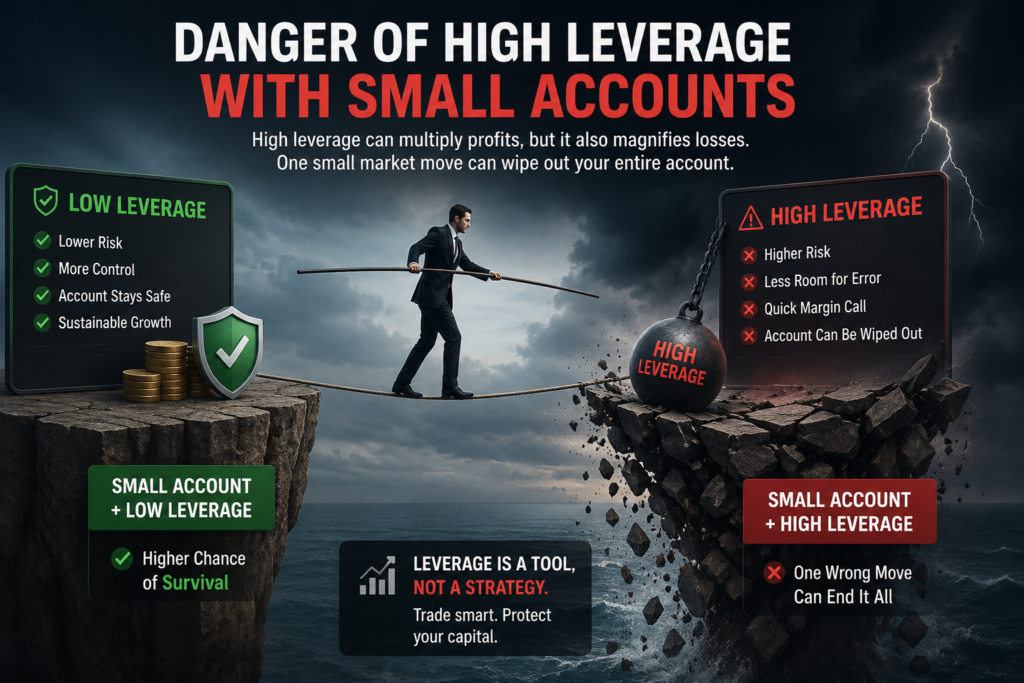
The most common path to a blown account combines high leverage with a tiny balance and outsized ambition. A trader deposits 100 dollars, opens with 1:1000, and treats the account like a lottery ticket. Because the position is enormous relative to equity, even a small adverse tick triggers a margin call. The account is gone before any real strategy had a chance to play out.
The mathematics are unforgiving. With high effective leverage, the buffer between your entry and a wipeout shrinks to almost nothing. Normal market noise, the random back and forth that occurs even within a winning trade, becomes fatal. You can be completely right about market direction and still be stopped out by ordinary volatility because your position left no room to breathe.
Small accounts feel the psychological pressure too. When a single trade can double or destroy your balance, fear and greed override judgment. Traders move stops, chase losses, and abandon their plans. High leverage does not just endanger your capital. It corrodes the discipline that long-term success depends on. The cruel irony is that the traders most attracted to high leverage, those with little capital, are exactly the ones least equipped to survive its consequences.
Margin and Stop-Out Mechanics Explained
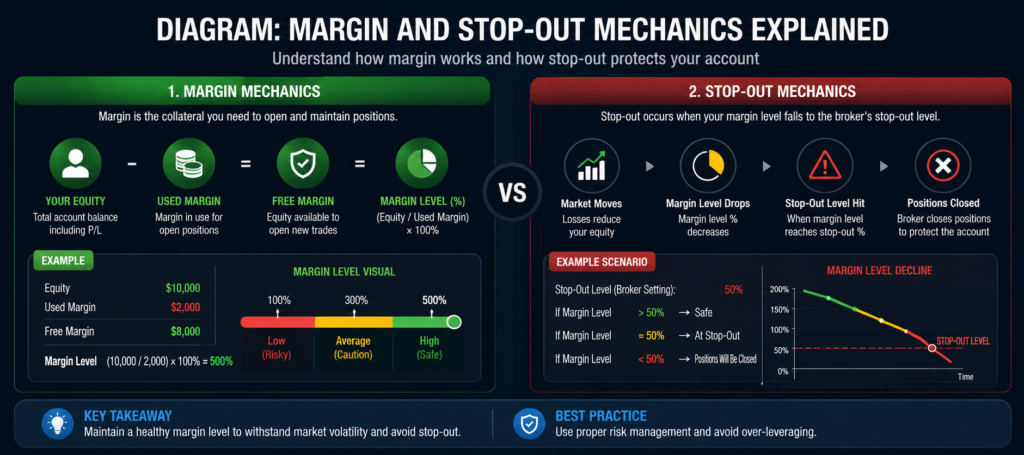
Understanding the plumbing behind leverage helps you avoid surprises. When you open a leveraged position, the broker sets aside a portion of your equity as required margin. Your free margin is what remains to absorb losses and support new trades. As an open position moves against you, your floating loss eats into equity, and your margin level, expressed as equity divided by used margin, falls.
Brokers define a margin call level and a stop-out level. The margin call is a warning that your equity is getting dangerously low relative to your positions. The stop-out level is the threshold at which the broker automatically closes positions to prevent your account from going negative. If your margin level hits the stop-out percentage, the platform liquidates trades, usually starting with the largest losing position, without asking permission.
With high leverage, you reach these thresholds far faster. A modestly sized loss that a low-leverage account would shrug off can push a high-leverage account straight into stop-out territory. This is why effective leverage matters more than the headline ratio. The single most reliable protection is position sizing. By risking only a small percentage of equity per trade and using sensible stop-loss orders, you keep your margin level comfortable regardless of how high your broker’s maximum leverage happens to be.
Who High Leverage Suits, and Who It Does Not
High leverage suits a narrow group. Experienced traders with proven, tested strategies can use it as a capital-efficiency tool, holding modest position sizes while keeping spare capital deployed elsewhere. Disciplined scalpers who take many small, tightly controlled positions may also benefit, since they exploit small moves and exit quickly. The common thread among traders who use high leverage well is that they almost never use the full ratio available to them.
High leverage does not suit beginners, undercapitalized traders, or anyone without a written risk plan. If you cannot calculate your effective leverage on a given trade, you are not ready for a high-leverage account. If a single losing trade would meaningfully damage your account, your position is too large, no matter what your broker permits. Emotional traders, those who move stops or revenge-trade, should avoid high leverage entirely, because it accelerates every mistake.
A useful self-test is simple. Ask whether you would trade the same position size if your broker only offered 1:30. If the honest answer is no, then the high leverage is driving your decisions rather than your strategy, and that is precisely the situation high leverage was designed to exploit. The best traders treat a high ceiling as optional headroom they rarely touch.
What Experts and Research Say
The professional literature is consistent on one point. Survival and psychology matter more than leverage. In Trading in the Zone, trader and author Mark Douglas argues that consistent results come from disciplined probabilistic thinking and emotional control, not from larger bets. His work explains why overleveraged traders sabotage themselves even when their market analysis is sound, because the pressure of an oversized position distorts decision-making.
The data reinforces this. The European Securities and Markets Authority, ESMA, reported that a large majority of retail CFD and forex accounts lose money, with many studies and broker disclosures citing figures commonly in the range of roughly 70 to 80 percent of retail accounts ending in losses. That finding directly motivated the regulated leverage caps discussed earlier. The academic record points the same way. Barber and Odean’s research, often summarized by their paper title “Trading Is Hazardous to Your Wealth,” found that the most active retail traders tend to underperform, undermining the fantasy that aggressive, leveraged activity reliably builds wealth.
Warren Buffett put the core lesson plainly: “Risk comes from not knowing what you’re doing.” High leverage does not create knowledge. It simply enlarges the consequences of whatever knowledge, or ignorance, you already bring to the market.
Frequently Asked Questions (FAQs)
What is the forex broker with highest leverage available right now?
The highest advertised leverage usually comes from offshore brokers offering 1:1000, 1:2000, or even higher ratios. No single firm holds this title permanently, because offers change and regulation varies by region. Rather than chasing the biggest number, focus on whether a high-leverage broker is properly licensed, segregates client funds, and pays withdrawals reliably. The forex broker with highest leverage is only worth using if its safeguards match the elevated risk you are accepting.
Is a 1:500 leverage forex broker safe to use?
A 1:500 leverage forex broker can be safe if it is reputable, holds a recognized license, and offers negative balance protection. The leverage itself is neutral. Danger comes from how you use it. Many traders operate safely at 1:500 by keeping their effective leverage low through disciplined position sizing. Always verify the broker’s track record on independent forums before depositing, and never treat a high ceiling as permission to oversize your trades.
Why is IBKR forex leverage so much lower than offshore brokers?
IBKR forex leverage is conservative because Interactive Brokers operates under strict regulation across major jurisdictions and targets serious, well-capitalized traders. Its leverage, often around 1:50 retail in many regions, aligns with regulated norms rather than offshore marketing. This reflects a deliberate emphasis on counterparty safety, execution quality, and accountability. Always check the current figures on the official Interactive Brokers website, as leverage and margin terms vary by client type and location.
Does high leverage increase my profits?
High leverage increases the size of positions you can control, so it amplifies both profits and losses equally. It does not improve your win rate or your strategy. Many traders find that high leverage actually reduces long-term profits, because it triggers premature stop-outs and emotional decisions. The math cuts both ways, and ordinary market volatility becomes far more dangerous when your effective leverage is high.
What leverage should a beginner use?
Beginners are usually better served by low leverage, often 1:10 or lower in effective terms, even if their broker permits much more. Lower leverage leaves room for trades to breathe and protects your account from being wiped out by normal market noise. Focus first on consistent risk management and a tested strategy. You can always increase leverage later once you have proven you can preserve capital under pressure.
Final Thoughts
The hunt for the forex broker with highest leverage distracts most traders from the question that actually determines their survival, which is how much risk they take on each trade. Headline ratios like 1:500, 1:1000, and beyond are tools, and like any powerful tool they reward skill and punish carelessness. Regulated caps near 1:30 to 1:50 exist because the data shows extreme leverage harms typical retail traders, and conservative houses like Interactive Brokers thrive precisely because cautious clients value safety over spectacle. If you choose a high-leverage offshore broker, vet it ruthlessly for regulation, fund segregation, and reliable withdrawals, then keep your effective leverage modest regardless of the ceiling. Discipline, not the size of your leverage, separates traders who last from those who do not. Treat leverage as borrowed responsibility, and let your strategy, never the ratio, drive your decisions.