
Introduction
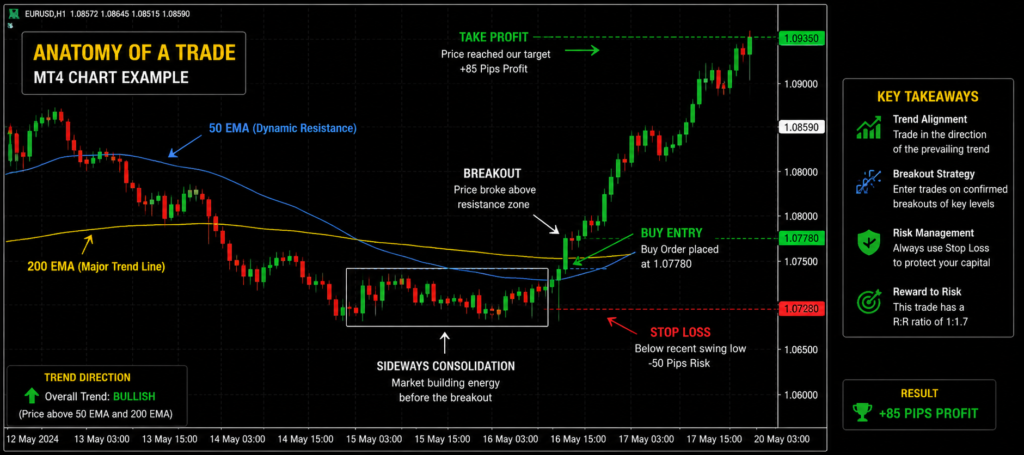
Price tells you where the market is, but forex volume indicators tell you whether the move actually means anything. Most beginners stare at candlesticks all day and ignore the one dimension that separates a real breakout from a fakeout: participation. When volume confirms a price move, the odds shift in your favor; when it diverges, smart traders get cautious. The challenge in the currency market is that there is no central exchange, so traders rely on tick volume and broker-aggregated flow rather than true contract counts. In this guide you will learn how the major volume tools work, how to read them inside MT4 and MT5, and how to pair them with a popular signal tool like the xmaster formula indicator forex traders love. By the end, you will know exactly which indicator suits your style and how to avoid the classic traps.
Why Volume Matters in a Decentralized Market
Forex is the largest financial market on earth, yet it lacks something stocks and futures take for granted: a single exchange that records every transaction. Because trades happen across thousands of banks, brokers, and liquidity providers, no one can publish a definitive count of contracts changing hands. This is the first thing every trader must internalize before trusting any volume reading. What your charting platform shows is not true traded volume but tick volume, which counts the number of price changes within a given period. A bar that ticks two hundred times saw far more activity than one that ticked twenty times, and research has repeatedly shown that tick volume correlates strongly with actual traded volume in liquid pairs. So while purists complain that forex volume is “fake,” the practical reality is that tick volume is a reliable proxy for participation, especially on the major pairs during active sessions.
The reason participation matters comes down to conviction. A price move backed by heavy volume reflects broad agreement among market participants, which makes that move more likely to continue. A move on thin volume, by contrast, can reverse the moment a few large orders dry up. This is why seasoned traders treat forex volume indicators as a confirmation layer rather than a standalone signal. Volume rarely tells you what to do on its own, but it constantly tells you how much to trust what price is doing. Once you adopt that mindset, your chart reading becomes noticeably sharper.
On-Balance Volume: The Running Total That Reveals Pressure
On-Balance Volume, or OBV, is one of the oldest and most respected volume tools, popularized by Joe Granville decades ago. The concept is elegantly simple: on every up bar, the period’s volume is added to a running total, and on every down bar it is subtracted. The resulting line does not care about the absolute number; what matters is its direction and slope. When OBV climbs steadily, buying pressure is accumulating beneath the surface, and when it falls, distribution is underway. The real power of OBV emerges through divergence. If price grinds to a new high but OBV refuses to follow, it warns that the move lacks the participation needed to sustain itself, and a reversal may be brewing.
In MT4 and MT5, OBV is a built-in indicator that you can attach in seconds, and it works across any timeframe. Scalpers watch its short-term slope for momentum shifts, while swing traders use it to confirm that a multi-day trend has genuine fuel behind it. Because OBV is cumulative, you should focus on its shape relative to recent price rather than fixating on the raw value. Pair it with simple support and resistance and you have a clean, uncluttered system that filters out a surprising number of weak setups.
Volume Profile and VWAP: Where Price Actually Traded
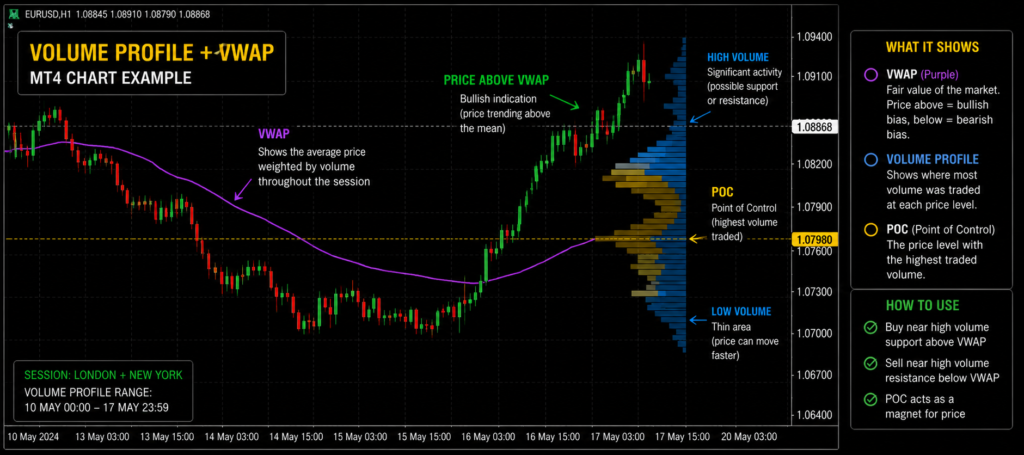
While OBV tracks pressure over time, Volume Profile flips the axis and shows you volume distributed across price levels instead. The result is a horizontal histogram that reveals where the most trading occurred, highlighting high-volume nodes that act as magnets and low-volume gaps that price tends to slice through quickly. The fattest part of the profile, often called the point of control, marks the price the market considered most fair during that session. Traders use these levels to anticipate where price is likely to stall, bounce, or accelerate, which makes Volume Profile a favorite among institutional-style discretionary traders.
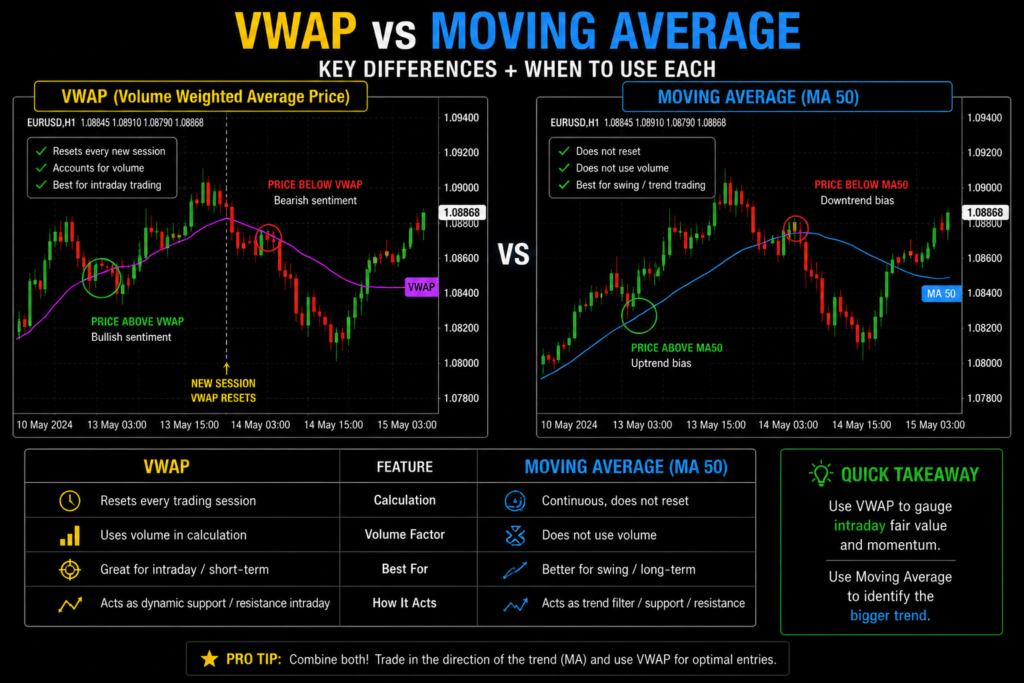
Closely related is Volume Weighted Average Price, or VWAP, which gives you the average price weighted by volume over a chosen session. VWAP is the institutional benchmark; large desks measure their execution quality against it, which means the line frequently behaves as dynamic support or resistance. A common intraday approach is to favor longs when price holds above VWAP and shorts when it stays below, treating the line as the session’s center of gravity. Combining VWAP with a profile of where volume clustered gives day traders a precise map of the battlefield, telling them not just whether a move is strong but exactly where the important transactions happened.
Chaikin Money Flow and the Money Flow Index
The next family of tools blends price and volume into bounded oscillators that are easy to read at a glance. Chaikin Money Flow (CMF) measures buying and selling pressure over a set lookback, typically twenty or twenty-one periods, by examining where each close falls within its range and weighting that by volume. Readings above zero suggest accumulation while readings below zero suggest distribution, and sustained moves toward the extremes signal strong conviction. Because CMF oscillates around a zero line, it is excellent for spotting shifts in the underlying tone of a market before they fully show up in price.
The Money Flow Index (MFI) is often described as a volume-weighted cousin of the RSI. It travels between zero and one hundred, flagging overbought conditions above eighty and oversold conditions below twenty, but unlike RSI it folds volume into the calculation, so its readings reflect committed money rather than price alone. This makes MFI particularly useful for catching exhaustion: when price pushes to a fresh extreme but MFI rolls over, the move is running on fumes. Many traders run CMF and MFI together with a trend filter, using the oscillators purely to time entries within an established direction rather than to predict reversals out of thin air.
Comparing the Major Volume Indicators
Each volume tool answers a slightly different question, so choosing the right one depends on your timeframe, trading style, and the kind of confirmation you need. The table below summarizes how the most widely used forex volume indicators stack up, including their typical use case and where they shine.
| Indicator | What It Measures | Best For | Typical Platform |
|---|---|---|---|
| On-Balance Volume (OBV) | Cumulative buying vs selling pressure | Trend confirmation, divergence | MT4 / MT5 built-in |
| Volume Profile | Volume distributed across price levels | Identifying key levels, day trading | MT5 / third-party |
| VWAP | Volume-weighted average price per session | Intraday bias, institutional entries | MT5 / custom scripts |
| Chaikin Money Flow | Accumulation vs distribution (bounded) | Tone shifts, swing trades | MT4 / MT5 |
| Money Flow Index | Volume-weighted momentum (0-100) | Overbought/oversold timing | MT4 / MT5 built-in |
| Force Index | Strength of a move (price x volume) | Confirming breakouts | MT4 / MT5 |
No single row is “best.” A scalper leaning on session structure may live inside VWAP and Volume Profile, while a swing trader watching daily charts may prefer OBV and CMF. The smartest approach is to pick one cumulative tool and one bounded oscillator so you get both the big-picture pressure and the timing signal without cluttering your screen.
Tick Volume in MT4 and MT5
For most retail traders, tick volume is the practical foundation everything else is built on, so it deserves a section of its own. In both MetaTrader platforms, the standard volume histogram at the bottom of the chart reflects tick count, coloring bars to show whether activity is rising or falling. The key skill is learning to read tick volume in context: a breakout candle accompanied by a towering volume bar carries far more weight than the same candle on a shrunken bar. During the London and New York overlap, tick volume naturally swells because liquidity is at its peak, while the late Asian session often produces thin, unreliable readings you should treat with caution.
A frequent mistake is comparing tick volume across different brokers or across pairs as if the absolute numbers were universal. They are not, because each feed ticks differently. Instead, judge each bar relative to its own recent average on the same chart. When tick volume spikes well above the recent norm at a key level, it often marks the moment institutions step in, and that is precisely where price-action setups become high-probability. Treat tick volume as your participation gauge and the rest of your volume toolkit becomes far more meaningful.
Where the Xmaster Formula Indicator Fits In
Volume indicators excel at confirmation, but many traders also want a clean visual cue that says “the conditions you watch for just lined up.” This is where the xmaster formula indicator forex enthusiasts download fits naturally into a volume-based workflow. The Xmaster Formula is a free, popular MT4 tool that plots colored arrow signals directly on the chart, painting an arrow when its blend of smoothed moving averages and filters suggests a potential entry. It is not a volume indicator itself; rather, it is a trend and momentum helper that complements the volume picture you have already built.
The smart way to use it is as a second opinion, not a master switch. When the Xmaster Formula prints a buy arrow at the same moment OBV is rising and tick volume is expanding into a level, you have multiple independent factors agreeing, which is exactly the kind of confluence professionals chase. Some traders search for the variant spelled xhmaster formula indicator forex as well, since both spellings circulate across forums and download sites for the same family of arrow indicator. Whatever the spelling, the principle holds: arrows give you a timing trigger, volume tells you whether to trust it, and you should always verify that any such tool does not repaint before relying on its signals in live trading.
Building a Simple Volume-Confirmed Strategy
Pulling everything together, a robust approach does not require a screen buried under a dozen indicators. Start with clean price action and a clear directional bias drawn from structure, support, and resistance. Layer in one cumulative volume tool such as OBV to confirm that pressure agrees with the trend, then add a bounded oscillator like MFI or CMF to time your entries within that trend rather than against it. Use tick volume as a real-time participation filter, only acting on breakouts that arrive on expanding volume and stepping aside when bars shrink.
Here is the one short checklist worth memorizing before you click buy or sell:
- Confirm the trend direction with structure and OBV slope.
- Wait for tick volume to expand into your level, not contract.
- Require an oscillator (MFI or CMF) to agree with your direction.
- Treat an Xmaster Formula arrow as a trigger, never as the whole reason.
This kind of layered confluence is what turns volume from a vague concept into an edge. The goal is never to predict the future with certainty but to stack independent confirmations so that, over many trades, the math works in your favor. Discipline and consistent application matter far more than the specific combination you settle on.
What Top Traders and Research Say
The most cited practitioner text on this topic is Anna Coulling’s *A Complete Guide to Volume Price Analysis*, which walks traders through reading volume alongside price to detect accumulation and distribution by larger players. For a broader foundation in chart-based methods, John Murphy’s classic *Technical Analysis of the Financial Markets* remains a standard reference that covers volume’s confirming role within wider technical study. On the academic side, the well-known paper by Andrew Lo, Harry Mamaysky, and Jiang Wang, “Foundations of Technical Analysis” (Journal of Finance, 2000), used rigorous statistical methods to evaluate technical patterns and found that several carried measurable informational value, lending credibility to systematic technical approaches. The throughline across all three is that volume earns its keep as confirmation rather than prophecy. As Paul Tudor Jones is often quoted: “The secret to being successful is to play great defense.” Reading volume well is, at heart, a defensive discipline that keeps you out of low-conviction moves.
Suggested Images
[Image placeholder] **Type:** Annotated MT4 chart screenshot. **Where:** Inside the On-Balance Volume section. **Alt text:** “Fig 1.1 OBV forex volume indicator showing bullish divergence on an MT4 chart.”
[Image placeholder] **Type:** Volume Profile / VWAP overlay graphic. **Where:** Within the Volume Profile and VWAP section. **Alt text:** “Fig 1.2 Volume profile and VWAP forex volume indicators marking key price levels on EUR/USD.”
[Image placeholder] **Type:** Comparison infographic. **Where:** Beside the indicator comparison table. **Alt text:** “Fig 1.3 Comparison of major forex volume indicators including OBV, VWAP, CMF and MFI.”
[Image placeholder] **Type:** Chart with arrow signals plus volume histogram. **Where:** In the Xmaster Formula section. **Alt text:** “Xmaster formula indicator forex arrows confirmed by expanding tick volume.”
FAQs
Is forex volume real or fake? Forex has no central exchange, so platforms display tick volume, which counts price changes rather than actual contracts traded. While this is not true exchange volume, studies and decades of trader experience show tick volume correlates closely with real activity on liquid major pairs. For practical purposes, forex volume indicators built on tick data are dependable confirmation tools, especially during active London and New York sessions.
Which is the best volume indicator for beginners? On-Balance Volume is the friendliest starting point because it is built into MT4 and MT5 and only requires you to watch its direction and divergence against price. Once comfortable, beginners often add the Money Flow Index for overbought and oversold timing. The best choice ultimately depends on your timeframe, but starting simple with OBV prevents the chart clutter that overwhelms new traders.
Can I use volume indicators with the Xmaster Formula indicator? Yes, and the two complement each other well. The xhmaster formula indicator forex traders use plots arrow signals for potential entries, while volume tools confirm whether those signals have genuine participation behind them. When an arrow appears as OBV rises and tick volume expands, you have stronger confluence. Always verify the indicator does not repaint before trusting any live signal.
Do volume indicators work for scalping? They can, provided you respect session timing. Tick volume and VWAP are popular among scalpers because they reflect real-time participation and the institutional benchmark price. The key is trading during high-liquidity windows when volume readings are meaningful, and avoiding thin periods where tick data becomes erratic and unreliable for fast decisions.
How do I avoid false signals from volume? Never trade volume in isolation. Use it as a confirmation layer on top of structure and price action, and require agreement from at least two independent factors before acting. Watching for divergence, demanding expanding volume on breakouts, and combining a cumulative tool with a bounded oscillator dramatically reduces the false signals that catch impatient traders.
Final Thoughts
Volume is the dimension most retail traders ignore, and that is exactly why understanding it gives you an edge. From the cumulative pressure of On-Balance Volume to the price-level intelligence of Volume Profile, the institutional benchmark of VWAP, and the bounded momentum of CMF and MFI, each tool answers a different question about market participation. Layered on top of clean price action and a reliable signal helper like the Xmaster Formula, forex volume indicators transform guesswork into structured, confluence-based decisions. The goal is not certainty but better odds, achieved by stacking confirmations and trading only when participation backs the move. Master tick volume in MT4 and MT5 first, add one or two complementary tools, and stay disciplined.
Ready to sharpen your edge with more practical, no-fluff trading guides? Visit forexmarkettrendss.com for deeper tutorials, indicator breakdowns, and strategy walkthroughs that help you trade with confidence.
*This article is for educational purposes only and does not constitute financial advice.*