
Strip away the indicators, the alerts, and the noise, and you are left with the one thing every trading decision ultimately rests on: price itself. Forex price action trading is the discipline of reading that raw price movement directly, interpreting what buyers and sellers are doing through structure, levels, and candles rather than through lagging calculations. This guide explains what price action really is, why it gives you a timing edge, how to read the key candlestick patterns in context, and how to build a clean, repeatable price action strategy that works on any pair and any timeframe.
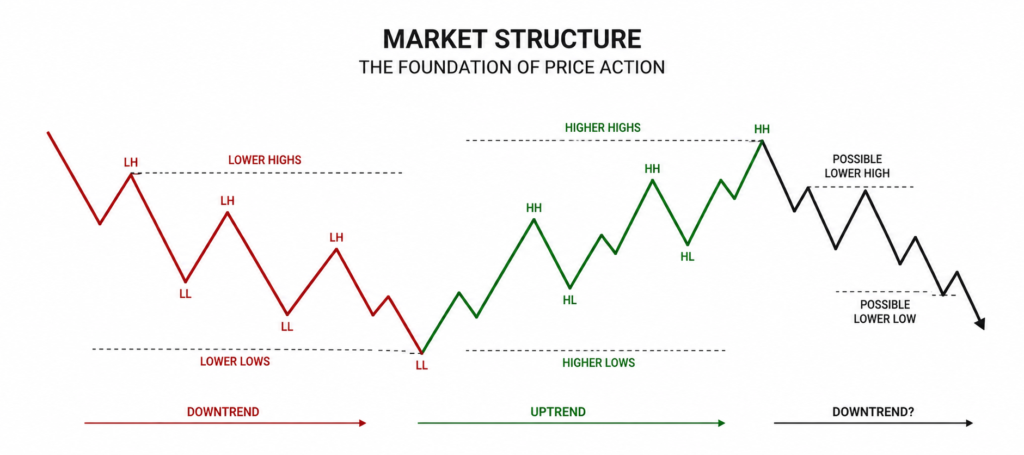
Fig 1.1 Forex price action trading on a clean chart
What Is Forex Price Action Trading?
Forex price action trading is a method of analysing and trading based purely on raw price movement, without relying on lagging indicators. Instead of cluttering the chart with tools that merely process past prices, the price action trader reads what the market itself is communicating through its structure, its key levels, and the behaviour of individual candles. The chart becomes the primary source of truth rather than a backdrop for indicators.
The logic behind the approach is compelling. Every indicator ever created is derived from price, so by definition it lags behind the very thing it measures. Price action traders argue that it makes more sense to read the source directly than to wait for a delayed mathematical echo of it. The result is faster, cleaner decision-making and a deeper, more intuitive understanding of why the market is moving.
This style suits traders who value simplicity and want to understand the market rather than merely follow signals. Once you learn to read price, the skill becomes universal: it applies to any currency pair, any timeframe, and any market condition, from quiet ranges to powerful trends. That portability is precisely why price action remains one of the most respected and widely taught approaches in all of trading.
Why Price Action Beats Indicator Overload
Indicators lag because they are built from historical prices, so they confirm moves only after those moves have begun. Price action, by contrast, reacts in real time, allowing a skilled reader to anticipate turns and breakouts as they form rather than after the fact. For an active trader, that timing advantage is significant and often the difference between a good entry and a late one.
A clean chart also reduces the decision paralysis that plagues so many traders. When five indicators flash conflicting signals, the natural response is to freeze; when you read pure price, the picture is far clearer and more decisive. Simplicity breeds confidence, and confidence enables the timely execution that profitable trading demands. The absence of clutter is not a limitation but a genuine advantage.
That said, price action is a skill that rewards screen time and pattern recognition rather than a magic setting you can switch on. It takes practice to read well, and beginners often underestimate the patience required. Once developed, however, it becomes a flexible, lifelong edge that no software update can obsolete and no broker can take away. The investment in learning to read price pays dividends for as long as you trade.
Reading Candlestick Patterns in Context
The candlestick patterns forex traders rely on are the vocabulary of price action, but they carry meaning only in context. A pin bar, with its long wick, shows the market rejecting a price level; an engulfing candle reveals a sudden shift in control from buyers to sellers or vice versa; and an inside bar reflects consolidation and coiling energy before a breakout. Each tells a small story about the battle between buyers and sellers.
The crucial insight is that these patterns gain their power from where they appear, not merely from their shape. A pin bar floating in the middle of nowhere means little, but the same pin bar rejecting a strong resistance zone, in line with the broader trend, becomes a high-probability signal. The table below summarises the key patterns and the locations where they matter most.
| Candle | Signal | Strongest Location |
|---|---|---|
| Pin bar / Hammer | Rejection, possible reversal | At support or resistance |
| Shooting star | Bearish rejection | At resistance |
| Bullish engulfing | Buyers seize control | At support |
| Bearish engulfing | Sellers seize control | At resistance |
| Inside bar | Consolidation, breakout pending | Within a trend |
Always combine the candle with the level and the trend, because this confluence of signal, location, and direction is what separates a tradeable edge from random noise. A candle alone is a hint; a candle at a key level in the direction of the trend is a genuine setup worth risking money on.
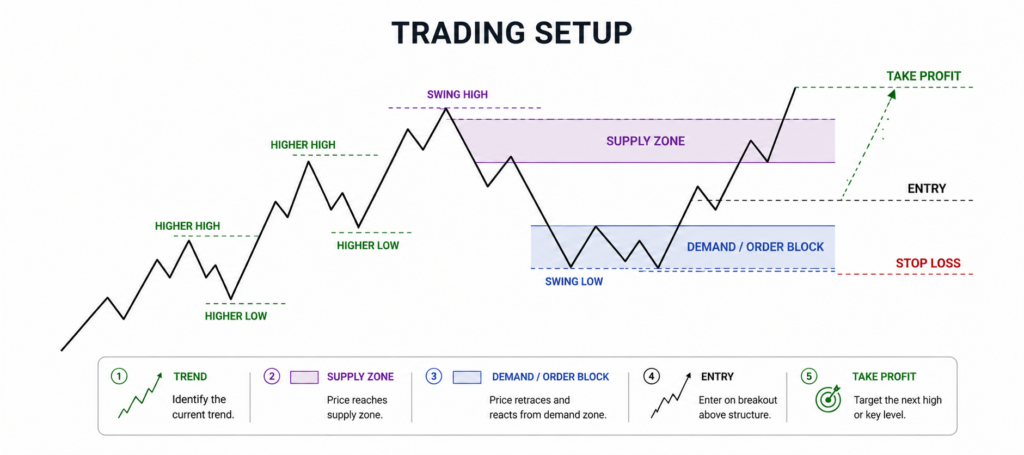
Fig 1.2 Candlestick patterns forex pin bar
Building a Forex Price Action Strategy
A sound forex price action strategy begins long before any trade, with preparation. Before the session, you read the higher-timeframe trend and mark the key support and resistance zones where price is most likely to react. This map focuses your attention on the small number of high-quality areas that genuinely matter, rather than every minor wiggle on the chart.
When price reaches one of those marked levels, you wait, and waiting is the hardest and most important part. You enter only when a confirming candlestick pattern prints in the direction of the trend, such as a bullish pin bar bouncing off support within an uptrend. This patience filters out the countless low-quality setups that tempt impulsive traders and ensures you commit only when signal, location, and direction align.
Risk management completes the strategy and is inseparable from it. You place your stop beyond the level or the candle’s wick, where the trade idea would be invalidated, and you target the next significant level or a fixed reward of at least twice your risk. Clean reading paired with disciplined risk control is the entire method; there is no secret ingredient beyond patience, context, and the willingness to wait for genuine confluence.
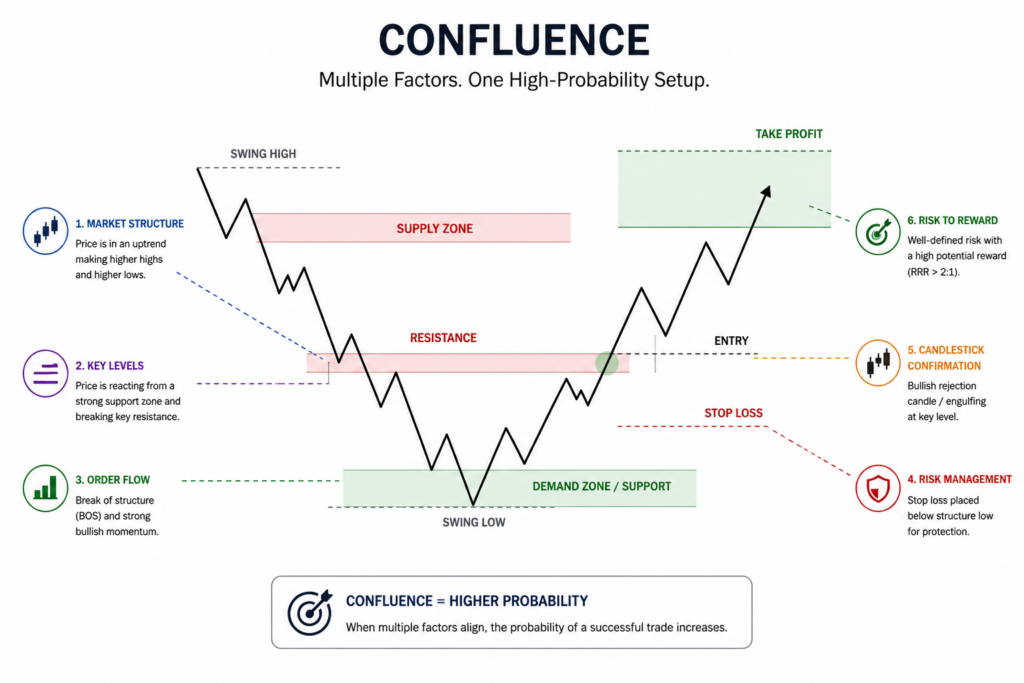
Fig 1.3 Forex price action confluence
What Top Traders and Research Say About Price Action
Price action sometimes attracts scepticism, yet both expert practice and academic research lend it real credibility. Steve Nison, the author who introduced Japanese candlestick charting to the Western world in his classic Japanese Candlestick Charting Techniques, demonstrated that these centuries-old patterns encode meaningful information about shifting market sentiment when read in context. His work transformed candlesticks from an obscure curiosity into a cornerstone of modern technical analysis.
Academic finance offers support as well. In the influential study “Foundations of Technical Analysis,” the researchers Andrew Lo, Harry Mamaysky, and Jiang Wang applied rigorous statistical methods to common technical patterns and concluded that several of them do carry genuine, measurable informational value. That finding does not guarantee any single pattern will work, but it does validate the disciplined, evidence-based reading of price that sits at the heart of the approach.
The legendary speculator Jesse Livermore captured the right mindset when he observed, “Markets are never wrong; opinions often are.” For a price action trader, this is the daily discipline: let the chart, the confirmed candle, and the key level tell you what to do, rather than forcing the market to fit an opinion you have already formed. Reading what is actually there, not what you wish were there, is the essence of trading price action well.
Common Price Action Mistakes
The most frequent error is trading patterns without context, such as buying every pin bar regardless of its location or the prevailing trend. A pattern in open space lacks the support of a key level and fails far more often than one positioned at genuine confluence. Always demand that signal, location, and trend agree before risking money.
Overcomplicating the chart defeats the entire purpose of price action; drawing too many levels or chasing every minor candle recreates the very clutter the approach is meant to escape. Equally damaging is fighting the dominant trend, which lowers your win rate for little reward. And as with every method, neglecting risk management, whether by skipping the stop or oversizing the position, can turn even a well-read setup into an account-threatening loss. Respect your stop on every single trade.
Frequently Asked Questions
Is forex price action trading profitable?
Forex price action trading can be highly profitable because it reads the market in real time rather than relying on lagging indicators. Profitability depends on trading patterns at key levels, in the direction of the trend, with solid risk management. The method rewards screen time and pattern recognition, so it improves steadily with practice. Combined with a reward-to-risk ratio of at least two to one, disciplined price action reading can deliver consistent results over a long series of trades.
What are the best candlestick patterns in forex?
The candlestick patterns forex traders rely on most are the pin bar, the engulfing candle, and the inside bar. The pin bar signals rejection at a key level, the engulfing candle shows a shift in control, and the inside bar marks consolidation before a breakout. These patterns work best at strong support or resistance and in the direction of the trend. Mastering a few deeply, in context, beats memorising dozens superficially.
How do I build a forex price action strategy?
A clean forex price action strategy starts with preparation: read the higher-timeframe trend and mark key support and resistance zones before the session. When price reaches a level, wait for a confirming candlestick pattern in the trend direction before entering. Place your stop beyond the level or candle wick and target at least twice your risk. The whole method is patience, context, and disciplined risk control, with no secret ingredient beyond waiting for genuine confluence.
Is price action better than using indicators?
Price action offers real-time reading because it reflects raw price, while indicators lag since they are built from past data. A clean price action chart also reduces the paralysis caused by conflicting indicators. That said, price action requires practice to read well, whereas some traders find indicators more structured and reassuring. Many successful traders blend price action with one simple indicator for confirmation, but the core skill of reading price remains the foundation.
Can beginners learn price action trading?
Yes, beginners can learn price action, though it takes patience and screen time to develop genuine pattern recognition. Starting on higher timeframes makes signals cleaner and decisions less rushed, and focusing on a few core patterns at key levels accelerates the learning curve. The hardest part is psychological: waiting for true confluence rather than forcing trades. With consistent demo practice and disciplined risk management, beginners can build a flexible, lifelong trading skill.
What timeframe is best for price action trading?
Price action works on any timeframe, but the higher timeframes such as the one-hour, four-hour, and daily charts produce cleaner, more reliable signals with less noise. Lower timeframes offer more setups but more false patterns, which can frustrate inexperienced traders. Beginners should start higher to build confidence before moving down. Choose the timeframe that matches your trading style, schedule, and tolerance for noise, and stay consistent with it.
Final Thoughts
Forex price action trading strips the market back to its purest form, raw price movement read through structure, key levels, and candle behaviour, and in doing so it offers a clear, real-time edge that lagging indicators simply cannot match. The enduring beauty of the approach is its portability: once you learn to read the chart, the same skill applies to any pair, any timeframe, and any market condition for the rest of your trading life. Success flows from combining the candlestick patterns forex traders trust with strong support and resistance, the dominant trend, and the discipline to wait for genuine confluence rather than forcing every setup. The work of Steve Nison on candlesticks, the academic findings of Lo, Mamaysky, and Wang, and Jesse Livermore’s reminder that markets are never wrong all reinforce the same lesson: read what is actually there, not what you wish were there. Commit to mastering a few core setups, practise diligently on a demo account, and let your reading skill and your confidence grow together.