
How Does Leverage Work in Forex? A Complete Professional Guide
Introduction to Forex Leverage
Understanding how does leverage work in forex is one of the most important steps for anyone entering the currency trading market. Leverage is a financial mechanism that allows traders to control larger positions with a relatively small amount of capital. In simple terms, it amplifies your trading power by borrowing funds from your broker.
In the world of forex trading, even small price movements can create significant changes in profit or loss. This is why leverage in forex trading is considered both a powerful opportunity and a serious risk. Traders who understand leverage deeply are able to manage their capital more efficiently and avoid unnecessary losses caused by overexposure.
What is Leverage in Forex Trading?
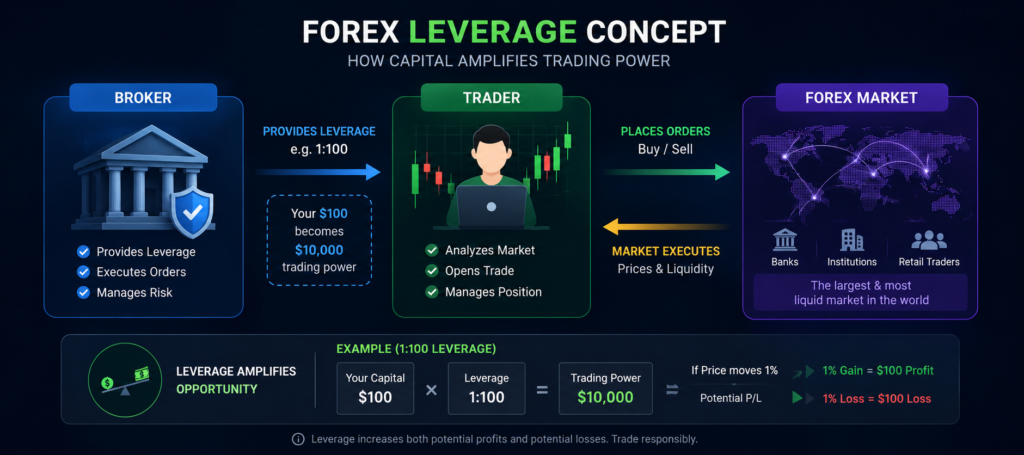
Leverage in forex is essentially a tool that increases your market exposure without requiring full capital upfront. When a broker offers leverage such as 1:100, it means that for every $1 you invest, you can control $100 in the market.
For example, if you deposit $200 and use 1:100 leverage, you can open a position worth $20,000. This does not mean you are receiving free money; instead, your broker temporarily extends your buying power while using your deposit as margin security.
Leverage is directly connected to both opportunity and risk. While it allows traders to earn larger profits from small price changes, it also increases potential losses at the same scale.
How Does Leverage Work in Forex Trading?
To understand how does leverage work in forex, it is important to break it down into a practical trading scenario.
When you open a trade, your broker requires a small portion of your capital called margin. This margin acts as a security deposit. Once the margin is placed, the broker extends leverage, allowing you to control a much larger trade size.
For instance, if your account balance is $500 and you use 1:100 leverage, you can open trades worth up to $50,000. If the market moves in your favor, your profits are calculated based on the larger position size, not just your initial deposit. However, if the market moves against you, losses are also magnified.
This is why professional traders treat leverage as a tool for position sizing rather than a shortcut to profit.
Understanding Margin and Risk in Forex Leverage
To fully grasp leverage in forex trading, one must also understand the concept of margin. Margin is the portion of your funds that is locked when you open a trade. It is not a fee but a deposit that ensures you can cover potential losses.
As leverage increases, the required margin decreases. This allows traders to open larger positions with smaller capital. However, this also increases exposure to volatility. A small unfavorable price movement can quickly reduce your account equity, leading to a margin call if proper risk management is not applied.
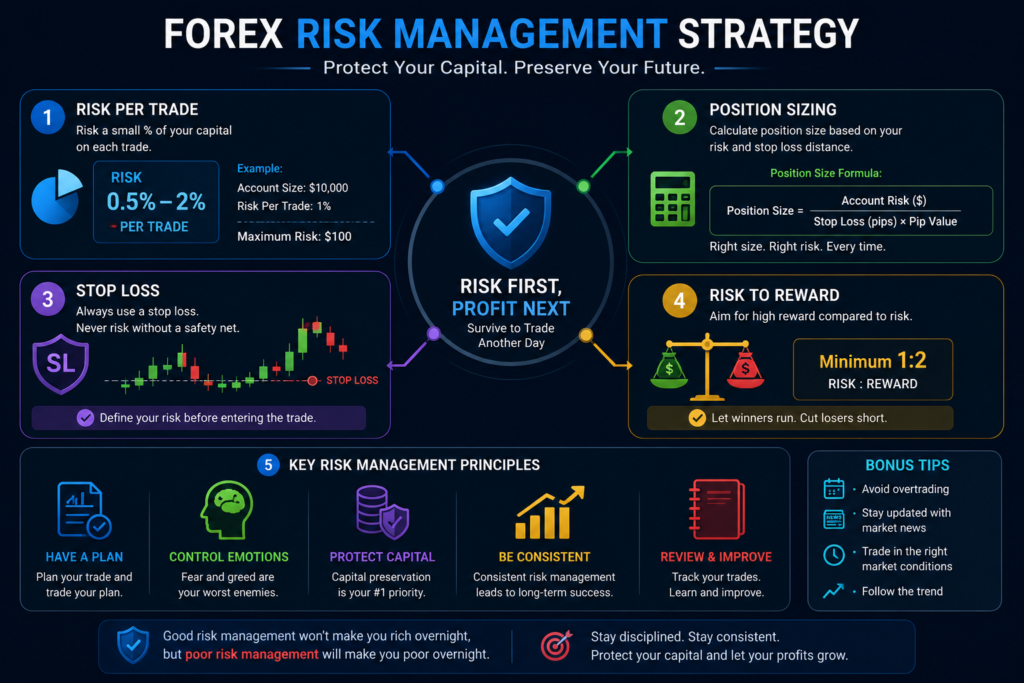
Risk management becomes essential here. Professional traders often use stop-loss orders, controlled position sizing, and low leverage ratios to protect their accounts from sudden market fluctuations.
Benefits of Using Leverage in Forex Trading
When used correctly, leverage in forex trading offers several advantages. It allows traders with limited capital to access larger market opportunities that would otherwise be unavailable. This increases flexibility and enables diversification across multiple currency pairs.
Leverage also improves capital efficiency. Instead of locking large amounts of money into a single trade, traders can distribute their funds across multiple positions. This helps balance risk and increase potential opportunities in the market.
However, these benefits only apply when leverage is used with discipline and a clear trading strategy.
Risks Associated with Forex Leverage
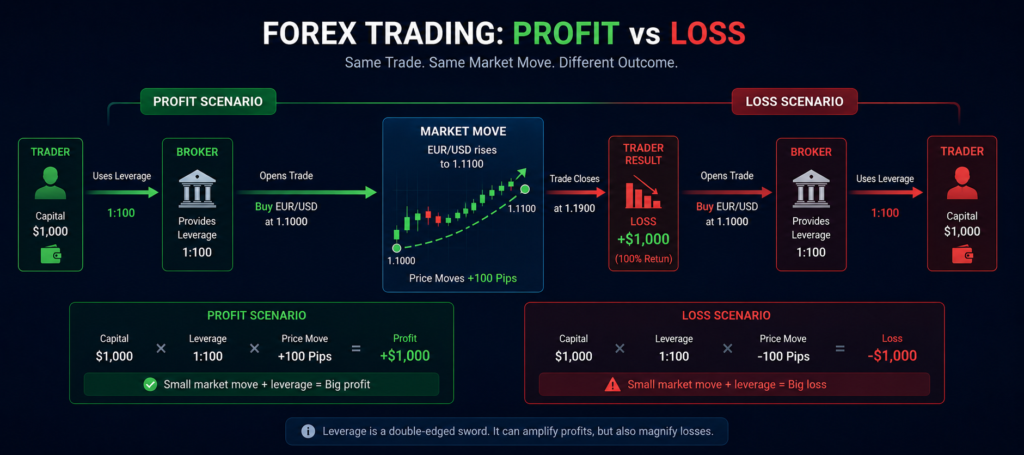
While leverage increases profit potential, it also increases risk exposure significantly. One of the most common risks is rapid capital depletion during volatile market conditions. A small price movement against your position can result in substantial losses.
Another major risk is emotional trading. Many beginners overuse leverage after a few successful trades, which often leads to overconfidence and poor decision-making. This is one of the leading causes of account blowouts in forex trading.
Therefore, understanding risk is just as important as understanding profit potential when learning how does leverage work in forex.
Safe Leverage Strategy for Beginners
For beginners, using conservative leverage is always recommended. Many professionals suggest starting with low ratios such as 1:10 or 1:30 until sufficient experience is gained.
A safe trading strategy focuses on risk per trade rather than maximizing leverage. Typically, risking only 1–2% of total account balance per trade helps protect capital over the long term.
Traders should also avoid using high leverage during major news events, as volatility can lead to unpredictable price swings. A disciplined approach to leverage ensures long-term sustainability in forex trading.
Common Mistakes Traders Make with Leverage
Many traders misunderstand leverage in forex trading and use it incorrectly. One of the most common mistakes is assuming that higher leverage guarantees higher profits. In reality, it only increases exposure.
Another frequent mistake is trading without stop-loss protection. Without a defined exit strategy, leveraged positions can quickly lead to significant losses. Overtrading is also common among beginners who try to take advantage of small market movements using high leverage.
Avoiding these mistakes is crucial for long-term success in forex trading.
FAQ’s
What is how does leverage work in forex for beginners?
It refers to how traders use borrowed capital from brokers to control larger trading positions with smaller deposits.What is leverage in forex trading and why is it important?
It is a mechanism that increases buying power in the forex market, allowing traders to open larger positions than their actual capital.Is high leverage in forex safe for new traders?
High leverage is not recommended for beginners because it increases both profit and loss potential significantly.How does margin relate to leverage in forex trading?
Margin is the required deposit to open a leveraged trade, while leverage determines how large that trade can be.Is swap important for short-term traders?
The safest approach is to use low leverage, apply stop-loss orders, and maintain strict risk management rules.Final Thoughts
Understanding how does leverage work in forex is essential for building a strong foundation in currency trading. Leverage allows traders to control larger positions with limited capital, making the forex market accessible even for small investors. However, it is not a tool for guaranteed profits; instead, it is a double-edged mechanism that amplifies both gains and losses.
Successful traders treat leverage in forex trading as a strategic tool rather than a shortcut to wealth. They focus on risk management, disciplined execution, and consistent position sizing instead of relying on high leverage. When used responsibly, leverage can significantly enhance trading efficiency and market opportunities. But when misused, it can quickly lead to financial loss and emotional stress.
In conclusion, mastering leverage is not about using the highest ratio available it is about understanding market behavior, controlling risk exposure, and applying a sustainable trading strategy that supports long-term growth in the forex market.