
What is Swap in Forex? Complete Professional Guide
Introduction
In forex trading, every position you hold carries a hidden cost or benefit known as what is swap in forex. Many traders focus only on entry and exit points, but professional traders understand that overnight holding costs can significantly affect overall profitability.
This cost is directly linked to forex rollover rates, which determine whether a trader pays or earns interest for holding a position overnight. Swap is not just a technical fee; it is a reflection of global interest rate differences between currencies.
If you ignore swap, your trading strategy may look profitable on paper but still result in reduced net gains in real trading conditions. That is why understanding swap is essential for both beginners and advanced traders.
What is Swap in Forex Trading?
Swap in forex trading refers to the interest adjustment applied when a trading position is held overnight. This adjustment is based on the difference in interest rates between the two currencies involved in a currency pair.
Every forex trade involves buying one currency and selling another. Since currencies have different interest rates set by central banks, holding a position overnight creates an interest imbalance. Brokers adjust this difference in the form of swap.
In simple terms, swap can either be a cost or a gain:
- You may pay a charge if you hold a low-yield currency against a high-yield currency
- You may earn interest if the position favors the interest rate differential
This makes swap a dynamic and important factor in long-term forex trading decisions.
How Forex Rollover Rates Work
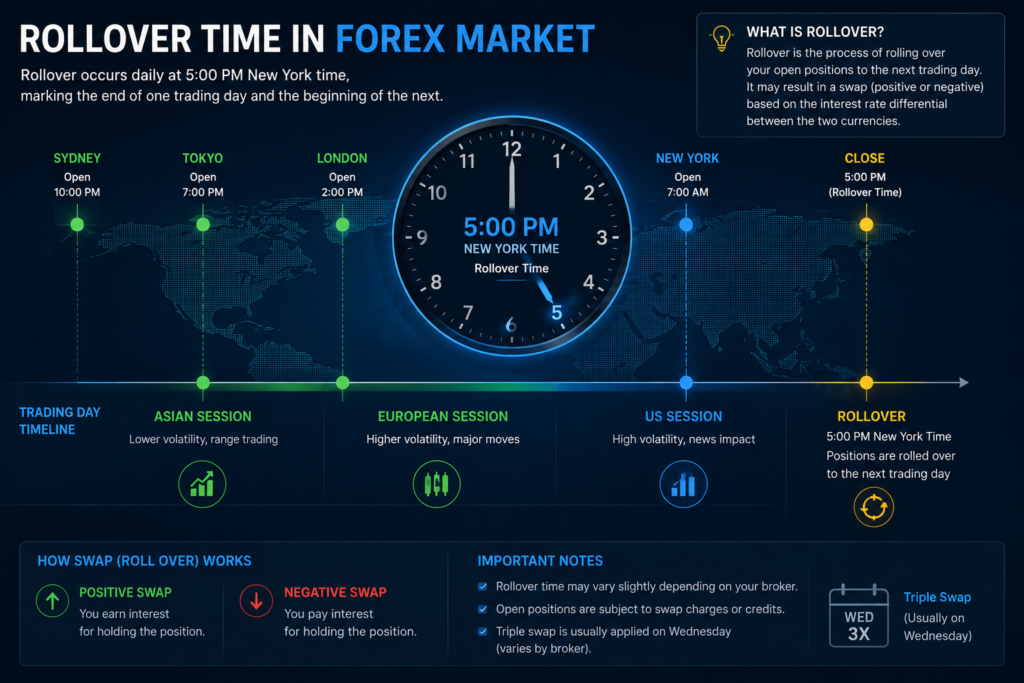
The concept of forex rollover rates is directly tied to swap. When a trading day ends in the forex market, positions are automatically rolled over to the next trading day if they remain open.
This rollover typically occurs at 5 PM New York time, which is considered the global forex settlement time.
At this point:
- Open positions are recalculated
- Interest differences are applied
- Swap is either added or deducted
This mechanism ensures that forex trading reflects real-world financial conditions where currencies carry interest value over time.
How Swap is Calculated in Forex
The calculation of swap is based on several factors, including lot size, interest rate difference, and broker policy. While traders do not manually calculate it every time, understanding the logic behind it helps in better risk management.
The swap amount is influenced mainly by:
- Interest rate difference between currencies
- Position size (lot size)
- Trade direction (buy or sell)
- Broker markup or fees
In most trading platforms, swap is automatically calculated and displayed under the contract specifications. However, traders who hold positions for multiple days must pay close attention to how compounding swap charges affect their profits over time.
Positive Swap vs Negative Swap
Swap is not always a cost. In some cases, traders can actually earn money by holding positions overnight.
A positive swap occurs when the trader earns interest due to favorable rate differences between currencies. This usually happens in carry trade strategies where high-interest currencies are bought against low-interest currencies.
A negative swap, on the other hand, reduces trading profit because the trader pays interest to hold the position. Over time, repeated negative swaps can significantly reduce overall returns, especially in swing or long-term trading.
Understanding this difference is critical because it helps traders decide which currency pairs are more suitable for their strategy.
Real Impact of Swap on Trading Profit
Swap may look small on a daily basis, but its long-term impact is often underestimated. Traders who hold positions for several days or weeks may experience noticeable profit erosion due to accumulated swap charges.
For example, even if a trade moves in the expected direction, repeated negative swap deductions can reduce net profit. This is why many professional traders always calculate holding costs before entering long-term positions.
Swap also influences strategy selection. Day traders are less affected, while swing traders and position traders must carefully manage swap exposure.
Swap-Free Forex Accounts (Islamic Trading Accounts)
Many brokers offer swap-free forex accounts, also known as Islamic accounts. These accounts are designed for traders who cannot pay or receive interest due to religious principles.
Instead of swap, brokers may apply:
- Fixed administrative fees
- Wider spreads in some cases
- Conditional holding restrictions
While these accounts remove traditional swap charges, traders should still read broker terms carefully because cost structures may vary.

Broker Swap Comparison (Conceptual Overview)
Different brokers offer different swap rates depending on liquidity providers and internal policies. Some brokers offer lower swap charges on major currency pairs, while others may have higher rollover costs.
This variation makes broker selection an important part of managing long-term trading costs.
Why Swap Matters in Forex Strategy
Swap plays a crucial role in shaping trading decisions. It is not just a background fee but a factor that can influence strategy performance.
For instance, carry trade strategies depend entirely on earning positive swap over time. Similarly, avoiding high negative swap pairs can help protect profits in swing trading.
Professional traders always analyze swap conditions before holding positions overnight because it directly affects risk-to-reward outcomes.
FAQ’s
What is swap in forex trading?
What is swap in forex trading refers to the interest charged or earned when a trading position is held overnight. It is based on the interest rate difference between two currencies.How do forex rollover rates affect trading?
The forex drawdown meaning describes how much a trader’s account has dropped from its peak due to losing trades, showing overall risk level of a trading strategy.Why do traders pay swap fees?
Traders pay swap fees because forex involves borrowing one currency to buy another, and interest rate differences must be adjusted.Can swap be avoided in forex trading?
Yes, swap can be avoided by closing positions before rollover time or using swap-free forex accounts offered by brokers.Is swap important for short-term traders?
Short-term traders are less affected, but swap still matters if positions are held overnight even for a few days.Final Thoughts
Understanding what is swap in forex is essential for anyone serious about trading in the global currency market. Swap is not just a minor fee; it is a core component of trading economics that reflects real-world interest rate differences between currencies. Whether you are a beginner or an experienced trader, ignoring swap can lead to unexpected costs that reduce your overall profitability.
The role of forex rollover rates becomes even more important for swing traders and position traders who hold trades overnight or for multiple days. Even small swap charges can accumulate and significantly impact long-term performance. On the other hand, in some cases, traders can benefit from positive swap conditions, turning overnight holding into an additional income stream.
By understanding swap calculation, rollover timing, and swap-free account options, traders can make more informed decisions and optimize their strategies. Ultimately, successful trading is not only about predicting market direction but also about managing hidden costs like swap efficiently. Mastering this concept gives traders a strong advantage in building sustainable and profitable forex strategies over time.