
The rise of proprietary trading firms has transformed how skilled but undercapitalized traders reach the markets, and few names come up as often as Apex Trader Funding. Before you spend money on an evaluation, you deserve a clear-eyed assessment of how the firm actually works, whether it genuinely pays its traders, and what its rules really demand of you. This apex trader funding review breaks down the one-step evaluation, the trailing drawdown, the payout structure, and the legitimacy question, then explains exactly which kind of trader the firm suits. By the end, you will be able to decide with confidence rather than guesswork.
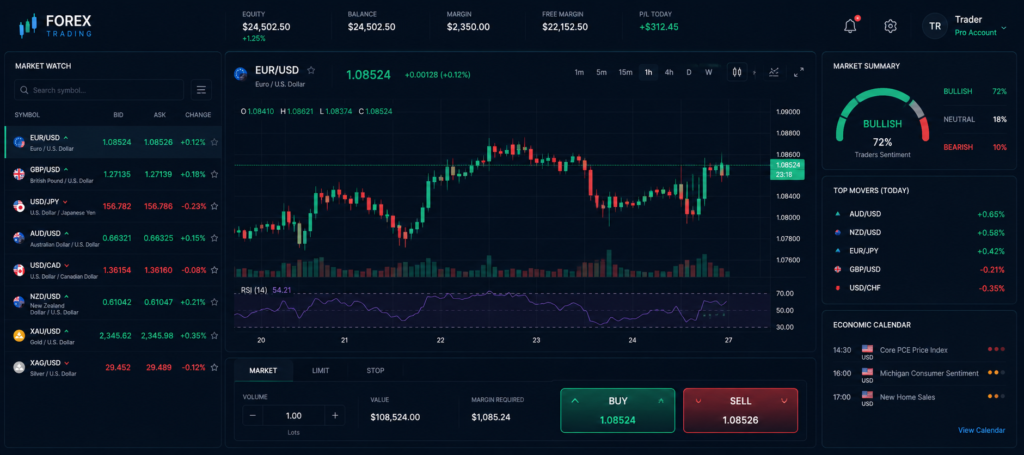
Fig 1.1 Apex Trader Funding review trading dashboard
Apex Trader Funding Review: The Quick Verdict
This apex trader funding review examines one of the most popular futures-focused proprietary trading firms in the world today. The premise is straightforward and genuinely appealing: rather than risking a large amount of your own capital, you prove your trading ability on an evaluation account, and once you pass, you trade the firm’s money and keep the lion’s share of any profits you generate. For a skilled futures trader who simply lacks a five- or six-figure account, this model can be transformative.
Apex has earned a reputation as an established, active, and trader-friendly name in the futures prop space. It is widely known for running frequent discounts that dramatically lower the cost of entry, for keeping its evaluation refreshingly simple compared with the multi-step gauntlets some rivals impose, and for supporting a large, vocal community of funded traders who share screenshots of their accounts and payouts online. That visible community is part of why the firm inspires confidence among newcomers researching their first funded account.
Yet a review that only praised the firm would do you a disservice. The evaluation comes with specific rules, the trailing drawdown quietly ends more accounts than any other single factor, and the monthly subscription continues to cost you money for as long as you remain in the evaluation phase. Understanding these realities matters just as much as understanding the benefits, and the sections that follow walk through both sides honestly so you can reach your own conclusion rather than relying on marketing copy.
Is Apex Trader Funding Legit?
The first and most important question almost every prospective trader asks is simple: is apex trader funding legit? Based on its multiple years of continuous operation, its large and growing community of funded traders, and the sheer volume of publicly shared payout screenshots, Apex is generally regarded as a legitimate firm rather than a scam. That conclusion is not based on the firm’s own promises but on the observable behaviour of the people who actually trade with it.
Legitimacy in the proprietary trading industry ultimately rests on two pillars, and Apex satisfies both reasonably well. The first is transparency: the firm publishes its rules, its profit split, and its account specifications openly, so there are few hidden surprises for a trader who takes the time to read carefully. The second, and far more important, is whether the firm actually pays the traders it funds. A prop firm that takes evaluation fees but quietly blocks withdrawals is worthless regardless of how attractive its marketing looks, and the long trail of documented Apex payouts is the strongest available evidence that this is not what is happening here.
It is essential, however, to separate the idea of legitimacy from the idea of ease. A firm can be entirely honest and still see most of its evaluation candidates fail, and that is exactly the situation at Apex and across the industry. You pay for the evaluation, and many traders do not pass on their first attempt. This is not because the rules are rigged against them but because trading is genuinely difficult and most participants lack the discipline that consistent profitability requires. If you approach the evaluation as a serious test of skill rather than a lottery ticket, you will judge the firm far more accurately, and you will also dramatically improve your own odds of success.
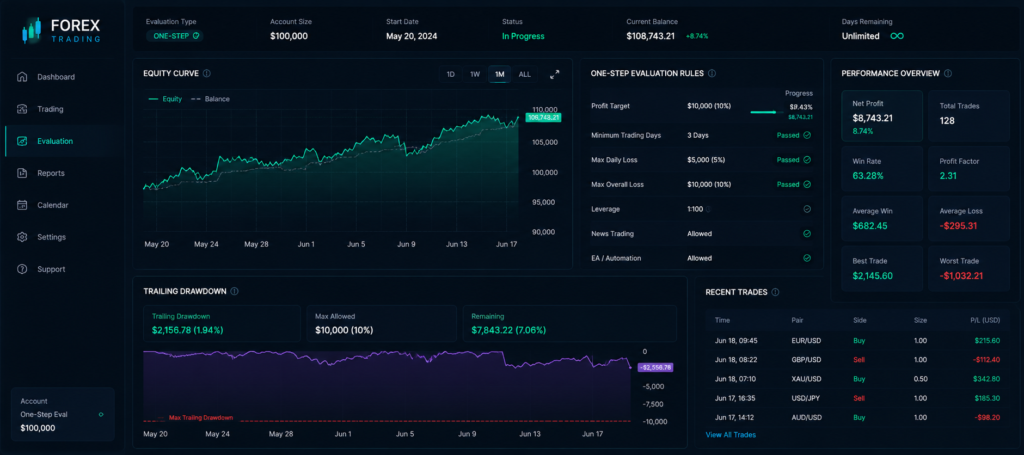
Fig 1.2 Apex trader funding one-step evaluation and trailing drawdown infographic
How the Apex Evaluation Works
Apex uses a one-step evaluation for its futures accounts, and that simplicity is one of the firm’s most attractive features. Where some competitors force you through two or three separate phases, each with its own targets and time pressures, Apex asks you to do one thing: reach a defined profit target while never violating the trailing threshold drawdown. On many of its account configurations there are no minimum profit days required either, which means a focused, disciplined trader can qualify in a relatively short span of time rather than grinding through weeks of mandatory activity.
The firm offers a range of account sizes, from modest starter accounts to large ones, and each size carries its own profit target, its own drawdown allowance, and its own limit on the number of contracts you can trade at once. Choosing the right size matters, because a larger account is not automatically better; it simply allows more size, which can be dangerous if your risk management is not yet rock solid.
The single rule that ends more Apex accounts than any other is the trailing threshold drawdown, and it deserves careful explanation. Unlike a static drawdown that stays fixed at your starting balance, a trailing drawdown follows your unrealized profits higher as a trade moves in your favour. If you are up several hundred dollars on an open position and then price reverses, your effective stop-out level may have climbed with that peak, which means a trade that briefly looked like a winner can end your account if you give too much of it back. Understanding this mechanic before you place a single trade is the difference between a smooth evaluation and an avoidable, frustrating breach.
Once you clear the evaluation, you graduate to a funded account and can begin earning real payouts. The table below summarizes the typical structure traders encounter, though the exact figures shift with promotions and account types.
| Element | Typical Apex Approach |
|---|---|
| Evaluation | One-step profit target |
| Drawdown | Trailing threshold |
| Markets | Futures (via Tradovate, Rithmic, etc.) |
| Profit split | High share to the trader |
| Fees | Monthly evaluation subscription |
Because these numbers genuinely do change with discounts and account tiers, the smartest move any prospective trader can make is to confirm the current figures directly on the official site before buying, and to read the rule set slowly enough to understand it rather than skimming it the way most people skim a terms-and-conditions page.
Apex Trader Funding Payout Explained
For most traders, the entire point of the journey is the payout, and the apex trader funding payout is a major reason the firm has attracted such a large following. Once you are funded, you keep a high share of the profits you generate, with the firm retaining a smaller cut as compensation for providing the capital and the trading infrastructure. The headline split is frequently cited as around ninety percent in the trader’s favour once initial thresholds are met, which is competitive with the best in the industry.
What reassures most prospective traders is not the split itself but the firm’s well-documented history of actually paying. Payout requests follow a defined schedule with minimum thresholds and a handful of safety rules that apply during the early stages of a funded account, and Apex publishes a large and continuous stream of payout proof to back up its claims. This visible track record matters enormously, because the proprietary trading model only makes sense for a trader if the firm reliably honours the money its funded accounts produce. A generous split on paper means nothing if the cash never reaches your bank account, and the weight of public evidence suggests that, for Apex, it generally does.
That said, you should always treat any specific figure you read in an older review as a starting point for your own due diligence rather than as a binding promise. Payout schedules, minimum amounts, and the precise rules around your first few withdrawals are periodically updated, so confirm the current terms directly with the firm before you build your expectations around them. A few minutes of verification can save you a great deal of confusion later.
What Top Traders and Research Say About Prop Success
It is tempting to believe that passing an evaluation is about finding a magical setup or the perfect indicator, but the deeper truth is that it is overwhelmingly a test of psychology and discipline. In his classic book Trading in the Zone, the trading psychologist Mark Douglas argues that lasting consistency comes not from predicting the market but from adopting a probabilistic mindset and executing a defined plan flawlessly, trade after trade, without letting emotion hijack the process. That lesson maps almost perfectly onto Apex’s trailing drawdown, a rule that quietly rewards the composed and punishes the impatient.
Academic research points in exactly the same direction. The widely cited study “Trading Is Hazardous to Your Wealth,” by Brad Barber and Terrance Odean, examined the records of thousands of retail traders and found that the most active among them significantly underperformed, largely because their frenetic overtrading generated costs and poor decisions that steadily eroded their returns. In the context of a prop evaluation, overtrading is even more destructive, because it does not merely shrink your profit; it eats into the drawdown and ends the account outright. The research effectively confirms what experienced traders already know: doing less, but doing it better, is the genuine edge.
The legendary trader Paul Tudor Jones is often quoted as advising, “Don’t focus on making money; focus on protecting what you have.” That single sentence captures the mindset that converts an Apex evaluation from a reckless gamble into a repeatable, fundable skill. Protect your capital first, let the profits follow, and the trailing drawdown stops being a trap and becomes simply another rule you respect.
The Pros, the Cons, and Who Should Join
Weighing Apex honestly means acknowledging both its genuine strengths and its real limitations. On the positive side, the firm offers a refreshingly simple one-step evaluation, a generous profit split, and frequent discounts that make the cost of attempting an account far more accessible than the headline price suggests. Layered on top of all of that is a strong, public track record of payouts, which is the single most important quality any prop firm can have and the one that many lesser competitors lack.
The drawbacks are equally real and worth taking seriously. The trailing drawdown is unforgiving to anyone who trades without discipline, and it will end your account without sympathy if you give back unrealized gains. The monthly subscription fee continues to accumulate for as long as you remain in the evaluation phase, so a trader who takes many months and several resets to pass can spend a meaningful amount before ever seeing a funded account. And of course futures trading itself carries real risk and a steep learning curve that no prop firm can shortcut on your behalf.
The practical conclusion is that Apex is an excellent fit for a particular kind of trader and a poor fit for another. It suits the disciplined futures trader who already has a tested approach and simply lacks the capital to trade meaningful size; for that person, the funded model can amplify earnings well beyond what a small personal account would ever allow. It is far less suitable for raw beginners or impulsive traders, who tend to be punished by the evaluation cost and the drawdown long before they develop the consistency the model demands. If you fall into the latter group, the smartest path is to build reliable results on a simulator, trade smaller than you think you should, set a self-imposed daily loss limit stricter than the firm’s, and only attempt the paid evaluation once your numbers genuinely justify the expense.
Frequently Asked Questions
1. Is Apex Trader Funding legit or a scam?
Based on its years of operation, large funded community, and abundant public payout proof, the answer to is apex trader funding legit is yes it is widely regarded as a legitimate futures prop firm rather than a scam. Legitimacy comes from transparent rules and the firm’s documented habit of actually paying the traders it funds. It is not a scam, but it is also not easy, and that distinction matters. Passing requires genuine futures-trading skill and discipline, and the great majority of failures stem from impatience and overtrading rather than from any dishonesty on the firm’s part.
2. How does the Apex Trader Funding payout work?
The apex trader funding payout gives funded traders a high share of their profits, frequently cited around ninety percent after initial thresholds, while the firm keeps a smaller cut for providing the capital. Payouts follow a set schedule with minimum amounts and a few early safety rules, and Apex publishes a steady stream of payout proof to support its reliability. Because the precise schedule and minimums are updated from time to time, always confirm the current payout terms on the official site rather than relying on figures from older reviews.
3. How hard is the Apex evaluation?
The Apex evaluation is a one-step profit target governed by a trailing threshold drawdown, and that drawdown is the hardest part by a wide margin. Because it follows your unrealized profits higher, it punishes any trader who lets a winning position turn into a loser. With a tested strategy, deliberately small position sizes, and strict risk management, a consistent futures trader can pass without enormous difficulty. The people who struggle are almost always rushing, oversizing, or overtrading rather than being defeated by anything unfair in the rules themselves.
4. What does it cost to use Apex Trader Funding?
Apex charges a monthly subscription for the evaluation, with the price scaling according to the account size you select, and the firm runs frequent discounts that can lower the entry cost substantially. There may also be activation or data fees associated with a funded account. Because pricing and promotions change so often, you should check the official site for the current numbers. It is wise to factor the recurring monthly fee into your decision, particularly if you expect to spend several months in the evaluation phase before passing.
5. Which markets and platforms does Apex support?
Apex is a futures-focused proprietary trading firm, which means you trade futures contracts rather than spot forex. It supports popular futures data feeds and platforms such as Tradovate and Rithmic, along with compatible front-ends like NinjaTrader. This focus makes the firm a natural home for traders who prefer futures markets such as equity indices, energy, and metals. If your entire approach is built around spot forex, a forex-focused prop firm will probably suit you better than Apex.
6. Who is Apex Trader Funding best for?
Apex is best suited to disciplined futures traders who already have a tested, proven approach but simply lack the capital to trade meaningful size on their own. For that trader, respecting the trailing drawdown and following the rules unlocks earnings far beyond what a small personal account could produce. It is a poor fit for beginners and impulsive traders who have not yet demonstrated consistency, because the evaluation cost and the drawdown tend to punish them quickly. Building reliable simulator results first is the smartest possible preparation.
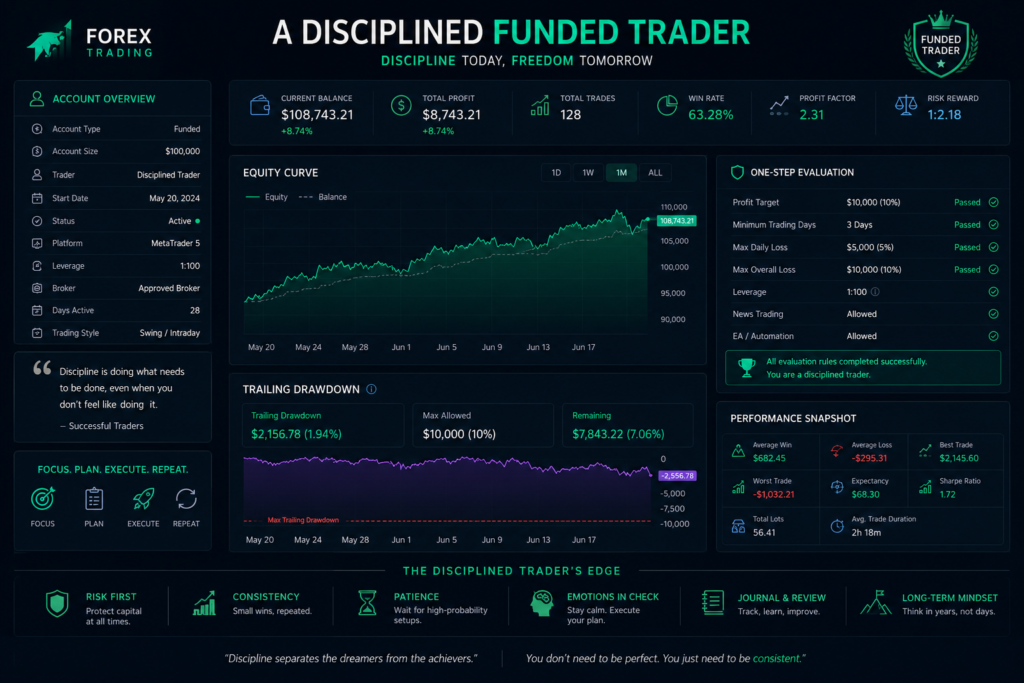
Fig 1.3 Disciplined funded futures trader managing risk
Final Thoughts
This apex trader funding review lands on a balanced and ultimately positive verdict. Apex is one of the most established and active futures proprietary trading firms operating in 2026, distinguished by a simple one-step evaluation, a generous profit split, frequent discounts, and a strong, well-documented record of paying the traders it funds. For anyone still wondering whether the firm is trustworthy, the weight of evidence — years of continuous operation, a large and vocal funded community, and an abundance of payout proof — points firmly toward legitimacy, even though legitimacy should never be mistaken for ease. The trailing drawdown remains genuinely unforgiving, the monthly fees accumulate while you stay in the evaluation phase, and futures trading itself carries the same real risk it always has. The lessons drawn from Mark Douglas’s Trading in the Zone and from the Barber and Odean research are precisely the lessons Apex’s rules quietly enforce: protect your capital, trade less but better, and let consistency compound over time. That combination makes Apex an excellent choice for prepared, risk-conscious futures traders who lack capital, and a poor choice for beginners chasing quick riches. Understand the payout schedule, treat the evaluation as a serious test of skill rather than a gamble, verify the latest rules and fees on the official site, size down so you can survive the drawdown, and build consistent results before you pay. Approached with that kind of professionalism, Apex can become a genuinely powerful springboard for scaling a futures trading career.
Want to build the discipline and strategy that pass prop firm evaluations? Visit forexmarkettrendss.com for practical guides and risk-management insights to trade like a funded professional.
Related guides: