
Introduction
If you have ever scrolled through trading groups looking for an edge, you have probably seen channels promising free forex signals telegram users can copy in seconds. The appeal is obvious: real-time trade ideas, delivered straight to your phone, at no upfront cost. Yet the reality is far more nuanced than the marketing suggests. Some channels offer genuine value and transparent track records, while others exist only to lure deposits toward shady brokers. In this guide, we break down exactly what forex signals are, how Telegram channels operate, and what separates a trustworthy source from a costly trap. You will learn how to read a proper signal, verify a provider, weigh free against paid options, and avoid the red flags that catch new traders off guard. Most importantly, you will see why signals should support your own analysis, never replace it.
What Forex Signals Actually Are
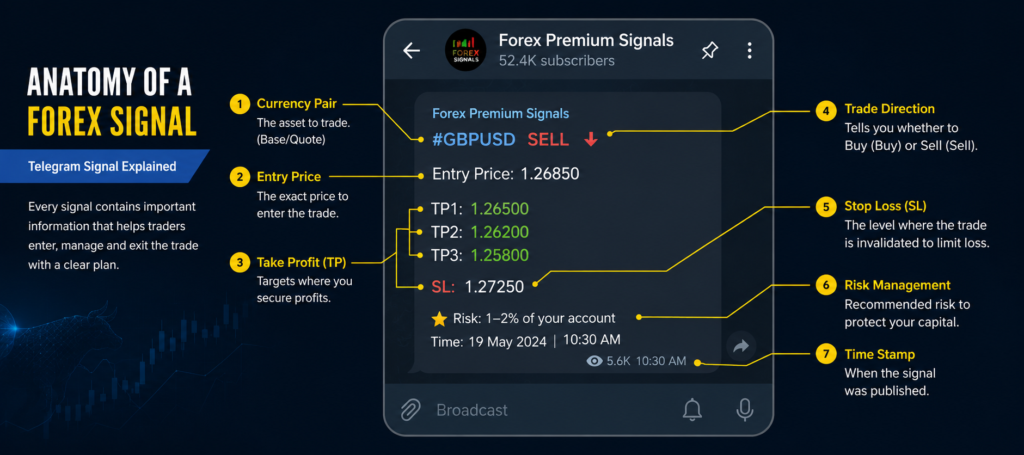
A forex signal is a trade recommendation. At its core, it tells you which currency pair to trade, whether to buy or sell, where to enter, where to place your stop-loss, and where to take profit. Think of it as a structured suggestion generated either by a human analyst, an automated system, or a blend of both. The idea is to compress hours of chart study into a single actionable message you can act on quickly.
When people search for telegram free forex signals, they are usually looking for these recommendations delivered without a subscription fee. The signal itself is platform-agnostic. You could receive the same information by email, SMS, or a trading app. Telegram simply happens to be the channel of choice because it is fast, free, mobile-friendly, and supports large broadcast groups.
It helps to understand what a signal is not. It is not a guarantee. It is not insider information. And it is not a substitute for understanding why a trade makes sense. A responsible signal is one input among many. The trader who blindly copies every alert without context is gambling, not trading. The trader who treats a signal as a second opinion, cross-checks it against their own read of the market, and sizes the position sensibly is the one who tends to last.
Signals come in different flavors. Scalping signals target small, rapid moves and may fire several times an hour. Intraday signals open and close within a single session. Swing signals hold for days, riding larger trends. Knowing which style a channel offers matters, because a scalping alert demands constant attention, while a swing setup suits someone who checks charts twice a day.
How Telegram Signal Channels Work
Telegram has become the default home for trading communities, and for good reason. Channels can broadcast to unlimited members, messages arrive instantly, and the format supports images, so providers can attach annotated charts alongside their calls. A typical setup involves a public channel that posts free signals and a private or “VIP” channel that charges a fee for higher-frequency or supposedly higher-accuracy alerts.
When you join a channel offering forex signal telegram alerts, you will usually receive a short message the moment the provider spots a setup. It might read something like: “BUY EURUSD @ 1.0850, SL 1.0820, TP1 1.0890, TP2 1.0930.” You then decide whether to mirror that trade in your own account. Some channels pair their calls with a brief rationale, explaining the technical or fundamental reasoning. Others simply fire the numbers and move on.
Many providers now lean on bots to automate delivery, track performance, and even push trades directly to connected accounts through copy-trading integrations. While convenient, automation introduces its own risks. A bot that auto-executes trades can drain an account quickly during a volatile session if risk controls are weak. Always understand exactly what you are authorizing before you connect any account.
It is worth knowing how these channels fund themselves. Free channels are rarely charities. Most monetize through broker affiliate links, earning a commission when you sign up and trade through their partner. Others use the free tier as a funnel toward a paid VIP product. Neither model is inherently dishonest, but it does shape incentives. A channel paid per lot you trade benefits when you trade often, whether or not those trades are wise. Keep that tension in mind whenever a provider nudges you toward a specific broker or higher volume.
Anatomy of a Quality Forex Signal
Not all signals are created equal. A vague “EURUSD going up, buy now” message gives you nothing to manage risk with. A complete, professional signal contains every element you need to plan and control the trade before you click. The table below outlines what a well-formed signal should include and why each piece matters.
| Component | What It Means | Why It Matters |
|---|---|---|
| Currency pair | The instrument, e.g. EUR/USD or XAU/USD | Tells you exactly what to trade |
| Direction | Buy (long) or Sell (short) | Sets the basic trade thesis |
| Entry price | The level to open the position | Defines your starting point and exposure |
| Stop-loss (SL) | The level that closes a losing trade | Caps your downside on every trade |
| Take-profit (TP) | One or more profit targets | Locks in gains and defines reward |
| Risk-reward ratio | Reward compared to risk, e.g. 1:2 | Shows whether the math favors you |
| Rationale | The reason behind the call | Lets you judge and learn from the setup |
| Timestamp | When the signal was issued | Confirms the entry is still valid |
The single most important field is the stop-loss. A signal without one is a warning sign, not an opportunity. Professional traders define their maximum loss before they ever think about profit, because survival comes first. The take-profit targets, often staggered into TP1, TP2, and TP3, let you scale out and bank partial gains as a move develops.
Equally telling is the risk-reward ratio. A channel that consistently offers setups risking 50 pips to make 60 pips is fighting an uphill battle, because even a respectable win rate may not produce net profit after spreads and the occasional slippage. Quality providers aim for asymmetry, where winners are meaningfully larger than losers. When you evaluate any source of telegram free forex signals, the presence of a clear stop-loss and a sensible risk-reward ratio tells you more about its credibility than any flashy win-rate claim.
How to Evaluate and Verify a Signal Channel
The hardest part of using signals is not finding a channel. There are thousands. The hard part is separating the credible few from the noisy majority. Verification takes patience, and the single best tool you have is time. Before you risk a cent, follow the channel for several weeks and log its calls yourself.
Start with the track record. A trustworthy provider publishes results transparently, including losing trades. Be deeply skeptical of any channel that shows only winners. Markets do not work that way, and even the best discretionary traders lose a meaningful share of their trades. Honest channels often post a monthly recap with both wins and losses, and they do not quietly delete the calls that went wrong. Screenshot deletion is a classic manipulation tactic, so watch for it.
Next, paper-trade the signals. Open a demo account, mirror every call exactly as posted, and record the outcome against the channel’s own claims. This does two things. It reveals whether the published results match reality, and it teaches you how the channel behaves under pressure, such as during news spikes or thin liquidity. If the demo results diverge sharply from the advertised performance, you have your answer.
Pay attention to communication style. Credible providers explain their reasoning and respond to questions without hostility. They acknowledge uncertainty and never promise specific returns. A provider who reacts to a fair question with insults or bans is hiding something. Finally, consider transparency around the team. Are real analysts named? Is there a verifiable history? Anonymity is not automatically disqualifying, but it does raise the bar for the proof you should demand before trusting your money to strangers.
Free vs Paid Forex Signals
The free-versus-paid debate has no universal answer, because it depends on what you actually need. Free channels lower the barrier to entry and let you sample a provider’s style at zero financial risk. That is genuinely useful for learning and for comparison shopping. The trade-off is that free tiers are often slower, less frequent, or designed primarily to funnel you toward a broker or a paid upgrade.
Paid signals, in theory, come with more accountability. A provider charging a subscription has a reputation to protect and a customer who can cancel, which can align incentives toward quality. In practice, a price tag guarantees nothing. Plenty of expensive channels deliver mediocre or fabricated results, and plenty of free ones offer thoughtful, well-reasoned calls. Cost is a weak proxy for quality. The real signal of quality is transparency and a verifiable record over time.
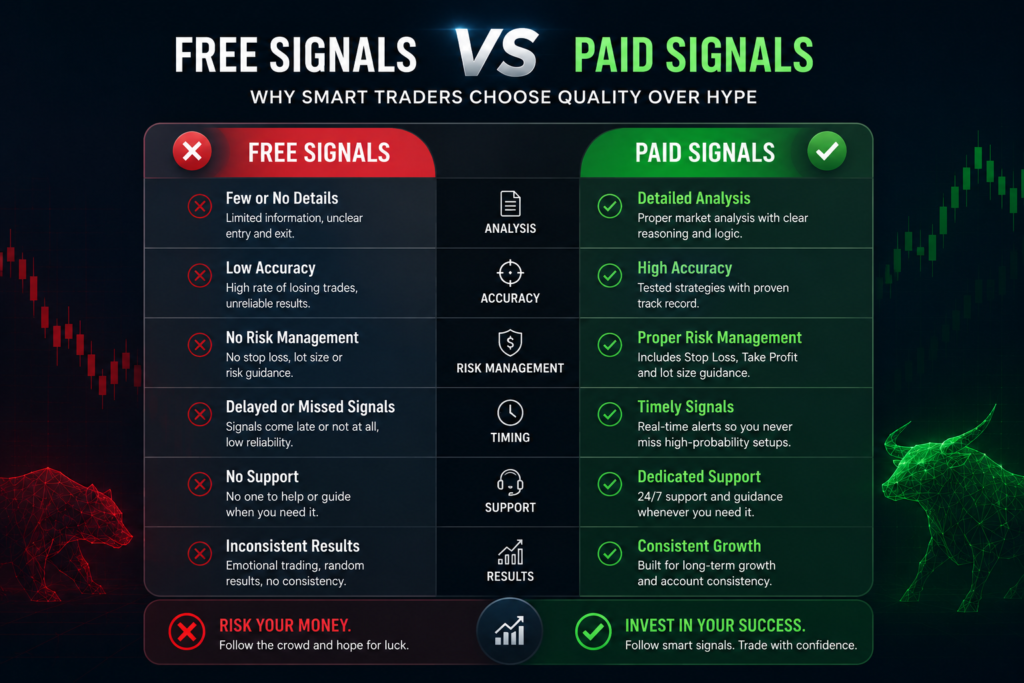
Here is the honest framing. If you are still learning, a reputable free channel is a sensible starting point. Use it to study how setups are structured and to practice on a demo account. As your understanding deepens, you may find that the best “signal” is your own analysis, informed by what you have learned from watching others. Many seasoned traders eventually stop paying for signals entirely, because they have internalized the process. The goal of any forex signal telegram subscription should be to make itself obsolete by teaching you to think independently.
Red Flags and Scams to Avoid
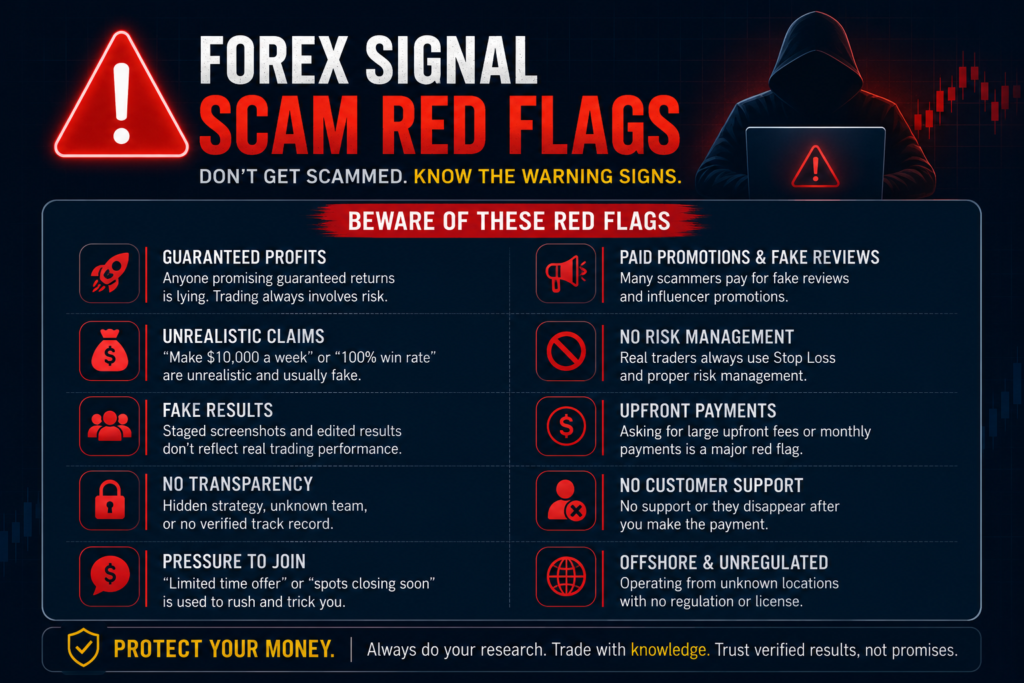
The forex signal space attracts scammers because the promise of easy money is powerful and the barrier to launching a channel is nonexistent. Anyone with a phone can post screenshots and call themselves an expert. Protecting yourself starts with knowing the warning signs, and most scams share a recognizable pattern.
The biggest red flag is guaranteed or unrealistic returns. No legitimate provider can promise “90% accuracy” or “double your account this month.” Markets are uncertain by nature, and anyone who claims otherwise is either lying or deluded. Be just as wary of pressure tactics: countdown timers, “only 5 VIP spots left,” and aggressive demands to deposit immediately are designed to short-circuit your judgment.
Below is a concise checklist of the most common warning signs to watch for. This is the one short list in this guide, because spotting these quickly can save you real money.
- Promises of guaranteed profits or specific account growth
- Pushing you toward one unregulated or obscure broker
- Hidden or deleted losing trades and edited screenshots
- No stop-loss on signals, or vague entries with no risk plan
- Urgency tactics, fake scarcity, and high-pressure upsells
- Requests to send funds directly to the “manager” for managed accounts
That last point deserves emphasis. A reputable signal provider never asks to manage your money or hold your funds. The moment someone requests a direct transfer to trade “on your behalf,” walk away. This is one of the most common ways traders lose entire balances. Likewise, treat fabricated testimonials and rented Lamborghini lifestyle content as the marketing theater it usually is. Real trading is patient, unglamorous, and full of losing trades. Anyone selling a fantasy is selling you, not teaching you.
Using Signals Responsibly With Your Own Analysis
The healthiest way to use signals is as a starting point, not a final answer. When an alert arrives, treat it as a hypothesis to test rather than an order to obey. Pull up the chart yourself. Does the setup line up with the broader trend? Is there a clear level supporting the entry? Is major news due that could blow through the stop? If the trade does not make sense to you after a quick check, you are under no obligation to take it. Skipping a signal is always a valid choice.
Risk management is where you exert real control. Regardless of how confident a channel sounds, decide your own position size based on your account and risk tolerance. A widely used guideline is to risk only a small percentage of your capital, often one or two percent, on any single trade. This means a string of losses, which is inevitable, will not threaten your ability to keep trading. The provider does not feel your losses. You do. So the final risk decision must always be yours.
Keep a trading journal. Record every signal you take, your reasoning, the outcome, and how you felt during the trade. Over time this journal becomes more valuable than any channel, because it reveals your own patterns, strengths, and weaknesses. It also lets you measure objectively whether a given source of signals actually improves your results or merely adds noise. Combining the convenience of free forex signals telegram delivery with disciplined personal analysis is how thoughtful traders extract value without surrendering control.
Finally, manage your expectations and your emotions. Signals will not eliminate losing trades, and chasing every alert leads to overtrading, which erodes accounts faster than almost anything else. Slow down. Take the setups you understand, pass on the ones you do not, and let consistency compound over months and years rather than days.
What Top Traders and Research Say
The wisdom of experienced traders and the findings of academic research point in the same direction: discipline and psychology matter more than any single trade tip. In his widely respected book Trading in the Zone, Mark Douglas argues that consistent results come from a trader’s mindset and probabilistic thinking, not from a magical entry method. His central insight is that the market offers an endless stream of uncertain outcomes, and the trader’s job is to manage risk across many trades rather than to be right on any one of them. That framing is the perfect antidote to signal dependency.
Academic research reinforces the danger of treating trading as a shortcut. In their well-known study “Trading Is Hazardous to Your Wealth,” published in the Journal of Finance, Brad Barber and Terrance Odean analyzed thousands of individual investor accounts and found that the most active traders earned the worst net returns, largely because frequent trading and overconfidence drove up costs and mistakes. The lesson translates directly to forex: chasing constant signals and overtrading tends to hurt, not help.
As trader Paul Tudor Jones reportedly put it, “The most important rule is to play great defense.” Capital preservation comes first. Signals can inform your offense, but your defense, your stop-losses, your position sizing, and your discipline, is what keeps you in the game long enough to improve.
Frequently Asked Questions (FAQs)
Are free forex signals telegram channels worth following?
They can be, but only with caution. The best free forex signals telegram channels offer transparent track records, clear stop-losses, and honest reasoning. Many free channels, however, exist mainly to push broker sign-ups or paid upgrades. Treat free signals as a learning tool, paper-trade them first, and never assume a free alert is a sure thing. The value comes from how you use them, not from the price.
How accurate are telegram free forex signals?
Accuracy varies wildly and is often exaggerated. Genuine providers post realistic win rates that include losing trades, while scams advertise impossible numbers like 95% accuracy. Remember that win rate alone means little without risk-reward context. A channel winning 50% of trades with strong reward-to-risk can be profitable, while one winning 80% with tiny targets may not be. Always verify claims with your own demo testing of any telegram free forex signals.
Is it safe to use a forex signal telegram bot for auto-trading?
It can be convenient but carries real risk. A forex signal telegram bot that auto-executes trades can move fast during volatile markets and drain an account if risk controls are weak. Before connecting any account, understand exactly what permissions you grant, set strict position limits, and test on a demo first. Never authorize automated trading you do not fully understand.
How do I spot a scam forex signal channel?
Look for guaranteed profit claims, hidden or deleted losing trades, pressure to deposit immediately, and requests to send funds directly to a manager. Legitimate providers never promise specific returns or ask to hold your money. They publish losses, explain their reasoning, and answer questions calmly. If a channel pushes one obscure broker hard, treat that as a major warning sign.
Should I rely only on signals or learn to trade myself?
You should aim to learn. Signals are best used as a second opinion that supports your own analysis, not as a replacement for understanding the market. The most durable traders eventually trust their own judgment, using signals only to spot ideas or confirm a view. Build your skills through study, journaling, and demo practice so you control your own outcomes.
Final Thoughts
Free forex signals delivered through Telegram have changed how everyday traders access trade ideas, putting real-time recommendations in everyone’s pocket at no upfront cost. That accessibility is genuinely valuable, but it comes with responsibility. The smartest approach is to treat signals as one input among many: study how quality signals are built, verify any channel through transparent track records and demo testing, stay alert to the red flags that mark scams, and always keep risk management and position sizing firmly in your own hands. Whether a channel is free or paid matters far less than whether it is honest and whether it makes you a more capable, independent trader over time. Use signals to learn, not to outsource your thinking, and let discipline rather than hype guide every decision you make.