
Introduction
High-frequency trading lives and dies by the millisecond, and the server behind your strategy decides whether you win or lose that race. The best forex vps for high-frequency trading in 2025 is not a marketing label — it is a precisely engineered stack of low-latency networking, high-clock CPUs, fast memory, and NVMe storage tuned to feed an execution engine without hesitation. This technical deep-dive explains exactly what HFT demands from infrastructure, why microseconds matter at the order-routing layer, and how to measure and minimize latency from ping to fill. You will learn how colocation near broker servers in LD4, NY4, and Equinix data centers compresses round-trip times, which hardware specs move the needle, how to tune the operating system and optimize MT4/MT5 expert advisors, and how to benchmark a server honestly. The goal is performance literacy, not advice — so you can read a spec sheet and know what is real.
What High-Frequency Trading Actually Demands From Infrastructure
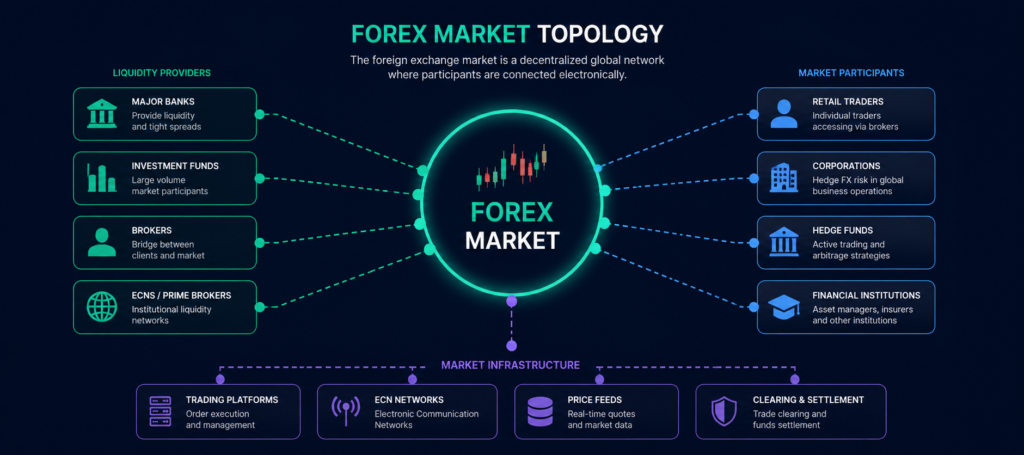
High-frequency trading compresses the entire decision-to-execution loop into a window measured in microseconds. The strategy reads market data, evaluates a signal, and dispatches an order before a human could blink. For that loop to function, every layer of the infrastructure must remove delay rather than add it. A retail desktop running over a residential connection introduces unpredictable jitter, packet loss, and routing detours that make consistent HFT impossible. A purpose-built server removes those variables.
The first demand is deterministic performance. HFT does not just need a fast server — it needs a server that performs the same way on every tick. Predictability matters as much as raw speed because variance in execution time corrupts backtested expectations. A strategy modeled on stable fills behaves unpredictably when latency spikes randomly. The best forex vps for high-frequency trading in 2025 therefore prioritizes consistent, low-variance round-trip times over headline benchmark numbers.
The second demand is proximity. Market data and order flow travel as electrical or optical signals, and those signals obey physics. The shorter the physical and network distance to the broker’s matching engine, the less time each round trip consumes. The third demand is isolation. Shared, oversold environments let noisy neighbors steal CPU cycles at the worst moment. Genuine HFT-grade hosting allocates dedicated resources so your execution engine never waits in a queue behind someone else’s workload.
Why Milliseconds — and Microseconds — Decide Outcomes
In slower trading styles, a few hundred milliseconds of delay rarely changes the result. In high-frequency trading, that same delay is catastrophic. When a price moves, dozens of participants compete to act on the same information. The order that arrives first gets the fill at the quoted price. Orders arriving later face slippage, partial fills, or rejection. Speed converts directly into edge.
Consider the mechanics of slippage. Your strategy sees a price, calculates an entry, and sends the order. During the time that order travels to the broker, the market continues to move. A 50-millisecond delay on a fast-moving pair can mean the difference between the price you wanted and a measurably worse one. Across thousands of trades, those fractions compound into a meaningful drag on profitability. Reducing latency is not vanity — it is risk reduction applied to execution quality.
Microseconds matter most at the network and software boundary. The journey from your strategy’s order instruction to the broker’s acknowledgment passes through the operating system network stack, the network interface card, switches, fiber, and finally the broker’s gateway. Each hop adds time. Shaving microseconds at each stage, then multiplying across heavy trade volume, separates a competitive setup from one that quietly bleeds performance. This is why the technical conversation around forex virtual private server trends 2025 centers on measurable, end-to-end latency rather than vague “fast servers” language.
How to Measure and Minimize Latency
You cannot optimize what you do not measure. Latency assessment starts with a simple ping to the broker’s server, which reveals base round-trip time on the network path. But ping alone is misleading — it measures ICMP echo, not actual order execution. The figure that matters is execution latency: the elapsed time from sending an order to receiving the broker’s confirmation. MT4 and MT5 platforms can surface this through scripts and broker-side reporting, and serious traders log it continuously rather than spot-checking.
Network hops are the next variable to inspect. A traceroute exposes every router between your server and the broker. Each additional hop introduces processing delay and a potential failure point. The fewer hops, the cleaner the path. When a server sits in the same data center as the broker’s matching engine, the path can collapse to a single switch, driving round-trip time toward sub-millisecond territory.
This is where colocation earns its reputation. Major brokers host their servers in tier-one financial data centers — LD4 in Slough near London, NY4 in Secaucus near New York, and the broader Equinix network that anchors much of global financial connectivity. Placing your VPS inside or adjacent to these facilities means your order travels meters of fiber rather than thousands of kilometers across the public internet. The table below summarizes how setup choice maps to realistic latency expectations.
| Setup Type | Typical Network Path | Realistic Round-Trip Latency | HFT Suitability |
|---|---|---|---|
| Home desktop, residential ISP | Public internet, many hops | 80-300 ms (high jitter) | Unsuitable |
| Generic cloud VPS, distant region | Public internet, several hops | 40-120 ms | Poor |
| Quality VPS, same region as broker | Optimized routing, few hops | 5-30 ms | Moderate |
| VPS in broker’s data center (e.g., LD4/NY4) | Cross-connect, minimal hops | 1-5 ms | Strong |
| Colocation with direct cross-connect | Single switch / direct fiber | Sub-millisecond | True HFT-grade |
Minimizing latency, then, follows a clear hierarchy: locate near the broker first, reduce hops second, and tune software third. Reversing that order wastes effort — no amount of OS tuning compensates for a server on the wrong continent.
Operating System Tuning and EA Optimization
A correctly specified server still underperforms if the operating system fights you. OS tuning removes hidden latency that default configurations leave in place. On Windows Server, that means disabling unnecessary background services, power-saving features that throttle CPU frequency, and automatic updates that reboot at unpredictable times. Power management is a frequent culprit — a CPU dropping to a lower clock to save energy during a quiet moment is exactly wrong for a workload that needs full frequency on demand. Setting the system to a high-performance profile keeps the processor ready.
Network stack tuning is the second lever. Adjusting buffer sizes, disabling features that batch packets to improve throughput at the cost of latency, and pinning network interrupts to specific cores can all trim microseconds. On Linux-based setups, traders disable CPU frequency scaling, isolate cores for the trading process, and tune the kernel network parameters for low-latency rather than high-throughput operation. The principle is consistent across platforms: configure for the lowest, most predictable response time, not the highest aggregate transfer rate.
Expert advisor optimization closes the loop on the software side. A poorly written EA can squander a perfectly tuned server. Efficient code avoids unnecessary indicator recalculations on every tick, minimizes file and terminal logging during active trading, and keeps the OnTick handler lean. Heavy computation belongs outside the critical execution path wherever possible. For MT4 and MT5, reducing chart objects, limiting the number of simultaneous symbols processed, and avoiding blocking calls inside the tick loop all preserve responsiveness. The server provides the capacity; disciplined EA design ensures the strategy actually uses it.
Hardware That Genuinely Moves the Needle
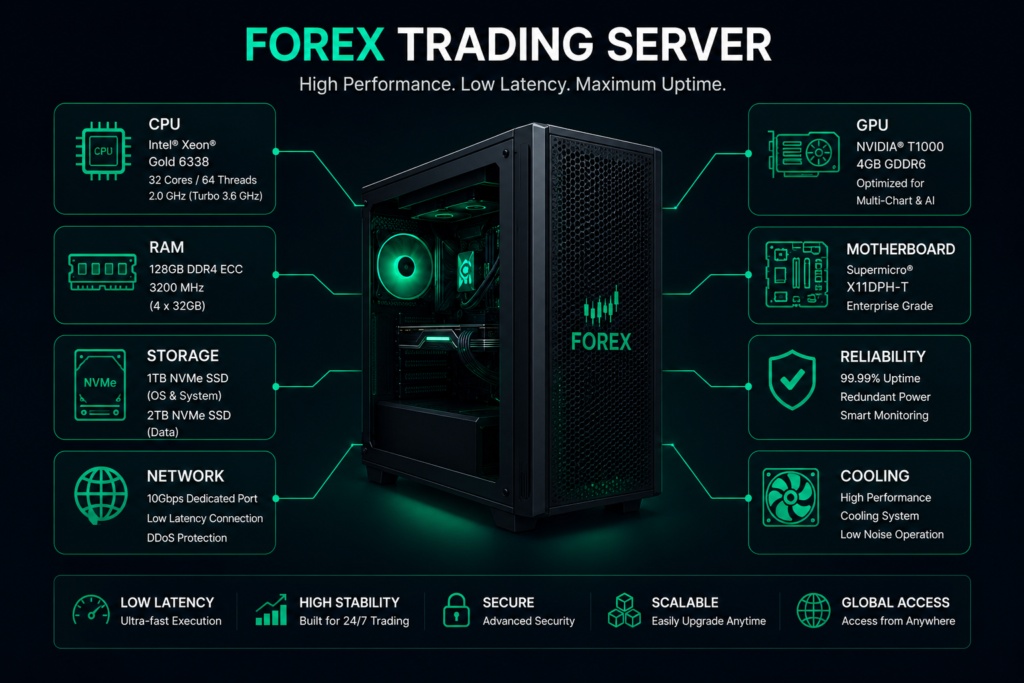
Hardware selection for HFT inverts the usual server logic. Most cloud workloads favor many cores at moderate clock speeds for parallel throughput. HFT favors the opposite. Trade logic is largely single-threaded and sequential — a signal must be evaluated and acted upon in order — so high per-core clock speed beats core count. A processor running at a high sustained frequency executes each instruction in the critical path faster, which is exactly what matters when a single decision must complete before the next tick arrives. The best forex vps for high-frequency trading 2025 is built around high-clock CPUs with strong single-thread performance rather than maximum thread counts.
Memory plays a supporting but essential role. Sufficient RAM keeps the platform, tick history, and multiple expert advisors resident without paging to disk. Paging is poison for latency because disk access is orders of magnitude slower than memory. Adequate, fast RAM ensures the working set stays in memory where the CPU can reach it instantly. For a multi-EA setup or one consuming heavy tick data, generous memory headroom prevents the silent slowdowns that come from memory pressure.
Storage matters less for the hot execution path and more for data ingestion, logging, and platform responsiveness. NVMe solid-state drives connect over the PCIe bus and deliver dramatically lower access latency than SATA SSDs or spinning disks. When your platform writes trade logs, reads historical data for indicators, or restarts after an update, NVMe keeps those operations from stalling the system. The combination that matters is consistent: a high-frequency CPU, ample fast memory, and NVMe storage, all on dedicated rather than shared resources.
Benchmarking and Testing Your VPS Honestly
Marketing claims about latency mean nothing without verification. Benchmarking turns assumptions into evidence. Start with sustained latency logging rather than a single snapshot — measure execution round-trip time across an entire trading session and study the distribution, not just the average. The average can look excellent while occasional spikes ruin specific trades. The tail of the distribution, the worst few percent of fills, often reveals the real story.
CPU benchmarking should test sustained single-thread performance under load, because that mirrors the trading workload. A server that posts impressive multi-core scores but throttles single-core performance under thermal or contention pressure will disappoint in production. Storage benchmarks should focus on random read and write latency, not just sequential throughput, since trading I/O patterns are small and scattered. Memory bandwidth and latency tests confirm the working set stays fast.
The most revealing test is a controlled comparison: run the same strategy on the candidate server and on a known reference, side by side, against the same broker, and compare fill prices and execution times. This exposes the practical difference between a server that merely claims low latency and one that delivers it. Honest benchmarking also means testing during volatile market conditions, when contention and message volume peak — a server that performs well on a quiet afternoon may degrade exactly when performance matters most.
Retail “Low Latency” Claims Versus True HFT-Grade Setups
The phrase “low latency” appears on nearly every forex VPS provider’s homepage, but it carries no standardized meaning. Many retail offerings advertise low latency while running oversold shared environments, placing servers in convenient general-purpose cloud regions rather than financial data centers, and offering no measurable guarantees. The latency they reference may be ping to a generic endpoint, not execution time to a specific broker. The gap between this and a true HFT-grade setup is wide.
A genuine HFT configuration is defined by verifiable characteristics. It sits in or directly cross-connected to the broker’s data center. It runs dedicated CPU resources, not shares of an overcommitted host. It exposes or supports continuous latency measurement so performance can be audited rather than assumed. And it is tuned end to end — hardware, OS, and network — for deterministic low-latency operation. The difference is the difference between a server marketed for trading and a server engineered for execution.
This distinction sits at the heart of current forex virtual private server trends 2025. As more retail traders deploy automation, providers increasingly differentiate on measurable proximity and dedicated resources rather than vague speed language. The informed reader learns to ask pointed questions: Which data center? Dedicated or shared CPU? What is the measured execution latency to my specific broker? Answers to those questions separate the genuine article from the marketing.
How the Best HFT VPS Is Configured
Pulling the threads together, a serious high-frequency configuration is recognizable by its choices. It begins with location: the server sits where the broker’s matching engine lives, in LD4, NY4, or another Equinix-anchored financial facility, connected by a cross-connect that minimizes hops. It is built on a high-clock CPU with dedicated cores reserved for the trading process, paired with ample fast RAM to hold the entire working set in memory and NVMe storage for everything else. The operating system is stripped of latency-adding services, locked to a high-performance power profile, and tuned for low-latency networking.
On top of that foundation sits a lean, well-optimized expert advisor that respects the critical path and avoids blocking operations during execution. The whole stack is instrumented so latency, fills, and uptime are continuously measured rather than assumed. This is what the best forex vps for high-frequency trading in 2025 looks like under the hood — not a single magic component, but a coherent chain in which no link silently adds delay. It ties directly to the broader market narrative around the best forex vps for high-frequency trading 2025, where measurable performance, not branding, defines quality.
Reliability, Redundancy, and Common Technical Mistakes
Speed without reliability is a liability. An HFT strategy that executes brilliantly but goes offline mid-session can leave positions unmanaged and exposed. Reliability therefore ranks alongside latency. Strong setups provide redundant power, redundant network paths, and failover mechanisms so a single component failure does not halt trading. Uptime guarantees backed by real infrastructure — not just a number on a sales page — protect the strategy from interruption. DDoS protection and connection stability guard against external disruption that could sever the link to the broker at a critical moment.
Several technical mistakes recur often enough to name. The most common is prioritizing core count over clock speed, which optimizes for the wrong workload. Another is choosing a server location based on price or convenience rather than proximity to the broker, undermining latency before any tuning begins. Many traders also neglect continuous measurement, assuming a one-time ping test reflects ongoing performance. Some run heavy, inefficient expert advisors that bottleneck on the software side regardless of hardware. And a frequent oversight is ignoring the distribution of latency — celebrating a good average while tail spikes quietly damage results.
On the operational and risk side, two reminders apply. First, faster execution amplifies both correct and incorrect strategy decisions; superior infrastructure does not fix a flawed strategy, it executes it more efficiently. Second, infrastructure performance should be validated continuously, because data center routing, broker-side changes, and resource contention all shift over time. This article is educational and explains how the technology works; it is not financial or trading advice, and every reader should evaluate setups against their own requirements and the realities of their broker.
What Top Traders and Research Say
The technical literature on speed in trading is substantial and well-established. Irene Aldridge’s book High-Frequency Trading: A Practical Guide to Algorithmic Strategies and Trading Systems is a foundational reference, detailing how infrastructure, latency, and execution mechanics shape algorithmic performance. For the mechanics of order routing and direct market access, Barry Johnson’s Algorithmic Trading and DMA remains a standard technical text on how orders actually reach the market.
On the research side, the influential 2015 study by Eric Budish, Peter Cramton, and John Shim, The High-Frequency Trading Arms Race, published in the Quarterly Journal of Economics, analyzes how competition over speed drives continuous investment in ever-lower latency — directly relevant to why traders pursue colocation and tuned infrastructure. Complementing it, Joel Hasbrouck and Gideon Saar’s 2013 work on low-latency trading examines how reduced response times affect market activity and liquidity.
As Aldridge frames the core idea: “Speed is the defining characteristic of high-frequency trading.” That concise observation captures why every technical decision in this article — from data center selection to CPU clock to EA design — ultimately serves the same end: removing delay from the path between signal and fill.
Frequently Asked Questions
What latency should the best forex VPS for high-frequency trading in 2025 deliver? A genuinely HFT-grade setup targets single-digit-millisecond round-trip execution to the broker, often pushing toward sub-millisecond when colocated in the broker’s data center. The best forex vps for high-frequency trading in 2025 is judged by measured execution latency to your specific broker, not by ping to a generic endpoint. Consistency matters as much as the headline number, so evaluate the full distribution, not just the average.
Does CPU core count or clock speed matter more for HFT? For high-frequency trading, clock speed and strong single-thread performance matter far more than raw core count. Trade logic runs sequentially in a critical path, so a faster per-core frequency processes each decision quicker. Many cores help only if you run many independent processes, but the execution loop itself benefits most from high sustained clock speed and dedicated cores.
Why does colocation near LD4, NY4, or Equinix improve performance? Brokers host matching engines in these tier-one financial data centers. Placing your VPS inside or directly cross-connected to the same facility collapses the network path to a few meters of fiber and minimal hops, driving round-trip latency toward sub-millisecond. This proximity is central to current forex virtual private server trends 2025 and is the single highest-impact factor in reducing execution delay.
How do I tell real low latency from marketing claims? Ask specific, verifiable questions: which data center hosts the server, whether CPU resources are dedicated or shared, and what the measured execution latency to your broker is. Retail “low latency” often refers to generic ping on oversold shared hosts. A true setup supports continuous measurement so performance can be audited rather than assumed.
Can OS and EA tuning replace good hardware and location? No. Tuning the operating system and optimizing expert advisors trims microseconds and removes hidden delays, but it cannot compensate for a distant server or shared, throttled hardware. Optimize in order: locate near the broker first, reduce network hops second, then tune software. The best forex vps for high-frequency trading 2025 combines all three, with no weak link silently adding latency.
Final Thoughts
High-frequency trading rewards infrastructure that removes delay at every layer, and understanding that chain — from data center proximity through CPU clock, memory, NVMe storage, OS tuning, and lean expert advisor design — is what separates a server marketed for trading from one engineered for execution. Throughout this deep-dive, the consistent lesson is that real performance is measurable: locate near the broker, minimize hops, tune the stack, and benchmark honestly against the tail of the latency distribution rather than the comfortable average. The best forex vps for high-frequency trading in 2025 is a coherent system, not a single feature, and the informed reader now knows which specifications and questions actually matter. For more technical breakdowns, latency engineering guides, and the latest analysis of forex virtual private server trends 2025, visit forexmarkettrendss.com and continue building your performance literacy.