
Introduction
Choosing the best swap free forex broker matters more than most new traders realise, because the wrong account structure can quietly drain returns or, worse, conflict with personal beliefs. A swap-free account, often called an Islamic account, removes the overnight rollover interest that standard accounts charge or pay when you hold positions past the daily cut-off. That single change has big implications for traders who follow Sharia principles and for anyone who simply wants to avoid compounding interest costs. Yet not every broker that advertises “swap-free” is genuinely fair, transparent, or properly regulated. In this guide, you will learn how swap-free trading actually works, the criteria that separate strong brokers from weak ones, and the regional nuances that affect traders in India and Malaysia. We will keep things factual, practical, and focused on helping you verify claims yourself before you deposit a single dollar.

What “Swap Free” Really Means
A swap, also known as a rollover, is the interest adjustment applied when you hold a forex position open past the broker’s daily settlement time, usually around 5 p.m. New York time. Because every currency pair represents borrowing one currency to buy another, standard accounts either charge or credit the interest-rate differential between the two currencies. Over days or weeks, those small daily amounts add up and can meaningfully change the outcome of longer-term trades.
A swap-free account removes that overnight interest entirely. No interest is charged, and none is paid. This structure was created primarily to serve Muslim traders, since charging or earning interest, known as riba, is prohibited under Islamic finance principles. The goal is to let observant traders participate in the currency markets without violating their faith.
It is important to understand what swap-free does not do. It does not make trading risk-free, and it does not eliminate every cost. Brokers still need to cover the financing of leveraged positions held overnight, so most replace the swap with an alternative charge. Understanding exactly how a broker handles that replacement is the single most important step in identifying the best swap free forex broker for your needs.
How the Best Swap Free Forex Broker Handles Replacement Fees
When a broker removes interest-based swaps, it almost always introduces a different mechanism to cover overnight financing. The most common approach is a flat administration fee charged per lot for positions held beyond a certain number of days. A genuinely fair broker discloses this fee clearly, applies it consistently, and keeps it modest. A weaker broker buries the fee in the fine print, applies it from day one, or sets it so high that it effectively recreates the swap it claimed to remove.
Some brokers instead widen spreads slightly on swap-free accounts or rely on a transparent per-trade commission model paired with raw spreads. None of these approaches is automatically wrong. What matters is transparency and proportionality. The cost should reflect the broker’s real financing burden, not act as a hidden penalty for using an Islamic account.
The table below summarises the main ways swap-free brokers recover costs and how to judge each one.
| Replacement method | How it works | What to watch for |
|---|---|---|
| Flat admin fee per lot | Fixed charge after a grace period | Should start after several days, not day one |
| Slightly wider spreads | Cost built into the price | Compare against the standard account spread |
| Commission plus raw spread | Transparent per-trade fee | Confirm the commission is clearly published |
| No extra charge (limited window) | Free for a short holding period | Verify what happens after the window ends |
Before committing, ask the broker’s support team in writing how overnight costs apply, then confirm the answer against the official account specifications page. If the explanation is vague or the numbers shift between sources, treat that as a warning sign.
Regulation: The Foundation of Trust
No feature matters if your funds are not safe, which is why regulation should be your first filter, not your last. A well-regulated broker is supervised by a recognised financial authority, segregates client money from company funds, and is subject to audits and reporting obligations. These safeguards reduce the risk of fraud and give you a path to recourse if something goes wrong.
Look for oversight from established regulators with strong reputations, and verify the licence number directly on the regulator’s public register rather than trusting a logo on the broker’s homepage. Many scam operations simply copy regulatory badges they are not entitled to display. A two-minute check on the official register can save you from a serious loss.
Pay attention to which entity you are actually signing up with. Large brokers often operate several legal entities across different jurisdictions, and the protections attached to each can vary widely. The entity that serves clients in one region may offer weaker safeguards than the one promoted in its marketing. Always read the client agreement to confirm which entity holds your account and what protections apply.
Spreads, Execution, and Platform Quality
Once safety and fee transparency are settled, trading conditions come into focus. Spreads represent the gap between the buy and sell price and are a recurring cost on every trade, so tighter is generally better. However, an unusually tight headline spread can be misleading if it is paired with poor execution, frequent requotes, or high slippage during volatile periods. The realistic spread you experience during news events matters far more than the marketing figure shown for calm markets.
Execution quality determines whether your orders fill at or near the price you expect. Brokers using a non-dealing-desk or ECN model typically route orders to liquidity providers, which can reduce conflicts of interest. Reliable execution, fast order processing, and minimal slippage are especially important for active traders and scalpers.
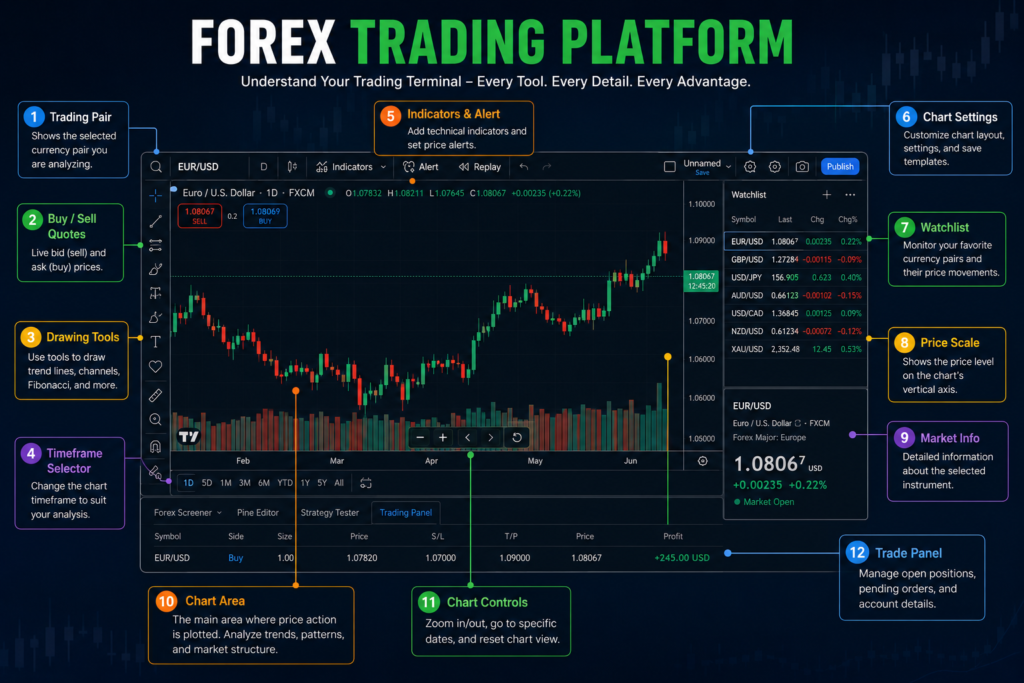
Platform quality rounds out the picture. Established platforms such as MetaTrader 4, MetaTrader 5, and cTrader remain popular because they are stable, widely supported, and rich in analytical tools. A good swap-free broker offers these on both desktop and mobile, with a clean interface, dependable charting, and responsive customer support. Test the platform on a demo account first to confirm it behaves the way you need before you trade real money.
Choosing the Best Forex Broker in India
Selecting the best forex broker in India requires understanding a regulatory framework that is stricter than in many other countries. Forex trading in India is legal but tightly controlled. The Securities and Exchange Board of India, known as SEBI, together with the Reserve Bank of India, governs how residents may participate. Under current rules, Indian residents are generally permitted to trade currency derivatives on recognised domestic exchanges, and these products are typically limited to pairs involving the Indian rupee, such as USD/INR, EUR/INR, GBP/INR, and JPY/INR.
Trading exotic pairs or using leveraged offshore platforms can place a resident in a legal grey area, and authorities have periodically warned the public about unauthorised electronic trading platforms. For this reason, an Indian trader’s priority should be compliance first and features second. The safest route is to use a SEBI-regulated broker operating through a recognised exchange, then assess whether a swap-free structure is available within that compliant framework.
If you are exploring international brokers, scrutinise the legality of your activity carefully and never rely solely on a broker’s reassurance that it accepts Indian clients. Verify the regulatory status, understand the restrictions on rupee-based trading, and consider professional guidance if your situation is complex. A broker that is excellent on paper is the wrong choice if using it puts you on the wrong side of local rules.
Choosing the Best Forex Broker in Malaysia
Identifying the best forex broker in Malaysia follows a similar logic but within a different regulatory environment. Two bodies are central: Bank Negara Malaysia, the central bank, and the Securities Commission Malaysia. Together they oversee financial markets and maintain investor-protection standards. Bank Negara also publishes a financial consumer alert list naming entities and platforms that operate without proper authorisation, and checking that list is a sensible first step for any Malaysian trader.
Malaysia has a large population interested in Sharia-compliant finance, so swap-free accounts are particularly relevant here. A strong broker for Malaysian clients should offer genuine interest-free accounts with clearly disclosed replacement fees, alongside convenient local funding options that make deposits and withdrawals in ringgit straightforward and affordable. High conversion costs or awkward payment rails can erode returns just as surely as wide spreads.
As with India, regulatory verification should anchor the decision. Confirm the broker’s authorisation status, review the consumer alert list, and read the account terms to ensure the swap-free offering is authentic rather than cosmetic. The combination of legitimate regulation, transparent costs, and smooth local funding is what separates a dependable choice from a risky one.
The comparison below highlights how the selection criteria differ in emphasis between the two markets.
| Criterion | India focus | Malaysia focus |
|---|---|---|
| Primary regulators | SEBI and RBI | Bank Negara and Securities Commission |
| Permitted instruments | Mainly INR-based currency derivatives on exchanges | Broader access, subject to authorisation |
| Key public check | Recognised exchange and SEBI register | Bank Negara financial consumer alert list |
| Funding priority | Compliance with rupee rules | Smooth ringgit deposits and withdrawals |
| Swap-free relevance | Available within compliant frameworks | High demand for genuine Islamic accounts |
Account Verification and the Onboarding Process
Legitimate brokers are required to verify your identity before you can trade, a process known as Know Your Customer, or KYC. Expect to provide government-issued identification, proof of address, and sometimes additional documentation depending on your country. While this can feel tedious, robust verification is actually a positive sign. A broker that lets you deposit large sums with no checks at all is more likely to be cutting corners on regulation too.
When opening a swap-free account specifically, some brokers grant the Islamic designation automatically, while others require you to request it or even submit a declaration. Confirm how the broker handles this so you are not caught holding positions on a standard account by mistake. It is also wise to clarify whether the swap-free status is permanent or whether the broker reserves the right to revert accounts it suspects of abusing the feature, for example through interest-style arbitrage strategies.
Keep records of every document you submit and every confirmation you receive. Clear documentation protects you if a dispute arises later and makes withdrawals smoother. A transparent onboarding experience, with realistic timelines and responsive support, is itself a useful indicator of how the broker will treat you once your money is on deposit.
Red Flags to Avoid
Spotting trouble early is just as valuable as finding a good broker. The clearest warning sign is the absence of credible regulation, or a licence that cannot be verified on an official register. Treat unverifiable claims as disqualifying rather than merely concerning. Equally troubling are promises of guaranteed profits or unusually high fixed returns, because no legitimate broker can guarantee outcomes in a market driven by uncertainty.
Be cautious with brokers that make deposits effortless but withdrawals mysteriously difficult, or that impose surprise conditions before releasing funds. Aggressive sales tactics, pressure to deposit quickly, and reluctance to put fee details in writing all point toward a firm that prioritises its own revenue over your protection. With swap-free accounts in particular, watch for replacement fees that are hidden, applied from the first day, or set so high that the “interest-free” label becomes meaningless.
Finally, read independent reviews with a critical eye. A pattern of complaints about frozen accounts, manipulated pricing, or unresponsive support carries more weight than a handful of glowing testimonials that could be incentivised. When several independent signals point the same way, believe them.
What Experts and Research Say
Sound broker selection is only one part of trading well; understanding the discipline behind it matters just as much. In Technical Analysis of the Financial Markets, John Murphy lays out the analytical framework that many traders use to read price action across currencies and other markets, and it remains a respected reference for anyone learning to interpret charts methodically. For the psychological side, Mark Douglas’s Trading in the Zone explores why discipline and probabilistic thinking, rather than prediction, separate consistent traders from impulsive ones.
The evidence on retail outcomes is sobering and worth internalising before you risk capital. The European Securities and Markets Authority, ESMA, has reported that a large majority of retail investor accounts lose money trading CFDs, a finding reflected in the risk warnings regulated brokers are required to display. This is a powerful reminder that choosing even the best swap free forex broker does not change the fundamental difficulty of trading profitably.
As Warren Buffett put it, “Risk comes from not knowing what you’re doing.” The lesson is to pair a trustworthy, well-regulated broker with genuine education, disciplined risk management, and realistic expectations.
Frequently Asked Questions (FAQs)
What makes a broker the best swap free forex broker?
The strongest choice combines verifiable regulation, an authentic interest-free structure, and transparent replacement fees that are modest and clearly disclosed. It should also offer competitive spreads, reliable execution, and a stable platform. For many traders, the best swap free forex broker is simply the one that is honest about costs and safe with funds, rather than the one with the flashiest marketing.
How is a swap-free account different from a standard account?
A standard account applies overnight rollover interest, charging or crediting the interest-rate differential between the two currencies in a pair. A swap-free or Islamic account removes that interest entirely to comply with Sharia principles. To cover overnight financing, the broker usually substitutes a flat administration fee or slightly adjusted pricing, so the account is interest-free but not always entirely cost-free.
Is forex trading legal in India and Malaysia?
Forex trading is legal in both countries but regulated differently. In India, SEBI and the RBI generally restrict residents to rupee-based currency derivatives on recognised exchanges, so the best forex broker in India operates within that framework. In Malaysia, Bank Negara and the Securities Commission oversee the market, and traders should check the official consumer alert list before choosing the best forex broker in Malaysia.
Are swap-free accounts genuinely halal?
Swap-free accounts are designed to remove riba, the interest element prohibited in Islamic finance, which addresses a major concern for observant traders. Whether a specific account is fully Sharia-compliant can depend on the broker’s structure and the wider question of how currency speculation is viewed. Many traders consult a knowledgeable scholar and confirm the account terms before trading to ensure the offering meets their requirements.
What fees replace the swap on an interest-free account?
Most brokers apply a flat administration or holding fee per lot after a grace period, while some build the cost into slightly wider spreads or a transparent commission. A trustworthy broker discloses this clearly and applies it proportionally. Always confirm the exact charge in writing and check it against the official account specifications before opening any swap-free forex account.
Final Thoughts
Finding the best swap free forex broker comes down to disciplined verification rather than chasing the most persuasive advertisement. Start with regulation, because nothing else matters if your funds are not protected, and confirm every licence on the official register yourself. Next, examine exactly how the broker replaces the swap, insisting on clear, proportionate fees rather than hidden charges that quietly recreate the interest you wanted to avoid. Then weigh spreads, execution quality, and platform stability, testing everything on a demo account before committing real capital. If you trade from India, anchor your decision in SEBI and RBI rules and rupee-based instruments; if you trade from Malaysia, lean on Bank Negara and Securities Commission oversight and prioritise smooth local funding. Above all, remember that a great broker is a tool, not a guarantee, and that education and risk management determine your long-term results far more than any single account feature. Choose carefully, verify relentlessly, and trade with realistic expectations.