
Introduction
Understanding currency trading basics is the first real step toward making sense of the largest and most liquid financial market on earth, where trillions of dollars change hands every single day. For newcomers, the foreign exchange world can feel like a wall of jargon — pips, lots, spreads, leverage — that seems designed to keep ordinary people out. The truth is far more approachable. At its heart, currency trading is simply the act of exchanging one nation’s money for another’s and aiming to profit from the shifting rates between them. This guide strips away the intimidation and explains the essentials in plain language. You will discover how the market actually functions, what the core terms mean, how currency pairs are quoted, why leverage is both powerful and dangerous, and the habits that protect beginners from costly early mistakes. Think of this as the foundation every successful trader builds upon before anything else.

Fig 1.1 Currency trading basics
What Is Currency Trading?
Currency trading, also called forex or FX trading, is the buying and selling of national currencies against one another. Because every currency’s value constantly fluctuates relative to others, traders attempt to profit by buying a currency they expect to strengthen and selling one they expect to weaken. Unlike a stock exchange housed in a single building, this market is decentralised and operates electronically across the globe.
That global nature gives forex two defining qualities: enormous size and near-constant availability. The market runs twenty-four hours a day, five days a week, flowing from the Asian session into the European and then North American sessions. For a beginner, this means you can trade around a job or other commitments, but it also means the market never truly sleeps, which makes a clear plan and defined hours essential.
How Currency Trading Works
To grasp how currency trading works, picture every trade as a simultaneous exchange. You are always buying one currency while selling another, which is why prices are quoted in pairs. When you “buy EUR/USD,” you are buying euros and selling US dollars at the same time, betting the euro will rise against the dollar. If it does, you can later reverse the trade for a profit; if it falls, you take a loss.
Profit and loss come from the difference between your entry and exit prices, measured in tiny increments called pips. The mechanics are handled by a broker, who connects you to the market and provides a platform to place orders. Your job as a trader is to decide direction, manage how much you risk, and choose when to enter and exit — the broker simply executes those decisions. Once this exchange concept clicks, the rest of the terminology becomes far easier to absorb.
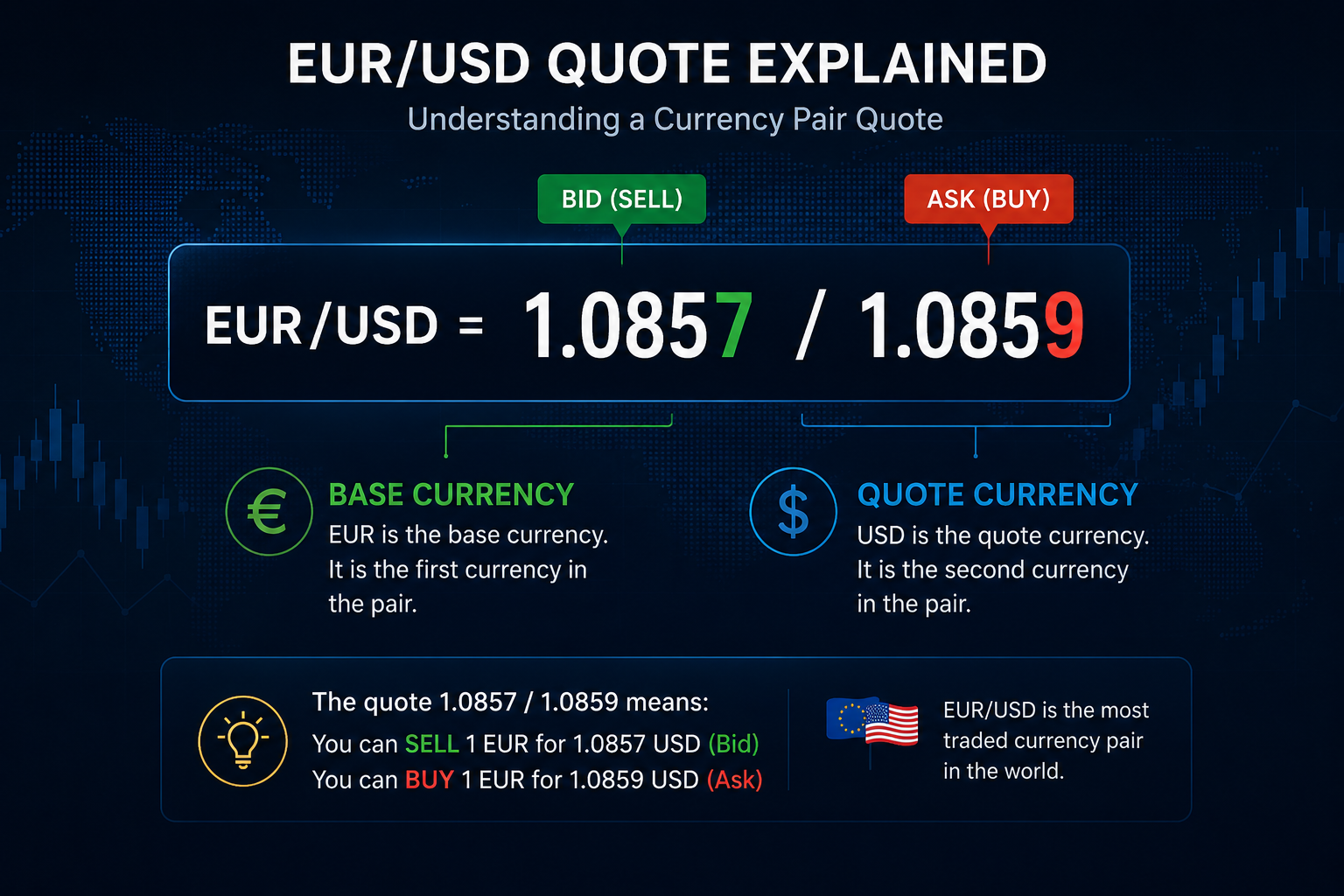
Fig 1.2 How currency trading works
The Basics of Currency Trading for Beginners: Key Terms
Mastering the basics of currency trading for beginners means getting comfortable with a small vocabulary that appears everywhere. These terms are not difficult once defined, and they form the language you will use in every trading decision you ever make.
The table below summarises the essential building blocks so you can reference them as you learn.
| Term | Meaning | Why It Matters |
|---|---|---|
| Pip | Smallest standard price move | Measures profit and loss |
| Lot | Standardised trade size | Controls how much each pip is worth |
| Spread | Gap between buy and sell price | The broker’s main cost |
| Leverage | Borrowed buying power | Amplifies gains and losses |
| Margin | Deposit to hold a position | Determines trade size you can open |
| Bid/Ask | Sell price and buy price | Sets your real entry and exit |
A currency pair always has a base currency, listed first, and a quote currency, listed second. The price tells you how much of the quote currency is needed to buy one unit of the base. Major pairs involve the most traded currencies and tend to be more stable, while exotic pairs can move sharply and cost more to trade.
Understanding Leverage and Margin
Leverage is the feature that most excites and most endangers beginners. It lets you control a large position with a relatively small deposit, multiplying your market exposure. With leverage, a modest account can open trades far bigger than its balance, which is why forex appeals to those starting with limited capital.
The catch is that leverage magnifies losses just as powerfully as gains. A small adverse move can wipe out a heavily leveraged account in minutes. Margin is the portion of your funds set aside to keep a leveraged position open, and if losses eat into it too far, the broker closes your trade automatically. Wise beginners treat high leverage with deep caution, using only a fraction of what is available so a single bad trade never threatens their entire account.
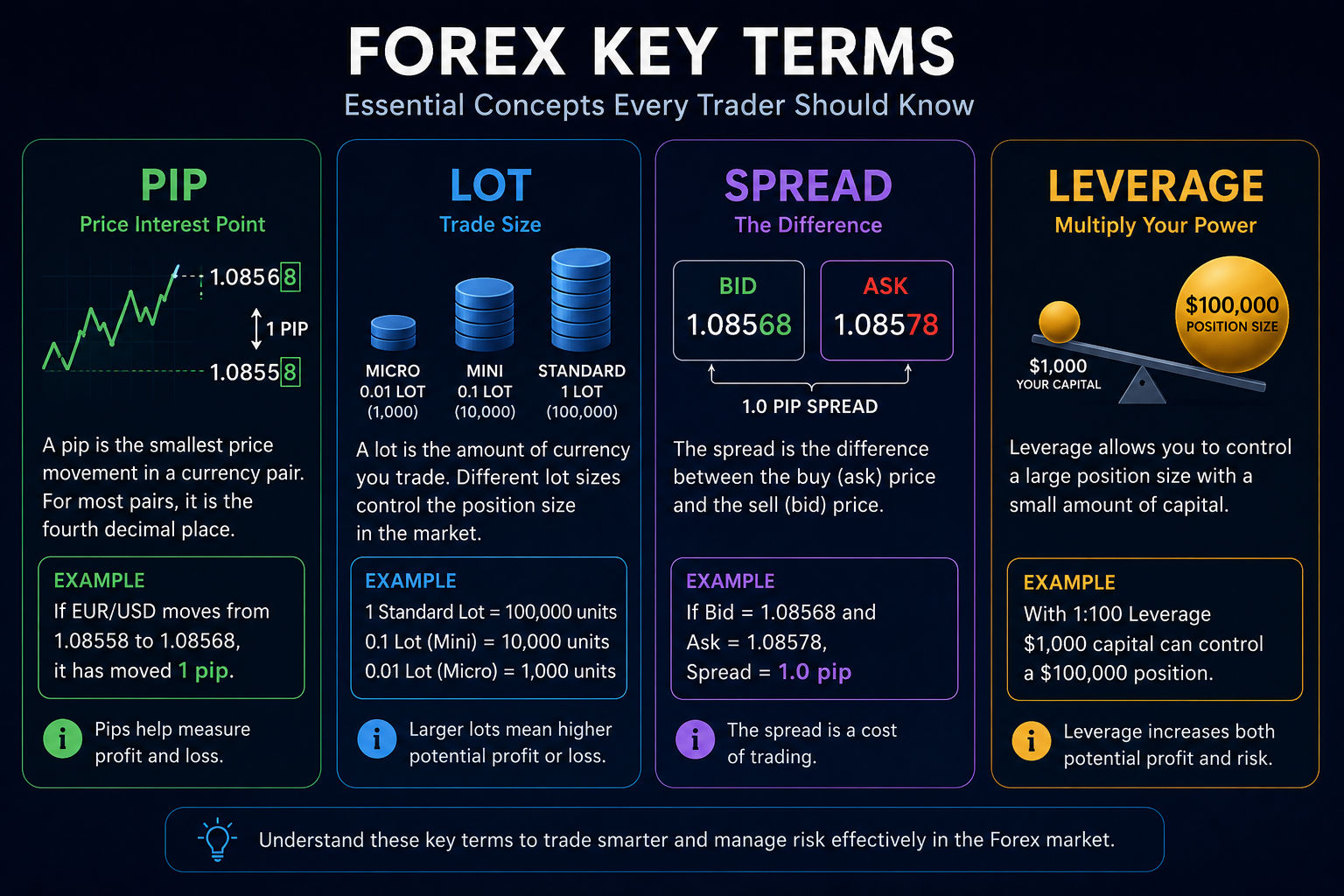
Fig 1.3 Basics of currency trading for beginners
How to Read a Currency Pair
Reading a quote becomes second nature with a little practice. Suppose EUR/USD is priced at 1.1000. This means one euro costs 1.10 US dollars. If the price climbs to 1.1050, the euro has strengthened, and a trader who bought earlier now profits; if it drops to 1.0950, the euro has weakened, producing a loss for that buyer.
You can profit whether the market rises or falls. Buying, or “going long,” wins when the base currency strengthens, while selling, or “going short,” wins when it weakens. This two-way flexibility is one of forex’s defining advantages, allowing skilled traders to seek opportunities in both rising and falling conditions rather than waiting only for prices to climb.
What Top Traders and Research Say
Experienced professionals constantly remind beginners that survival comes before profit. George Soros, one of the most famous currency traders in history, observed, “It’s not whether you’re right or wrong that’s important, but how much money you make when you’re right and how much you lose when you’re wrong.” That single idea reframes trading from prediction to disciplined money management.
The research backs this up. In their landmark study “Trading Is Hazardous to Your Wealth,” Brad Barber and Terrance Odean showed that overactive retail traders consistently underperformed, largely because excessive trading and overconfidence eroded returns. For a structured beginner education, John Murphy’s Technical Analysis of the Financial Markets is a widely respected starting point that explains how to read charts and trends methodically rather than guessing. The shared lesson is clear: learn the fundamentals patiently, and let careful risk control protect you while your skill develops.
Smart Habits for New Traders
The healthiest way to begin is on a demo account, where you can practise placing trades with virtual money and zero financial risk. This lets you internalise the mechanics — order types, position sizing, reading charts — before a single rand or dollar is at stake. Treat the demo seriously, as if the money were real, so the habits transfer cleanly to live trading.
From there, progress slowly. Risk only a tiny percentage of capital per trade, keep a journal of your decisions, and resist the temptation to trade constantly. The market will always offer new opportunities, so patience costs you nothing while impulsiveness can be expensive. Building these disciplined habits early is what separates traders who last from those who quit after an emotional, account-draining first month.
Frequently Asked Questions
What are the most important currency trading basics for a beginner?
The core currency trading basics every beginner needs are understanding currency pairs, pips, lots, spreads, leverage, and risk management. Together these explain how trades are priced and how profit and loss are measured. Beginners should also learn to place basic orders and read a simple chart. Mastering these foundations on a demo account first builds the confidence and habits required before risking any real money.
How does currency trading work in simple terms?
In simple terms, how currency trading works is that you exchange one currency for another and profit from the change in their relative value. Every trade buys one currency while selling another, quoted as a pair like EUR/USD. If the currency you bought strengthens, you can close the trade for a gain. A broker executes your orders, while you decide direction, size, and timing.
Can a complete beginner learn the basics of currency trading?
Yes, the basics of currency trading for beginners are very learnable with patience and the right approach. Start by understanding key terms and how pairs are quoted, then practise on a demo account with virtual funds. Focus on risk management before chasing profit, and progress slowly to a small live account. The mechanics are not complicated; the real challenge is discipline and emotional control, which improve with practice.
How much money do I need to start currency trading?
You can start with a small amount, since many brokers offer low minimum deposits and free demo accounts. However, the currency trading basics matter far more than your starting balance. Learn the mechanics risk-free first, then fund a small live account you can afford to lose entirely while developing discipline. Avoid using borrowed money or essential savings, and never let high leverage tempt you into oversized early positions.
Is currency trading harder than trading stocks?
Currency trading is not necessarily harder, but it differs from stocks. The forex market runs nearly twenty-four hours, uses currency pairs, and often involves higher leverage, which increases both opportunity and risk. The underlying currency trading basics — managing risk, reading price, and controlling emotion — overlap heavily with stock trading. Beginners who learn solid fundamentals and respect leverage can approach either market successfully with the right education and patience.
Final Thoughts
Learning currency trading basics is the essential groundwork that makes everything else in trading possible, and it deserves your patience rather than your impatience. Once you truly understand how pairs are quoted, what pips and leverage mean, and how a trade actually unfolds, the market transforms from an intimidating blur into a system you can navigate with confidence. The most successful traders never skip these fundamentals; they master them, practise them on demo accounts, and pair them with disciplined risk control before scaling up. Take your time, treat early losses as tuition, and build your knowledge brick by brick. Forex rewards the prepared, and a strong grasp of the basics is the most valuable head start any new trader can give themselves. This article is educational and not financial advice.