
Day Trading vs Prop Trading: A Complete Professional Guide for Forex Traders
The debate around day trading vs prop trading has become one of the most important topics in modern forex trading. As financial markets evolve, traders are constantly searching for a more scalable and profitable trading model. Some prefer independence through day trading, while others shift toward funded opportunities offered by prop firms.
In reality, both models serve different purposes, skill levels, and financial goals. Understanding their structure is essential before choosing a long-term trading path. This guide explains both approaches in depth, including profitability, risk structure, and real-world earning potential.
What is Day Trading in Forex Markets?
Day trading is a short-term trading approach where traders open and close positions within the same trading day. The goal is to capture small price movements in highly liquid markets like forex.
Day traders rely heavily on technical analysis, chart patterns, price action, and disciplined risk management. Since trades are not held overnight, they avoid swap fees and overnight volatility risk.
One of the key characteristics of day trading is that traders use their own capital. This means all profits belong to them, but at the same time, all losses are also their responsibility. Because of this structure, capital size plays a major role in determining income potential.
Most retail traders struggle with scalability in day trading because growing a small account into a significant income source takes time, patience, and consistent profitability.
What is Prop Trading and How Does It Work?
Prop trading (proprietary trading) is a model where traders use capital provided by a prop firm instead of their own money. After passing an evaluation process, traders receive a funded account and trade under predefined risk rules.
These firms typically offer profit-sharing models where traders keep a percentage of profits, often between 70% and 90%. The remaining share goes to the firm.
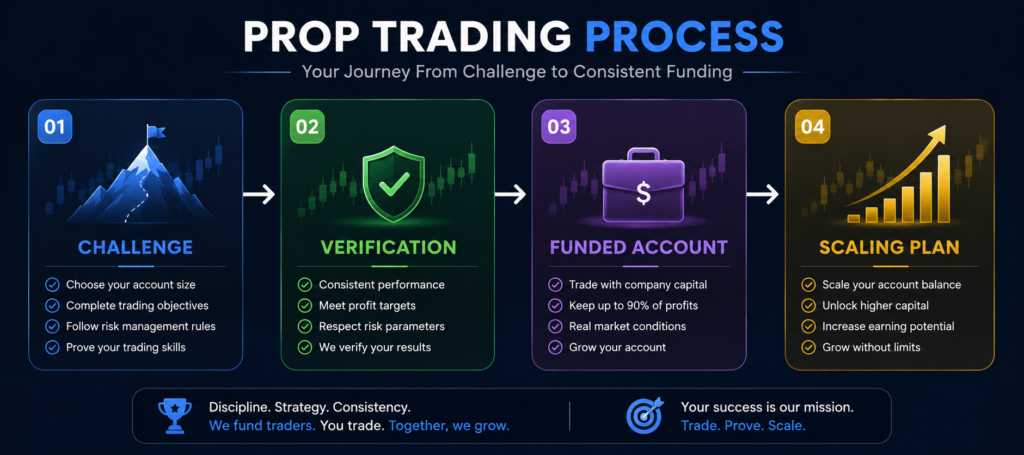
Prop trading has gained massive popularity because it removes the need for large personal capital. However, it introduces strict risk management rules that must be followed consistently. Violating drawdown limits or daily loss restrictions can result in account termination.
Despite these restrictions, prop trading provides traders with access to significantly larger capital than most retail accounts, which directly impacts earning potential.
Day Trading vs Prop Trading: Key Structural Differences
When comparing day trading vs prop trading, the differences go beyond just capital usage. Both models operate on fundamentally different financial frameworks.
Day trading is independent and flexible, allowing traders to make decisions without external restrictions. However, it is limited by personal capital and emotional pressure since traders risk their own money.
Prop trading, on the other hand, introduces a structured trading environment. Traders are evaluated based on consistency, discipline, and risk control. Once funded, they operate within strict guidelines but gain access to large capital pools.
Another major difference lies in profit distribution. In day trading, traders retain 100% of profits. In prop trading, profits are shared, but the larger capital base often compensates for this split.
Is Prop Trading More Profitable Than Day Trading?
One of the most searched questions in forex trading is: “is prop trading more profitable than day trading”
The answer depends on trading skill and capital efficiency.
A skilled trader with a small personal account may generate consistent returns, but growth is limited due to capital constraints. In contrast, prop traders can access accounts ranging from $25,000 to $200,000 or more, significantly increasing potential earnings.
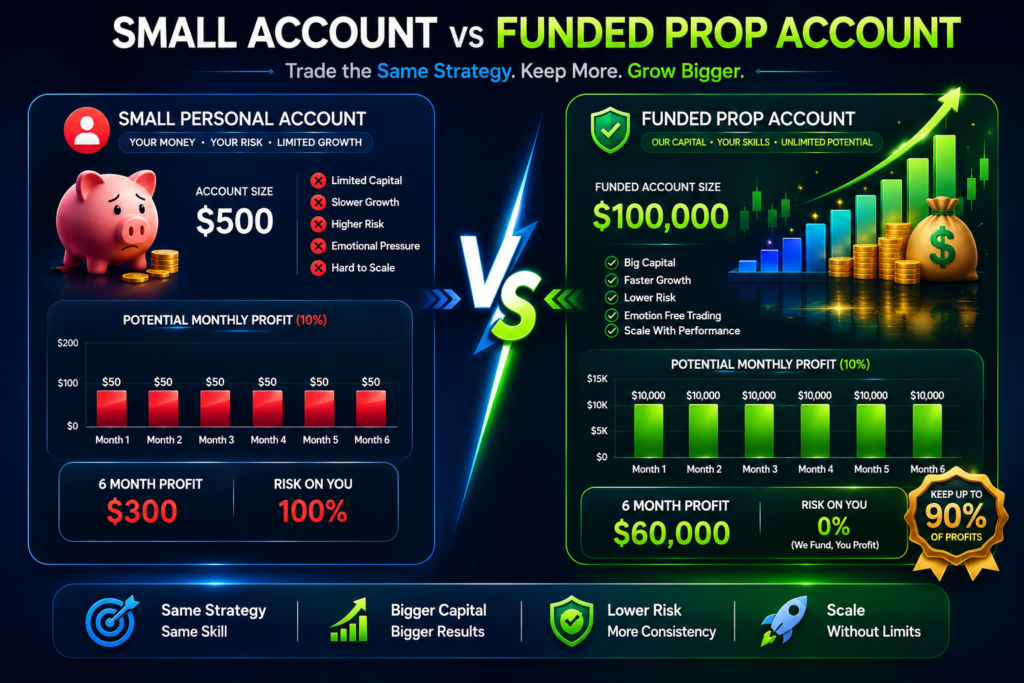
For example, a 5% monthly return on a $10,000 personal account equals $500. The same performance on a $100,000 funded account results in $5,000, even after profit sharing.
This shows why many traders consider prop trading more scalable and potentially more profitable. However, consistency is the deciding factor. Without discipline, even large accounts cannot be maintained.
Advantages of Day Trading
Day trading remains a strong option for traders who prioritize independence and control. One of its biggest strengths is full ownership of profits. Traders do not need to share earnings with any firm.
Another advantage is flexibility. Traders can design their own strategies, choose their preferred risk levels, and operate without external restrictions.
Day trading also allows complete psychological freedom from evaluation pressure. There are no challenge phases or strict drawdown rules imposed by third parties.
However, the biggest limitation remains capital dependency. Without sufficient funds, income potential stays restricted regardless of skill level.
Advantages of Prop Trading
Prop trading provides a structured path for traders who lack large capital but possess strong skills.
The most significant benefit is access to large funded accounts. This immediately increases earning potential without requiring personal financial risk beyond the evaluation fee.
Another advantage is professional discipline. Prop firms enforce strict risk rules, which help traders develop consistency and avoid overtrading.
Additionally, prop trading creates opportunities for scaling. Successful traders can gradually increase account sizes based on performance, leading to long-term income growth.
Challenges in Both Trading Models
Both systems come with unique challenges that traders must understand before choosing a path.
In day trading, emotional pressure is a major issue. Since traders risk personal capital, losses can lead to stress, impulsive decisions, and inconsistent performance. Scaling also remains slow unless large capital is available.
In prop trading, the biggest challenge is rule compliance. Even profitable traders can lose funded accounts if they violate drawdown limits or fail consistency rules. The evaluation process also adds pressure for beginners.
Which Trading Model is Better for Beginners?
For beginners, prop trading vs day trading depends on mindset and capital availability.
Beginners with limited capital often benefit more from prop trading because it provides access to larger funds without high financial risk. However, it requires discipline and strong risk control.
Day trading may be suitable for beginners who prefer learning independently and gradually building capital. However, the learning curve can be slower due to limited trading size.
In most cases, beginners start with demo trading before transitioning into either model.
Best Practices for Long-Term Success
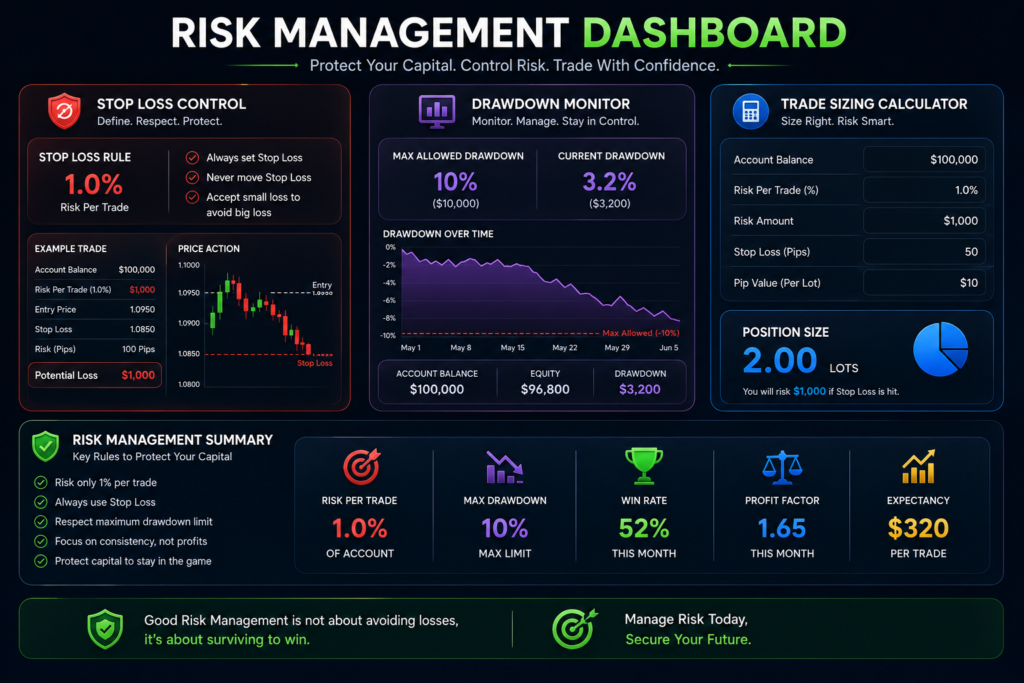
Regardless of whether a trader chooses day trading vs prop trading, long-term success depends on discipline, consistency, and emotional control.
Risk management should always be prioritized over profit chasing. Traders should focus on preserving capital and maintaining steady growth rather than aggressive gains.
A well-tested strategy combined with patience often produces better results than frequent strategy switching. Keeping a trading journal and analyzing mistakes can significantly improve performance over time.
FAQs
What is the difference between day trading and prop trading?
The main difference in day trading vs prop trading is capital ownership. Day traders use personal funds, while prop traders use firm-funded capital under strict rules.
Is prop trading more profitable than day trading?
Yes, in many cases prop trading is more profitable than day trading because traders access larger capital, increasing potential returns even after profit splits.
Can beginners start prop trading?
Yes, beginners can start prop trading, but they must first understand risk management and pass evaluation challenges before receiving funded accounts.
Which is safer, prop trading or day trading?
Prop trading is generally safer financially because traders risk minimal personal capital compared to day trading.
Do prop traders keep all profits?
No, prop traders share profits with the firm, usually between 10% to 30% depending on the agreement.
Conclusion
The comparison of day trading vs prop trading highlights two very different paths in forex trading, each designed for specific trader profiles. Day trading offers complete independence, allowing traders to control every aspect of their strategy while retaining full ownership of profits. However, its biggest limitation lies in capital constraints, which can slow down income growth even for highly skilled traders.
On the other hand, prop trading provides access to significantly larger capital, making it possible to scale earnings much faster. This is why many traders believe is prop trading more profitable than day trading—because larger account sizes naturally amplify returns. However, this advantage comes with strict risk management rules and profit-sharing structures that require discipline and consistency.
Ultimately, neither model is universally better. Success depends on a trader’s psychology, discipline, strategy quality, and risk management skills. Traders seeking independence may prefer day trading, while those aiming for scalability and structured growth may find prop trading more suitable.
For most modern forex traders, the smartest approach is not choosing one blindly but understanding both systems deeply and selecting the one that aligns with their financial goals and trading personality.