
A handful of classic chart patterns sit at the heart of technical trading, and few are as widely useful or as widely misused as the flag, the pennant, and the rising wedge. A clean flag pattern forex setup represents a brief pause in a strong trend, the pennant pattern trading approach offers a near-identical continuation idea on a tighter geometry, and the rising wedge forex structure adds a contrasting reversal-warning pattern that every continuation trader needs to recognise. Together they describe how price catches its breath, coils energy, and either resumes a move or warns that the dominant trend is exhausting. This guide explains exactly how to identify each pattern correctly, how to time entries on confirmation rather than anticipation, and how to manage risk with logical stops and measured targets, turning familiar shapes into a genuine, disciplined edge rather than a hopeful guess.

Flag pattern forex chart showing the pole, consolidation, and breakout of a bull flag.
What Is the Flag Pattern in Forex?
A flag pattern forex trader looks for is a short, sloped consolidation that forms after a strong, near-vertical move, creating a structure that resembles a rectangular flag attached to a vertical pole. The pole represents the powerful initial impulse, while the flag itself is a small counter-trend channel where price pauses and consolidates before, in most cases, resuming in the direction of the original move. A bull flag forms after a sharp rally and slopes gently downward; a bear flag forms after a sharp drop and slopes gently upward.
The pattern works because it tells a coherent story about market behaviour. Following an impulsive move, profit-takers exit, fresh participants hesitate, and the resulting tug-of-war produces a controlled, low-volatility pullback rather than a full reversal, because the dominant force has not actually changed. When the consolidation completes and price breaks the flag in the direction of the original trend, that controlled pause typically resolves into a continuation move that reflects the resumption of institutional interest.
What separates a high-quality flag from a vague rectangle on the chart is the surrounding context. A strong, near-vertical pole, a tight, well-defined consolidation that slopes against the trend, an alignment with the higher-timeframe direction, and a decisive break of the flag’s boundary together turn a common shape into a genuinely tradeable setup.
The Pennant Pattern: A Close Cousin
The pennant pattern trading approach is so similar to the flag that many traders use the terms interchangeably, though there is a meaningful structural distinction worth knowing. Where a flag is a roughly parallel-sided rectangle sloping against the trend, a pennant is a small symmetrical triangle, with converging trend lines forming a more compressed coil after the same kind of sharp pole. The story it tells is identical, a brief pause that compresses energy before the trend resumes, but the tighter geometry means breakouts from pennants often arrive faster and on lower volatility than equivalent flag breakouts.
In practice, pennants and flags are traded with the same workflow: identify a strong pole, mark the consolidation, wait for a decisive break in the direction of the original trend, and use the same kind of measured-move target derived from the pole’s length. The biggest practical hazard is the false breakout that pennants in particular are prone to, because the compressed shape gathers stop orders on both sides, which is why confirmation matters even more than usual.
The flag-and-pennant family fits naturally within a broader top-down framework. Marking the dominant trend on the daily chart, then looking for flags or pennants on the four-hour or one-hour chart that align with that trend, produces high-probability continuation setups that ride the momentum already established at the larger timeframe.

Pennant pattern trading diagram showing the symmetrical triangle and pole-based target.
The Rising Wedge in Forex
A rising wedge forex pattern looks superficially similar to a bull flag but tells the opposite story, and learning to distinguish the two is essential. Where a bull flag slopes against the trend on a tight, controlled retracement, a rising wedge slopes in the same direction as the prior move but with converging, narrowing trend lines and noticeably weakening momentum on each push higher. It typically appears at the end of an extended uptrend, marking a structure where each new high is achieved with less force than the last, until the wedge finally breaks downward and signals a reversal.
The falling wedge, its mirror image, behaves the same way at the end of a downtrend, with each new low achieved on diminishing momentum until the wedge breaks upward and signals a bullish reversal. Both wedge patterns are reversal warnings rather than continuation setups, and they belong on every trend trader’s radar because they help you exit an extended move at a more favourable price than waiting for a full top or bottom to develop. The momentum divergence so often visible across a wedge, where price climbs but an oscillator like RSI rolls over, is one of the cleanest tells in technical analysis.
The wedge’s contrast with the flag matters because retail traders frequently confuse them. A pattern that slopes against the trend after a sharp pole is a flag and points to continuation; a pattern that slopes with the trend on a tight, exhausted geometry is a wedge and points to reversal. Mixing them up means trading a continuation idea exactly when the pattern is warning of a reversal.
How to Trade These Continuation and Reversal Patterns
The disciplined workflow for a flag or pennant begins with identifying the pole, the strong, near-vertical move that defines the pattern. From there, draw the consolidation channel or triangle, wait for price to coil within it without breaking on either side, and then trade the eventual decisive break in the direction of the pole. The cleanest entries are on a strong close beyond the consolidation, or on a retest of the broken boundary that holds.
For a wedge, the workflow inverts. Identify the extended trend, recognise the converging, narrowing wedge with weakening momentum, and wait for a decisive break of the wedge against the prior direction to confirm the reversal. The conservative entry waits for the break and the retest, while the aggressive entry takes the initial break with a tighter stop. Waiting for confirmation rather than anticipating the reversal at the wedge’s narrowing tip is the difference between catching a real reversal and being repeatedly stopped out.
| Element | Flag / Pennant (Continuation) | Rising / Falling Wedge (Reversal) |
|---|---|---|
| Slope | Against the prior trend | With the prior trend |
| Geometry | Channel or symmetrical triangle | Converging, narrowing wedge |
| Momentum | Stable through the pause | Visibly weakening on each push |
| Break direction | In direction of the pole | Against the prior trend |
| Target | Pole length projected from the break | Prior structural level or measured move |
Stops, Targets, and Risk Management
The conventional stop placement on a flag or pennant sits just beyond the consolidation on the opposite side of the breakout, where a move back inside the channel would invalidate the continuation thesis. The target is the measured move, the length of the pole projected from the break point, which gives an objective profit target rather than a guess.
Position sizing matters as much as pattern recognition. Use volatility-based sizing anchored to ATR so that the stop distance you require translates into a smaller position rather than a larger dollar risk. Risk a fixed percentage of your account per trade, typically one to two percent, regardless of which pattern you are trading. This single discipline keeps the inevitable failed patterns from doing lasting damage.
What Top Traders and Research Say
Chart patterns have been studied seriously. In the influential study “Foundations of Technical Analysis,” Andrew Lo, Harry Mamaysky, and Jiang Wang applied rigorous statistical methods to common technical patterns and concluded that several carry genuine, measurable informational value rather than being purely subjective. While their work does not endorse every pattern equally, it lends real credibility to disciplined, confirmation-based trading of well-defined formations like flags and wedges.
The technical-analysis author Thomas Bulkowski, in his widely referenced Encyclopedia of Chart Patterns, catalogued the historical performance of dozens of patterns including flags, pennants, and wedges, consistently emphasising that confirmation and context, not the shape alone, determine reliability. The trader Jesse Livermore captured the broader principle: “Markets are never wrong; opinions often are.”
Common Mistakes to Avoid
The most common mistake is trading every consolidation as if it were a flag, ignoring the requirement for a strong, near-vertical pole and a clear higher-timeframe trend. Without those preconditions, a sloped rectangle is just sideways drift, and breakouts from it carry little informational weight. Demanding a clear pole and trend alignment filters out the majority of low-quality setups.
A second frequent error is confusing a rising wedge with a bull flag, entering long on what is actually a reversal warning and giving back trend profits as the wedge resolves downward. Reading the slope direction relative to the prior trend solves this almost entirely. Equally damaging is anticipating the breakout from inside the pattern, before a decisive break has confirmed. Finally, neglecting stop placement and position sizing turns a workable edge into a steady drain on the account.
Frequently Asked Questions
What is the flag pattern in forex?
A flag pattern forex setup is a short, sloped consolidation that forms after a strong, near-vertical move, resembling a flag attached to a vertical pole. A bull flag slopes downward after a rally and points to a continuation higher; a bear flag slopes upward after a drop and points to a continuation lower. The pattern is confirmed by a decisive break of the flag in the direction of the original move, and the target is the length of the pole projected from the break.
How does pennant pattern trading differ from a flag?
Pennant pattern trading uses a small symmetrical triangle, with converging trend lines, rather than the parallel-sided rectangle of a flag. The story is identical, a brief pause before the prior trend resumes, but the tighter geometry means breakouts often arrive faster. Trade pennants with the same workflow as flags: require a strong pole, align with the higher-timeframe trend, wait for a decisive break in the direction of the pole, and target the pole length projected from the break.
What is a rising wedge in forex and how is it different from a flag?
A rising wedge forex pattern is a reversal-warning structure that slopes in the same direction as the prior trend, with converging lines and visibly weakening momentum on each push higher. A bull flag slopes against the trend on a tight, controlled retracement and points to continuation; a rising wedge slopes with the trend on diminishing momentum and points to reversal. Confusing the two is a common, costly mistake.
Where do I place my stop and target?
On a flag or pennant, the stop sits just beyond the consolidation on the opposite side of the breakout. The target is the measured move, the length of the pole projected from the break point. On a wedge, the stop sits just beyond the recent extreme of the pattern, with the target anchored to a prior significant level. Always size the position so the stop distance represents a small, fixed percentage of your account.
Are flags and pennants beginner-friendly?
Flags and pennants are among the more beginner-friendly patterns because their structure, the pole, the consolidation, and the break direction, is clear and objective. The essential discipline beginners must learn is waiting for confirmation, the decisive break of the consolidation, rather than anticipating it from inside the pattern. Trading on higher timeframes produces cleaner, more reliable setups with less noise.
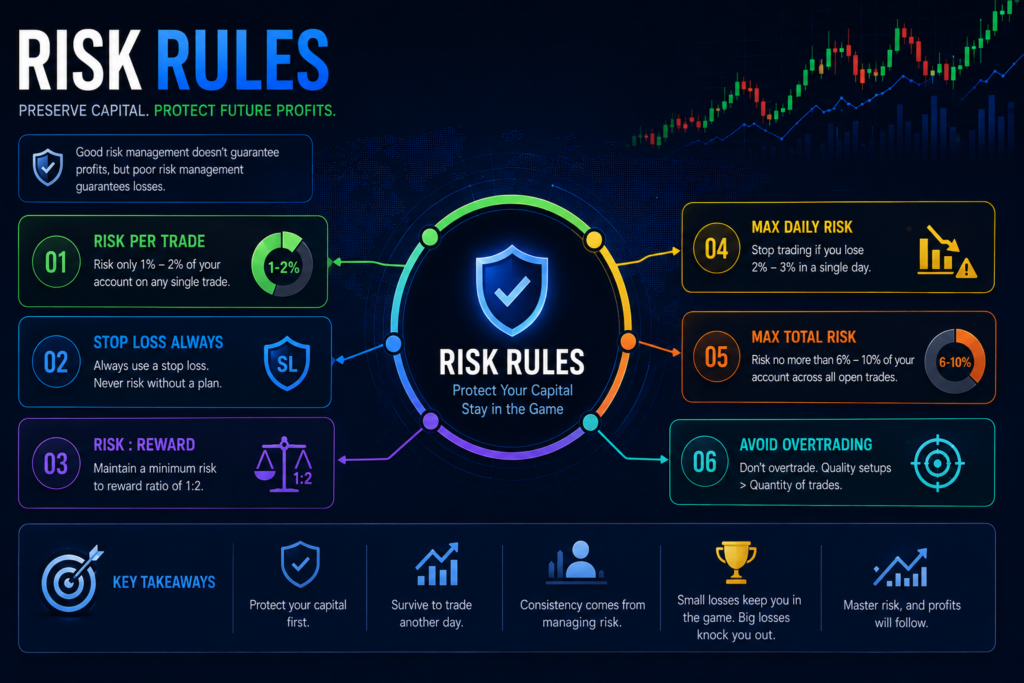
Flag pattern forex infographic summarizing stops, targets, and continuation versus reversal logic.
Final Thoughts
The flag pattern forex family, including its near-twin pennant and its contrasting cousin the rising wedge, sits at the centre of disciplined technical trading because each pattern tells a clear story about what price is doing at a specific moment in a trend. The flag and the pennant describe a brief, controlled pause before the dominant trend resumes, and pennant pattern trading uses the tighter triangle geometry that compresses energy before a breakout. The rising wedge forex structure, by contrast, warns that an extended trend is running out of momentum. The decisive lessons are universal across all three: a strong pole or trend, a well-defined consolidation, a decisive break for confirmation, and disciplined risk placement. The research of Lo, Mamaysky, and Wang lends real credibility to disciplined pattern trading, Thomas Bulkowski’s catalogue underlines that confirmation and context determine reliability, and Jesse Livermore’s reminder to read what the market actually shows keeps the method honest.