
Introduction
When traders outgrow a personal account, many wonder how the professionals manage money at scale. That curiosity often leads to forex hedge funds, pooled investment vehicles that trade currencies for wealthy and institutional clients. These funds use strategies most retail traders never touch, from global macro bets to carry trades and momentum systems. They charge high fees, demand large minimums, and restrict access to accredited investors. Yet they shape how trillions of dollars flow across the currency markets each day. This article explains what these funds really are and how they trade. We cover their fee structures, the role of gold forex funds as a safe-haven hedge, and how regulated forex mutual funds open the door for ordinary savers. You will also learn the risks, the realistic returns, and the smarter alternatives that suit a retail budget.

What Forex Hedge Funds Actually Are
A forex hedge fund is a private pooled investment vehicle that concentrates on currency markets. Investors hand capital to a manager, who trades that money under a defined mandate. The fund earns returns from movements in exchange rates rather than from stocks or bonds alone. Unlike a personal trading account, the structure is legal and contractual. A general partner runs the strategy, and limited partners supply the money and share the profits.
These funds sit inside the broader hedge fund universe but specialize in foreign exchange. Some are purely discretionary, where a seasoned trader makes judgment calls on the dollar, euro, or yen. Others are systematic, where computer models scan price data and place trades without emotion. Many blend both. The word “hedge” is partly historical, since early funds hedged risk, yet most modern currency funds take directional bets and use leverage to amplify them.
The appeal is simple. Currencies trade around the clock, move on macro news, and rarely all rise or fall together. A skilled manager can find opportunity whether the global economy expands or contracts. That flexibility, combined with deep liquidity in major pairs, makes the foreign exchange market a natural home for active professional managers seeking returns that do not track the stock market.
It also helps to understand who invests in these vehicles. The client base leans heavily toward pension plans, endowments, family offices, and sovereign wealth funds. These institutions rarely chase currency funds for outright thrills. Instead they want a return stream that zigs when their equity holdings zag. A currency manager who can post a positive year during a stock market crash earns a prized spot in such a portfolio. That single quality, low correlation to traditional assets, often matters more to a serious allocator than raw performance, because it smooths the overall ride and protects capital when it counts most.
How Forex Hedge Funds Trade Currencies
The most famous approach is global macro. A macro manager studies interest rates, inflation, trade balances, and central bank policy, then expresses a view through currencies. If a manager expects the Federal Reserve to raise rates faster than the European Central Bank, the fund might buy dollars against the euro. These trades can run for months and often involve large, concentrated positions backed by detailed economic research.
A second pillar is the carry trade. Here the fund borrows in a low-yielding currency and invests in a higher-yielding one, pocketing the interest rate difference. The strategy works smoothly in calm markets but can unravel violently when risk appetite shifts. Skilled managers size these positions carefully and hedge the tail risk, because a sudden reversal can wipe out months of patient gains in a single session.
Momentum and trend following form the third pillar. Systematic funds, often called managed futures or CTA strategies, ride established price trends until they break. They trade many currency pairs at once and rely on diversification rather than any single forecast. Other tools include relative value trades, volatility positioning, and options. Across all of these, leverage is central. Currency moves are small in percentage terms, so funds borrow heavily to make those moves meaningful, which raises both the potential reward and the danger.
Fee Structures: Understanding 2-and-20
The classic hedge fund fee model is known as “2-and-20.” The fund charges roughly two percent of assets each year as a management fee, regardless of performance, plus twenty percent of any profits as an incentive fee. The management fee keeps the lights on and pays salaries. The performance fee is meant to align the manager with investors, rewarding skill rather than mere asset gathering.
Most funds add protective clauses. A high water mark ensures the manager only earns performance fees on new profits, not on recovering past losses. A hurdle rate may require the fund to beat a benchmark before incentive fees apply. These terms sound investor-friendly, and they help, but the overall fee load remains heavy. Two percent of capital plus a fifth of the gains is a large drag that compounds against you year after year.
This matters more than many investors realize. In strong years the manager keeps a sizable slice of the upside, while in weak years you still pay the management fee. Over a decade, fees can quietly consume a large portion of gross returns. That is why fee awareness sits at the heart of any honest discussion about forex hedge funds. A manager must generate substantial gross alpha simply to leave the investor ahead of a cheap, passive alternative.
Accreditation and Access Requirements
These funds are not open to everyone, and that is by design. Regulators in most countries restrict private funds to accredited or qualified investors. In the United States, accreditation generally requires a high income or a net worth above one million dollars, excluding your primary home. The logic is that wealthier investors can absorb losses and afford professional advice, so they need less protection than the general public.
Minimum investments reinforce the barrier. Many currency-focused funds set entry points in the hundreds of thousands or even millions of dollars. On top of that, liquidity is limited. Investors often face lock-up periods during which they cannot withdraw, followed by redemption windows that open only quarterly with advance notice. This illiquidity lets the manager hold positions without being forced to sell at the worst moment.
For most readers, these requirements place direct fund access out of reach. That is not a flaw in your finances; it is simply how the private fund world works. Understanding these gates helps you set realistic expectations. It also explains why so many retail traders look toward regulated, publicly available products instead, which brings us to gold exposure and the broader world of currency funds built for ordinary investors.
The Role of Gold Forex Funds
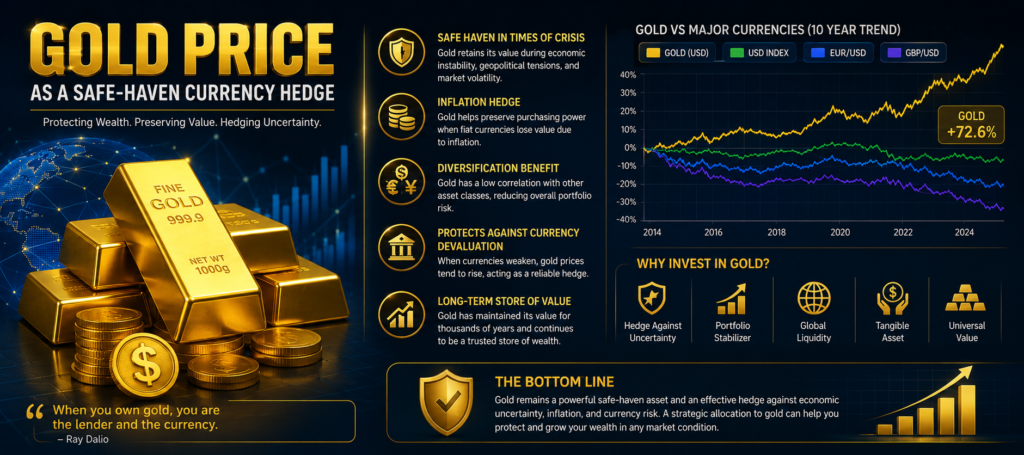
Gold occupies a special place in currency thinking. It behaves like money without a country, priced in dollars yet trusted across borders for thousands of years. Within macro strategies, gold forex funds treat the metal as both a currency and a safe haven. When confidence in paper money wobbles, capital often flows into gold, lifting its price even as risk assets fall. That inverse behavior makes it a valuable diversifier.
A macro manager may hold gold to hedge currency debasement. If central banks print aggressively and real interest rates turn negative, fiat currencies can lose purchasing power while gold tends to hold value. Funds also use gold to balance dollar exposure, since the two often move in opposite directions. A long gold position can soften the blow when the dollar weakens, smoothing the overall return profile of the portfolio.
It is important to stay realistic. Gold pays no interest and can sit flat or fall for long stretches. It is not a guaranteed shield, and its safe-haven reputation does not hold in every crisis. Funds that lean on gold treat it as one tool among many, sized to the macro environment. For retail investors, gold-linked exposure is far easier to obtain through low-cost funds and exchange-traded products than through a private fund with steep minimums.
The relationship between gold and the dollar also deserves a closer look, because it is not as fixed as many assume. In normal conditions the two tend to move in opposite directions, since a stronger dollar makes dollar-priced gold more expensive for foreign buyers. During severe panics, however, investors sometimes rush into both at once, treating each as a refuge from collapsing risk assets. A thoughtful manager studies these shifting correlations rather than relying on a simple rule. That is the deeper skill behind currency-and-metal strategies: reading when an old relationship still holds and when a crisis has temporarily rewritten it.
How Forex Mutual Funds Differ
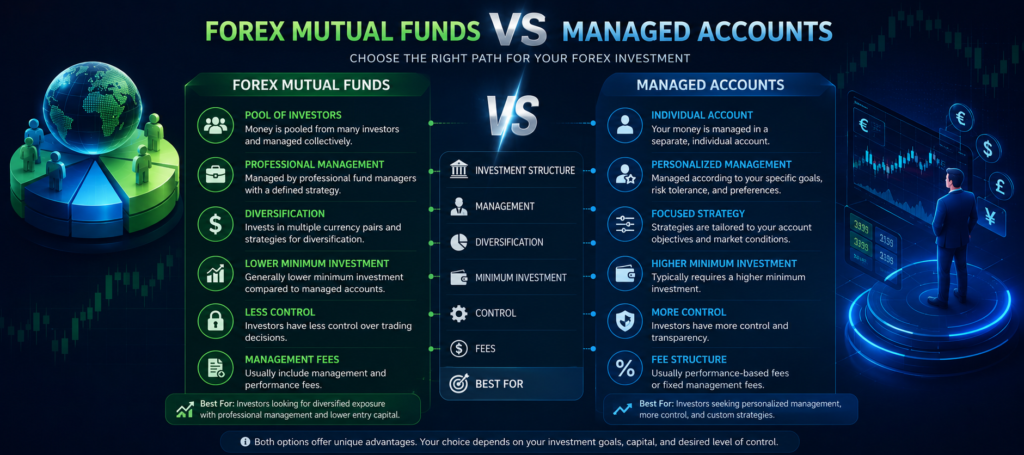
For the everyday investor, forex mutual funds and currency exchange-traded funds offer a more practical route. These are regulated, publicly traded products that pool money to gain currency exposure. Unlike private hedge funds, they are open to the general public, carry low minimums, and report holdings transparently. You can often buy them through a standard brokerage account with no accreditation required.
The trade-offs reflect their regulated nature. Public funds face strict limits on leverage and on how concentrated their positions can be. They cannot take the aggressive, swing-for-the-fences bets that define many hedge funds. Their goal is usually steady exposure to a currency, a basket of currencies, or a macro theme, rather than spectacular outperformance. In return, investors enjoy daily liquidity, lower fees, and the safety of oversight.
The comparison below summarizes the main differences across the most common ways to gain currency exposure.
| Feature | Forex Hedge Funds | Forex Mutual Funds | PAMM / Managed Accounts |
|---|---|---|---|
| Structure | Private pooled fund | Regulated public fund | Broker-linked managed account |
| Typical fees | 2% plus 20% of profit | Low expense ratio | Performance share, varies |
| Minimum access | High, often six figures | Low, retail friendly | Low to moderate |
| Investor eligibility | Accredited only | Open to public | Usually open |
| Liquidity | Lock-ups, periodic redemption | Daily | Often flexible |
| Leverage | High | Strictly limited | Variable, often high |
| Transparency | Limited disclosure | Full disclosure | Depends on broker |
| Regulation | Light | Heavy | Varies by jurisdiction |
Risks and Realistic Returns
Currency investing carries real danger, and leverage magnifies it. A move of one or two percent in an exchange rate is large by FX standards, yet a leveraged fund can turn that into a much bigger swing in either direction. Drawdowns can be sharp and sudden, especially when crowded carry trades unwind. No strategy removes this risk, and past performance never guarantees future results.
Returns vary widely and are far less glamorous than headlines suggest. Many macro and currency funds deliver modest single-digit annual returns over full cycles, punctuated by strong years and painful ones. After the heavy 2-and-20 fee load, the net result reaching the investor can be ordinary. A handful of managers genuinely produce alpha; many do not, and survivorship bias makes the average industry record look better than it truly is.
Other risks deserve attention. Liquidity terms can trap your money during a downturn. Manager risk is real, since a single person’s judgment or a flawed model can derail a fund. Operational and counterparty risks exist too, from custody failures to broker insolvency. Honest expectation setting is essential. Treat any projection of smooth, high returns with deep suspicion, and assume that real outcomes will include uncomfortable losing periods along the way.
Due Diligence Before You Invest
Careful research separates a thoughtful investor from a hopeful gambler. Start with the manager’s track record, but examine it critically. Look for a long history across different market regimes, not a short run of good luck. Ask how returns were achieved, how much leverage was used, and what the worst drawdown looked like. A manager who hides the bad periods is waving a red flag.
Scrutinize the structure as much as the strategy. Read the offering documents to understand fees, lock-ups, redemption rules, and the high water mark. Confirm that an independent administrator values the fund and that a reputable auditor reviews the books. Separation of duties matters, because many fund failures stem from weak controls rather than bad trades. Verify the custodian and the prime broker as well.
Finally, judge fit. A fund may be excellent yet wrong for you if its liquidity terms clash with your needs or its risk exceeds your tolerance. Never invest money you cannot afford to lock away or lose. If a manager pressures you, promises certainty, or resists answering hard questions, walk away. Sound due diligence is slow and unglamorous, but it is the single best protection an investor has.
Smarter Alternatives for Retail Investors
Most individuals do not need a private fund to gain currency exposure, and chasing one can be a costly mistake. Low-cost currency ETFs and regulated forex mutual funds provide transparent access with daily liquidity. For gold exposure, established exchange-traded products track the metal closely at a fraction of hedge fund fees. These vehicles let you build a diversified macro tilt without locking up capital or meeting accreditation rules.
A broader principle helps here. For long-term wealth, a diversified portfolio of low-cost index funds usually beats trying to chase currency alpha. Adding a small, deliberate allocation to currencies or gold can improve diversification, but it should support a core plan rather than replace it. Keep costs low, keep leverage modest, and resist the lure of complexity for its own sake.
Education remains your best investment. Learn how macro forces move exchange rates, practice with a demo account, and study the markets before committing real money. If you do want active management, a regulated managed account with clear terms may suit better than an opaque private fund. The goal is not to imitate the giants but to make sound, sustainable decisions that fit your own circumstances and risk appetite.
What Experts and Research Say
The literature on this subject is rich and worth reading. Sebastian Mallaby’s book More Money Than God offers a clear, balanced history of hedge funds, including the legendary currency bets that made and unmade fortunes. For a wider lens on investor behavior and the corrosive effect of fees and overconfidence, Morgan Housel’s The Psychology of Money is a valuable companion that reminds readers how much temperament shapes returns.
On the gold question, the academic study by Dirk Baur and Brian Lucey, published in 2010, examined whether gold acts as a hedge and a safe haven. Their research found that gold can serve as a safe haven for stocks during extreme market stress, though the effect is time-limited and not absolute. That nuance fits the cautious view of gold forex funds described above, where gold is a useful diversifier rather than a guaranteed shield.
One quote captures the macro mindset well. George Soros once observed, “Markets are constantly in a state of uncertainty and flux.” The remark underscores why disciplined risk management, not bold prediction, defines the best currency managers. It is a fitting reminder that humility and process matter more than confidence when real money is on the line.
Frequently Asked Questions (FAQs)
What are forex hedge funds and how do they make money?
Forex hedge funds are private pooled funds that trade currencies for accredited investors. They earn returns from exchange rate movements using strategies like global macro, carry trades, and trend following. Managers apply leverage to amplify small currency moves into meaningful gains. They charge a management fee plus a share of profits, and they aim to deliver returns that do not move in lockstep with stock markets.
How do forex mutual funds differ from hedge funds?
Forex mutual funds and currency ETFs are regulated, publicly available products open to ordinary investors. They carry low minimums, daily liquidity, and full disclosure of holdings. Unlike private hedge funds, they face strict limits on leverage and concentration. The trade-off is more modest, steadier exposure rather than aggressive bets, which suits most retail investors far better than a costly, illiquid private vehicle.
Why do some funds hold gold, and what are gold forex funds?
Gold forex funds treat gold as a currency without a country and a safe haven during stress. Macro managers use gold to hedge against currency debasement and to balance dollar exposure, since the two often move oppositely. Gold pays no interest and can stagnate, so funds size it as one tool among many. Retail investors can access similar exposure cheaply through gold exchange-traded products.
Do I need to be wealthy to invest in a currency hedge fund?
Generally, yes. Most jurisdictions restrict private funds to accredited or qualified investors with high income or substantial net worth. Minimums often reach six figures, and lock-up periods limit withdrawals. These barriers place direct access out of reach for most people. Fortunately, regulated currency funds and ETFs offer practical, low-cost alternatives that require no accreditation and provide everyday liquidity.
What returns can I realistically expect from currency funds?
Realistic returns are often modest and uneven. Many macro and currency strategies produce single-digit annual gains over a full cycle, with strong years and painful drawdowns. Heavy fees reduce the net result that reaches investors. Be deeply skeptical of any promise of smooth, high returns. Expect losing periods, focus on costs and risk, and judge performance across multiple market environments.
Final Thoughts
Forex hedge funds sit at the sophisticated end of currency investing, where global macro views, carry trades, and trend systems meet heavy leverage and steep 2-and-20 fees. They are powerful, but they are also restricted, illiquid, and far from a sure thing. Understanding their structure helps you see both their appeal and their limits. The role of gold forex funds as a partial safe haven, and the accessible, regulated nature of forex mutual funds, round out a fuller picture of how currency exposure works at every level. For most investors, the wiser path is low-cost, transparent, and diversified, supported by genuine education and patient risk management rather than the chase for headline returns. Approach this market with curiosity, discipline, and realistic expectations, and you will make decisions that serve your long-term financial health.
Disclaimer: This article is for educational purposes only and is not financial advice. Forex and CFD trading carry significant risk, and most retail accounts lose money. Always verify a broker’s regulation and confirm the legality of trading in your own country before acting. Consult a qualified professional where needed.