
Introduction
Every trader eventually meets the gap between the price they expect and the price they actually get. That gap is forex slippage, and it can quietly erode profits or amplify losses on even a well-planned trade. Slippage happens when your order fills at a different rate than the one you clicked, usually because the market moved in the split second between request and execution. It is not a glitch or a broker trick in most cases; it is a natural feature of fast, liquid markets where prices update thousands of times per minute. Understanding it helps you trade with clearer expectations and tighter controls. In this guide, you will learn how slippage works, what drives it, when it helps you, and how to keep it from wrecking your strategy. By the end, you will treat slippage as a manageable cost rather than a mystery.
What Forex Slippage Actually Is
Forex slippage is the difference between the expected price of a trade and the price at which the trade is finally executed. When you submit a market order, you ask your broker to fill it at the best available price right now. In a fast-moving market, right now changes in milliseconds, so the fill may land above or below the quote you saw. If the price moves against you, the difference is negative slippage. If it moves in your favour, it is positive slippage. Both are normal outcomes of trading in a continuous, decentralised market where no single price is guaranteed for a market order.
It helps to think of price as a moving target rather than a fixed sticker. The quote on your screen is a snapshot, and the market keeps ticking while your order travels to the liquidity provider. The size of the gap depends on how fast prices move and how much liquidity sits at each level. On a calm afternoon in EUR/USD, slippage is often a fraction of a pip. During a surprise rate decision, it can stretch to several pips. Recognising slippage as a cost of immediacy, much like the spread, sets a healthier baseline for every trade you place.
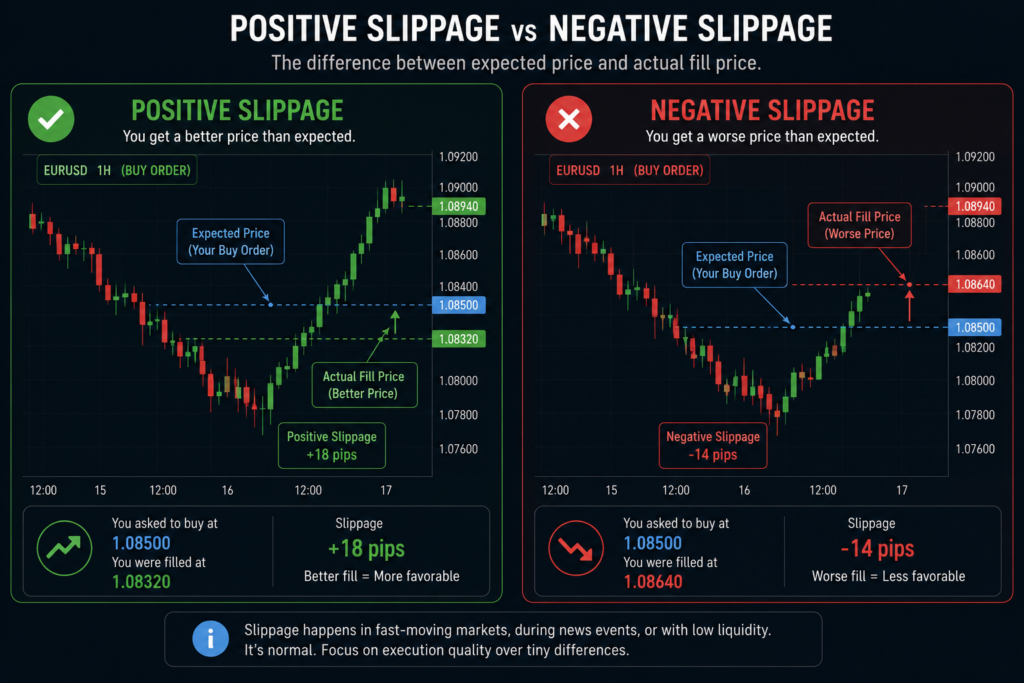
Fig 1.1 Diagram explaining forex slippage with requested
What Causes Slippage in Forex
To answer what causes slippage in forex directly, the root driver is a mismatch between order flow and available liquidity at the moment of execution. Three forces tend to combine. First, volatility widens the distance prices travel between your click and your fill, so trades placed around major news routinely slip more. Second, thin liquidity means there is not enough volume at your desired price, forcing the order to climb the order book to the next available level. Third, latency, the delay between your platform and the broker’s server, gives the market extra time to move before the order arrives.
Certain conditions stack these forces together. Economic releases such as the U.S. nonfarm payrolls report can move major pairs sharply within a single second, draining liquidity and widening spreads at the same time. The market open after a weekend often produces gaps when prices reopen far from Friday’s close, leaving stop orders to fill at the next traded level. Exotic and minor pairs carry thinner order books than EUR/USD or USD/JPY, so identical order sizes slip further. Your order type matters too: market orders accept whatever price is available, while limit orders refuse to fill beyond a set boundary. Knowing these triggers lets you anticipate slippage instead of being surprised by it.
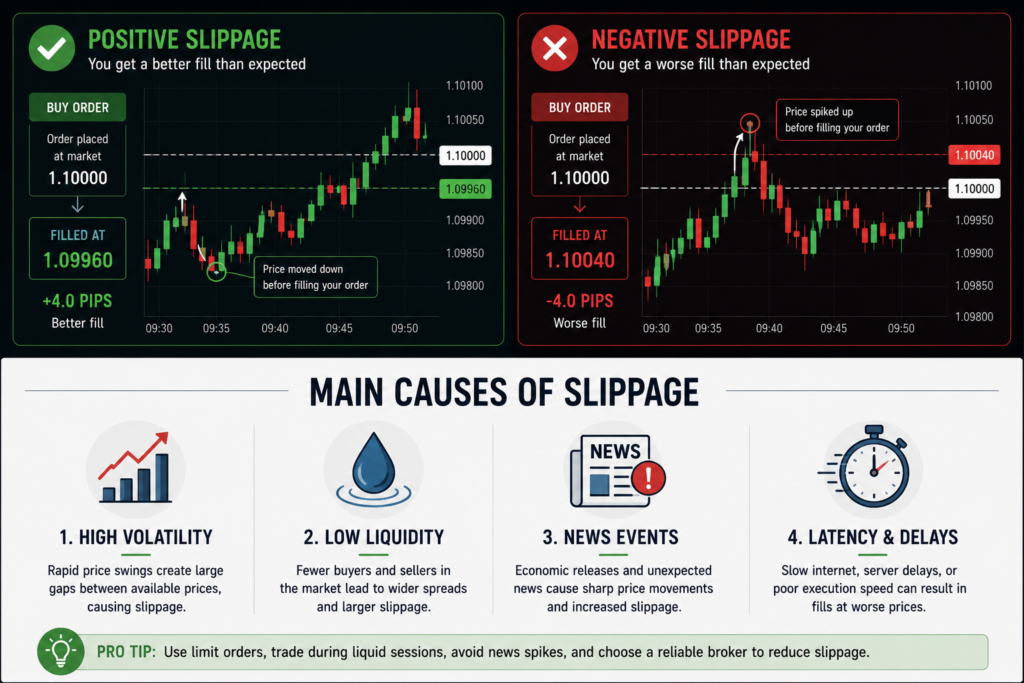
Fig 1.2 What causes slippage in forex
Positive vs Negative Slippage
Slippage is not automatically a loss. When your fill is better than expected, you enjoy positive slippage and pocket the difference. When it is worse, you absorb negative slippage as an extra cost. A fair broker passes both directions to you symmetrically rather than keeping the favourable fills and handing you only the bad ones. Reviewing your execution reports for one-sided slippage is a useful way to judge whether your broker treats fills honestly.
The table below contrasts the two outcomes and links each cause to a practical response, so you can see at a glance where slippage helps, where it hurts, and what to do about it.
| Aspect | Negative Slippage | Positive Slippage |
|---|---|---|
| Fill price | Worse than requested | Better than requested |
| Effect on trade | Higher cost or larger loss | Lower cost or extra gain |
| Common trigger | Buying into a fast rally | Price ticks your way before fill |
| Worst during | News spikes, thin liquidity | Volatile but favourable swings |
| Mitigation | Limit orders, slippage tolerance | Allow execution to capture upside |
The key takeaway is balance. A broker offering only negative slippage signals a problem, while symmetric slippage reflects genuine market execution. Aim to limit the downside without blocking the upside entirely.
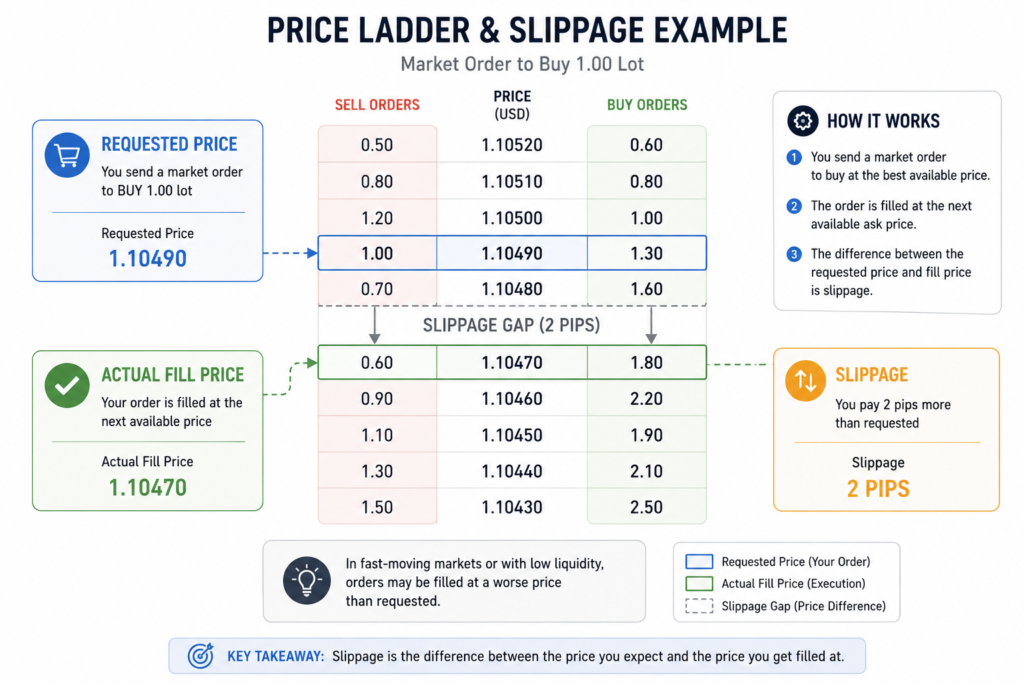
Fig 1.3 Comparison of positive slippage and negative slippage
How to Avoid Forex Slippage
The honest framing for how to avoid forex slippage is that you cannot eliminate it, but you can shrink and control it. Start with order types. A limit order will only execute at your chosen price or better, so it protects you from negative slippage on entries, though it may not fill at all in a fast market. Many platforms also let you set a maximum deviation or slippage tolerance, which caps how far a market order may drift before it is rejected. Setting a sensible tolerance keeps you in the trade during minor noise while blocking extreme fills.
Timing and infrastructure matter just as much. Avoid firing market orders into high-impact news unless slippage is part of your plan, because liquidity thins out exactly when you need it most. Trading liquid major pairs during overlapping London and New York hours gives you deeper order books and tighter execution. A low-latency connection, sometimes a virtual private server located near the broker, trims the delay that lets prices move before your fill. For stop losses, some brokers offer guaranteed stops that hold your exit price for a small premium, which can be worth it around volatile events. Combine these habits and slippage becomes a small, predictable line item rather than a recurring shock.
Managing Slippage Within Your Strategy
Slippage should sit inside your broader risk plan, not be treated as an afterthought. Build a realistic slippage buffer into your expected costs so your backtested edge survives live conditions. A strategy that looks profitable assuming perfect fills can turn flat once a pip of slippage joins the spread on every trade. Scalpers feel this most because their profit targets are small, so even modest slippage can flip a winning system into a losing one. Position size also plays a role: very large orders consume more of the order book and slip further, so scaling in can reduce impact.
It also pays to measure your own execution. Most platforms record requested versus filled prices, and reviewing that data reveals your true average slippage per pair and per session. If one broker consistently delivers worse fills than another on identical conditions, that is actionable evidence. Treating slippage as a tracked metric, rather than an occasional annoyance, turns it into something you actively manage. Over hundreds of trades, that discipline protects your edge more reliably than chasing a broker that merely advertises zero slippage, a claim no honest provider can guarantee.
What Top Traders and Research Say
Seasoned market participants treat execution cost as part of the edge, not a footnote. Kathy Lien, in Day Trading and Swing Trading the Currency Market, stresses that disciplined order placement and an awareness of liquidity conditions separate consistent traders from reactive ones, a principle that applies directly to managing slippage around volatile releases. Her emphasis on trading when liquidity is deepest mirrors the practical advice above.
Academic research reinforces the point that costs compound. In their influential study “Trading Is Hazardous to Your Wealth,” Brad Barber and Terrance Odean found that frequent traders underperformed largely because transaction costs ate their returns. While their data covered equities, the lesson transfers cleanly to forex: every avoidable pip of slippage stacks up across hundreds of trades and quietly drags down net performance. The trader who ignores execution quality pays for it slowly but surely.
As Paul Tudor Jones reportedly put it, “The most important rule is to play great defense.” Controlling slippage is exactly that kind of defensive discipline.
Frequently Asked Questions
Is forex slippage good or bad? It can be both. Negative slippage gives you a worse fill and raises your cost, while positive slippage hands you a better price than expected. Understanding forex slippage as a two-sided outcome helps you judge brokers fairly. A provider that passes both directions to you is treating execution honestly. The goal is to limit the downside without blocking the upside, not to escape slippage entirely, which is impossible in a live market.
Does slippage happen with limit orders? Limit orders protect you from negative slippage because they only fill at your chosen price or better. The trade-off is that they may not fill at all if price moves away quickly, which is a real risk during fast markets. This is central to how to avoid forex slippage on entries. Market orders, by contrast, prioritise getting filled and accept whatever price is available, exposing you to slippage in both directions.
What causes slippage in forex during news? When you ask what causes slippage in forex around news, the answer is a sudden collision of high volatility and thin liquidity. Major releases like nonfarm payrolls move prices sharply within a second, and liquidity providers pull quotes, so orders fill several levels away. Spreads widen at the same moment, compounding the cost. Avoiding market orders in those windows, or accepting slippage as part of a deliberate news strategy, is the practical response.
Can I completely eliminate slippage? No. Because forex prices update continuously and no single price is guaranteed for a market order, some slippage is unavoidable. What you can do is minimise it with limit orders, slippage tolerance settings, low-latency connections, and by trading liquid pairs during deep-liquidity hours. Guaranteed stop losses can lock an exit price for a premium. Think of slippage as a controllable cost, similar to the spread, rather than something you can switch off.
How much slippage is normal in forex? On liquid majors during active hours, slippage is often a fraction of a pip and frequently negligible. During volatile news or weekend gaps, it can widen to several pips or more. Normal therefore depends on the pair, the session, and market conditions. Tracking your own filled-versus-requested prices reveals your realistic average, which is far more useful than any general benchmark a broker advertises.
Final Thoughts
Forex slippage is not a flaw to fear but a normal cost of trading in a fast, liquid market where prices never stand still. The gap between your expected and actual fill comes down to volatility, liquidity, and latency, and it can run in your favour as easily as against you. Once you understand what causes slippage in forex, you can anticipate the high-risk moments, such as major news and weekend gaps, and adjust accordingly. The practical path to how to avoid forex slippage is layered: use limit orders and slippage tolerance, trade liquid pairs during deep sessions, keep latency low, and consider guaranteed stops for volatile events. Build a realistic slippage buffer into your strategy, measure your own execution, and treat the data as feedback. Handle it with discipline and slippage becomes a small, predictable line item rather than a recurring shock that quietly drains your account over time.