
Some of the largest fortunes in trading history were built on a single, deceptively simple idea: find a strong trend and ride it. A forex trend following strategy turns that idea into a structured, repeatable method, allowing you to capture the meaty middle of a sustained move rather than guessing tops and bottoms. This guide explains exactly what trend following is, why it works across markets and decades, how to build and trade it step by step, and how disciplined risk management turns a good idea into lasting consistency.
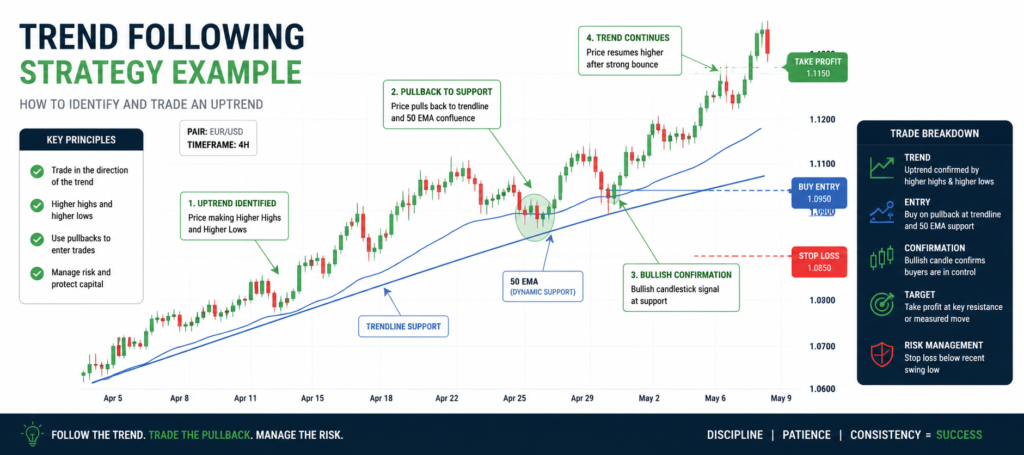
Fig 1.1 Forex trend strategy chart
What Is a Forex Trend Following Strategy?
A forex trend following strategy is a method that seeks to identify the market’s dominant direction and trade in alignment with it, riding sustained moves rather than trying to predict where they will begin or end. The philosophy is captured by the oldest cliché in trading, “the trend is your friend,” and despite its age the idea remains one of the most durable approaches ever devised.
The appeal of trend following lies in its honesty about what we can and cannot know. A trend follower does not pretend to forecast the future; instead, they wait for the market to reveal its direction through price itself, then commit to that direction until the evidence changes. This reactive, evidence-based stance removes much of the ego and guesswork that sink so many traders who insist on calling tops and bottoms.
In practice, trend following forex means buying strength in an uptrend and selling weakness in a downtrend, then holding the position while the trend persists. The method accepts many small losses when trends fail to materialise, in exchange for a handful of large winners that more than pay for them. That asymmetry, small losses and large gains, is the mathematical heart of the entire approach, and understanding it is the first step to trading it well.
Why Trend Following Works
Trend following endures because trends themselves are a persistent feature of markets, driven by the slow diffusion of information and the predictable behaviour of crowds. When a major economic shift begins, prices rarely adjust instantly; instead they drift in one direction over weeks and months as more participants react, and that drift is exactly what a trend follower harvests.
Human psychology reinforces the effect. As a move extends, fear of missing out pulls in new buyers during an uptrend, while loss aversion keeps sellers from capitulating until the pain becomes unbearable, and both forces push price further in the established direction. The trend follower simply positions alongside these powerful, recurring behavioural currents rather than fighting them.
The mathematics also favours the patient. Because forex trend following lets winners run while cutting losers short, a strategy can be profitable even with a win rate well below fifty percent, as long as the average winner dwarfs the average loser. A trend follower might be wrong more often than right and still finish far ahead, which is a liberating realisation for traders exhausted by the impossible pressure of needing to be right on every trade.
How to Build and Trade the Strategy
Building a sound trend following approach comes down to three decisions: how you define the trend, how you enter, and how you exit. For defining the trend, most traders rely on moving averages or simple price structure. When price trades above a rising long-term moving average and prints higher highs and higher lows, the trend is up; the mirror image defines a downtrend. This single filter keeps you on the right side of the dominant move.
For entries, the safest approach is to join the trend on a pullback rather than chasing an extended move far from value. Waiting for price to retrace toward a rising moving average or a prior support level within an uptrend gives you a better entry price and a tighter, more logical stop. You are buying temporary weakness within demonstrated strength, which is a far more favourable proposition than buying strength at its peak.
For exits, the guiding principle is to let profits run, and a trailing stop is the classic tool for the job. As the trend extends, the trailing stop ratchets along behind price, locking in gains while giving the move room to breathe, and it removes the impossible task of picking the exact top or bottom. The trade ends only when the trend itself shows genuine signs of reversing, which is precisely how it should be.
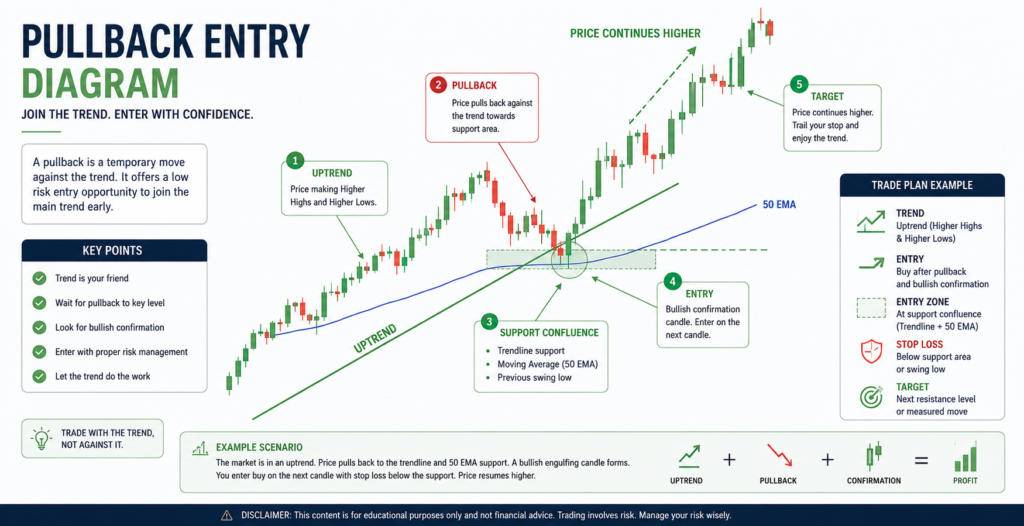
Fig 1.2 Trend forex pullback entry to a rising
Best Tools and Timeframes
Trend following rewards a small, complementary toolkit rather than a cluttered chart. The table below maps the most useful tools to their role, so you can assemble a clean, purpose-built setup.
| Tool | Primary Role | How to Use It |
|---|---|---|
| 200 EMA | Define the dominant trend | Trade with its slope |
| 50 EMA | Confirm intermediate momentum | Align it with the 200 EMA |
| ADX | Measure trend strength | A reading above 25 confirms a trend |
| Trailing stop | Protect and ride profits | Trail behind swing points |
| Support & resistance | Time pullback entries | Buy strength at value zones |
Higher timeframes such as the four-hour and daily charts produce the cleanest, most reliable trends with the least noise, which is why most successful trend followers build their analysis there. Lower timeframes offer more signals but far more false starts, so beginners are wise to start higher and only drop down once their discipline is genuinely proven. Whatever timeframe you choose, the ADX is invaluable for filtering out the choppy, rangebound conditions in which trend strategies struggle and lose money.
What Top Traders and Research Say About Trend Following
Trend following is not merely folklore; it is one of the most rigorously documented approaches in all of finance. Michael Covel’s influential book Trend Following chronicles decades of traders who built fortunes purely by following price, and his central message is that consistent success comes from a disciplined, rules-based system applied without emotion, not from clever prediction. The traders he profiles win precisely because they refuse to second-guess their rules.
Academic research backs this up with hard data. The landmark study “Time Series Momentum” by Tobias Moskowitz, Yao Hua Ooi, and Lasse Pedersen examined dozens of markets across many decades and found a robust, persistent tendency for assets that have trended in one direction to continue doing so over the following months. That finding provides serious empirical support for the idea that trends are real and exploitable rather than illusory.
The veteran trader Ed Seykota distilled the whole philosophy, and its single caveat, into one memorable line: “The trend is your friend until the end when it bends.” For a forex trend follower, the lesson is to ride the friendship fully while it lasts and to exit gracefully when the bend arrives, which is exactly what a disciplined trailing stop is designed to do.
Common Mistakes to Avoid
The most damaging mistake in trend following is impatience, specifically the urge to take profits too early out of fear. Because the entire edge depends on a few large winners, cutting them short destroys the asymmetry that makes the method work. Trend followers must learn to sit comfortably in a winning trade, trusting the trailing stop rather than their nerves.
A second frequent error is fighting the trend by trying to pick tops and bottoms, which is the exact opposite of the strategy and a reliable way to accumulate losses. Equally damaging is trading trend strategies during choppy, rangebound markets, where false breakouts abound; this is precisely why the ADX filter matters so much. Finally, abandoning the system after a string of small losses, just before the big winner arrives, is the quiet killer of most aspiring trend followers, because the losing streaks are an inseparable part of the method’s long-run success.
Frequently Asked Questions
Is a forex trend following strategy profitable?
A forex trend following strategy can be very profitable because it lets winners run and captures the large moves that outweigh many small losses. Success depends on trading with the dominant trend, entering on pullbacks, and using a trailing stop to ride extended moves. Because markets trend often enough, the approach rewards patient followers. With disciplined risk management, the strategy’s large reward-to-risk ratios can drive consistent long-term profitability even with a sub-fifty-percent win rate.
How do I identify the trend in forex?
The most popular method uses moving averages: price above a rising long-term moving average signals an uptrend, while price below a falling one signals a downtrend. The 50 and 200 EMAs define the broader trend, and a pattern of higher highs and higher lows confirms it. The ADX indicator helps measure whether a trend is strong enough to trade. Combining these reads keeps you aligned with the dominant direction and out of choppy conditions.
What is the best timeframe for trend following forex?
Higher timeframes such as the four-hour and daily charts produce the cleanest, most reliable trends with the least noise, which is why most trend followers build their analysis there. Lower timeframes offer more signals but far more false starts. Beginners should start on higher timeframes to build confidence before considering anything shorter. Whatever timeframe you choose, confirm trend strength with the ADX so you avoid trading during weak, rangebound markets.
What indicators work best for forex trend following?
The most effective tools include moving averages for direction, the ADX for trend strength, and a trailing stop to protect and ride profits. A 200 EMA defines the dominant trend, a 50 EMA confirms momentum, and an ADX above 25 signals a tradeable trend. Clear support and resistance levels help time pullback entries. Two or three complementary tools on a clean chart consistently outperform a screen cluttered with overlapping indicators.
How do I manage risk in a trend following strategy?
Risk a small fixed percentage per trade, often one to two percent, so that the inevitable string of small losses never threatens your account. Place your stop at a logical level beyond a swing point, and size the position from that distance. Use a trailing stop to let winners run while protecting gains. This framework produces the large reward-to-risk ratios that make trend following work and lets you survive the losing streaks that always precede the big winners.
Can beginners use a trend following strategy?
Yes, trend following is genuinely beginner-friendly because trading with the market is simpler and less stressful than predicting reversals. Starting on higher timeframes produces cleaner trends and less noise, and a basic moving-average framework makes the trend easy to read. The hardest part for beginners is psychological: sitting patiently in winners and accepting small losses. With demo practice and disciplined risk management, beginners can build confidence and consistency steadily over time.
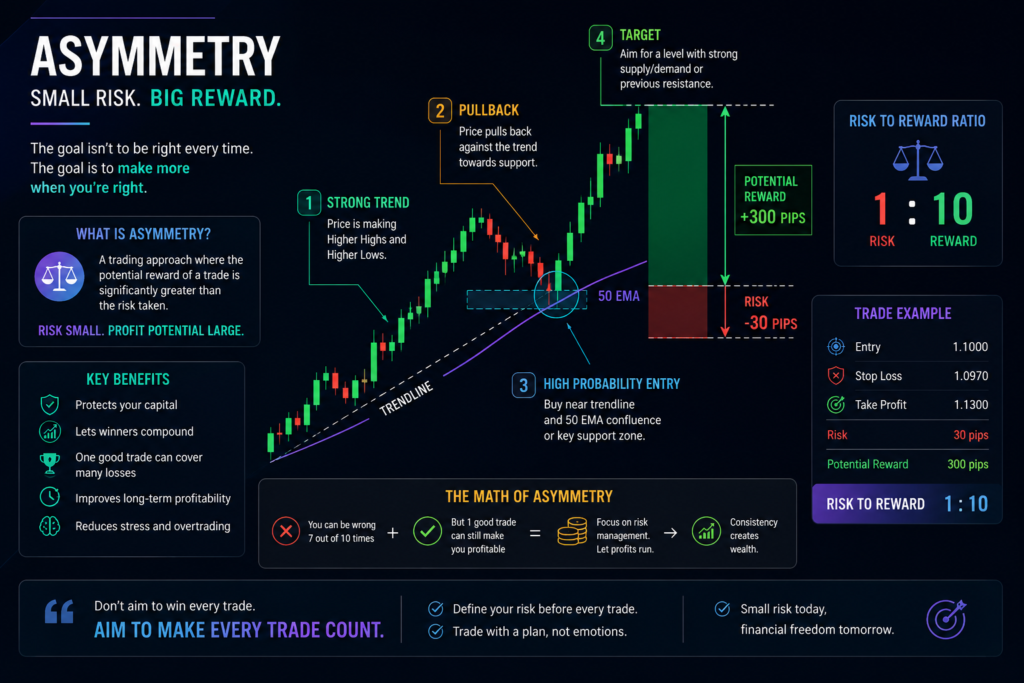
Fig 1.3 Forex trend strategy showing small losses and large winners
Final Thoughts
A disciplined forex trend following strategy remains one of the most powerful and durable approaches a trader can adopt, precisely because it aligns you with the market’s natural flow rather than fighting it. By defining the trend with moving averages, entering on pullbacks rather than chasing extended moves, and using a trailing stop to let winners run, you build a method whose entire edge rests on a simple asymmetry: many small, controlled losses paid for by a handful of large, trend-riding winners. This is why trend following forex can be profitable even with a win rate below fifty percent, and why patience and discipline matter far more than prediction. The wisdom of Michael Covel’s Trend Following, the empirical strength of the Moskowitz, Ooi, and Pedersen research, and Ed Seykota’s reminder that the trend is your friend until it bends all converge on the same truth: trends are real, exploitable, and best harvested by a rules-based system applied without emotion. Confirm strength with the ADX, risk only a small fixed percentage per trade, practise on a demo account, and let the trailing stop do the hard work of riding the move.