
Introduction
A usd/mxn forex signal tells you when a trade setup may be forming on the US dollar versus the Mexican peso, but the smart trader treats it as a starting point, not a command. The peso is a high-yielding emerging-market currency, so this pair swings on rate differentials, oil prices, and global risk appetite far more than a calm major like EUR/USD. In this guide, you will learn exactly what a signal contains, why USD/MXN moves the way it does, and how to read entry, stop, and target levels with confidence. We will walk through the technical indicators that matter for the pair, compare peso signals with eur usd signals forex, and look at how the carry trade shapes price. By the end, you will know how to pair any signal with disciplined risk management instead of blind faith.
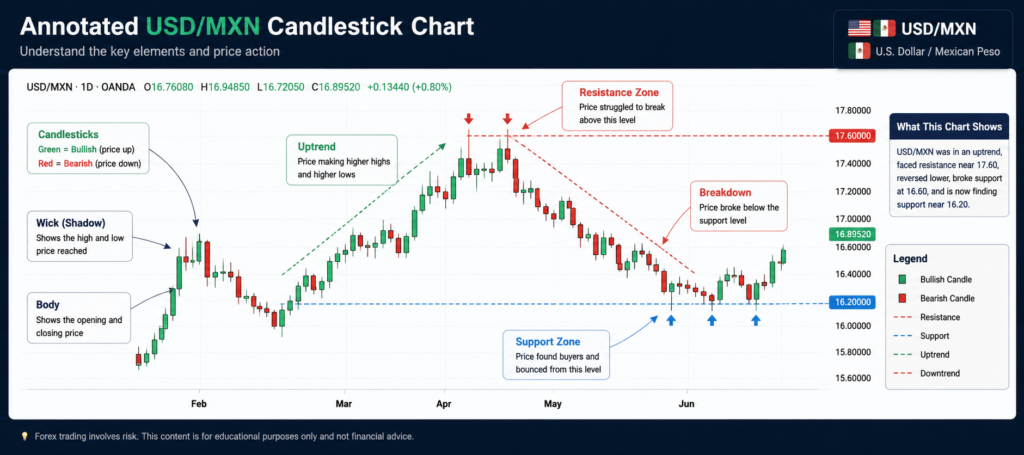
What a USD/MXN Forex Signal Actually Is
A trading signal is a structured suggestion to enter the market under specific conditions. A usd/mxn forex signal typically names a direction (buy or sell), a suggested entry price or zone, a stop-loss level to cap risk, and one or more take-profit targets. Many signals also attach a rationale, such as a moving-average crossover, a break of resistance, or a reaction to a Banxico rate decision. The signal is essentially someone else’s analysis packaged into an actionable format.
The key word is “suggestion.” A signal is not a promise, and the best ones admit that openly. Markets are probabilistic, and even a well-reasoned setup can fail when sentiment shifts or unexpected news hits. Treat a signal as a hypothesis you can test against your own rules. If it aligns with your bias, your timeframe, and your risk tolerance, it may be worth taking. If it does not, walking away is a perfectly valid response.
Signals come in different flavors depending on the trader’s style. Scalping signals target a handful of pips over minutes and demand tight spreads. Intraday signals open and close within a single session. Swing signals hold for days, riding larger moves driven by macro themes. USD/MXN suits swing and intraday traders especially well, because the peso’s sensitivity to rate news and oil creates clean, news-driven momentum that can carry over multiple sessions.
Anatomy of a Signal: Entry, Stop, and Targets
Reading a signal correctly starts with understanding each component and how they relate. The entry defines where you join the move. The stop-loss defines where you admit the idea was wrong. The take-profit defines where you bank the reward. The relationship between these three numbers produces your risk-reward ratio, which matters far more than any single forecast. A signal that risks 50 pips to make 150 pips offers a 1:3 ratio, meaning you can be wrong more often than right and still grow your account.
The table below shows an illustrative breakdown of a hypothetical USD/MXN swing signal. These numbers are examples for learning only and are not a live trade call.
| Signal Component | Illustrative Value | What It Means |
|---|---|---|
| Direction | Buy (long USD/MXN) | Expecting the dollar to strengthen vs the peso |
| Entry zone | 17.20 to 17.25 | Price area where you join the trade |
| Stop-loss | 17.05 | Exit point if the idea fails (about 15-20 pips risk) |
| Take-profit 1 | 17.45 | First target, often used to lock partial gains |
| Take-profit 2 | 17.70 | Extended target if momentum holds |
| Risk-reward | about 1:2.5 | Reward roughly 2.5x the risk |
| Rationale | Break above 50-day MA + hawkish Fed tone | Why the setup exists |
Notice how the rationale grounds the numbers. A signal without a reason is just a guess with decimals attached. When you understand why the levels were chosen, you can monitor whether the thesis still holds as price develops. If the dollar fails to break the moving average or Banxico surprises with a hawkish stance, the original logic weakens and you may exit early rather than waiting passively for the stop.
Why USD/MXN Moves: The Forces Behind the Peso
USD/MXN is one of the most fascinating pairs in forex precisely because so many forces tug at it. The single biggest driver is the interest-rate differential between Banxico, Mexico’s central bank, and the US Federal Reserve. Banxico has historically run high policy rates to defend the peso and curb inflation, which makes holding pesos attractive to yield-seeking investors. When that gap is wide and stable, the peso tends to stay firm. When the Fed turns hawkish and narrows the gap, the dollar often gains and USD/MXN climbs.
Oil is the second major lever. Mexico is a significant crude producer, and the state oil company’s revenues feed directly into national finances. Rising oil prices generally support the peso, while a sharp oil selloff can weigh on it. A sharp trader watching a usd/mxn forex signal will glance at the crude chart before acting, because a bullish dollar signal can be undercut by a sudden oil rally that strengthens the peso instead.
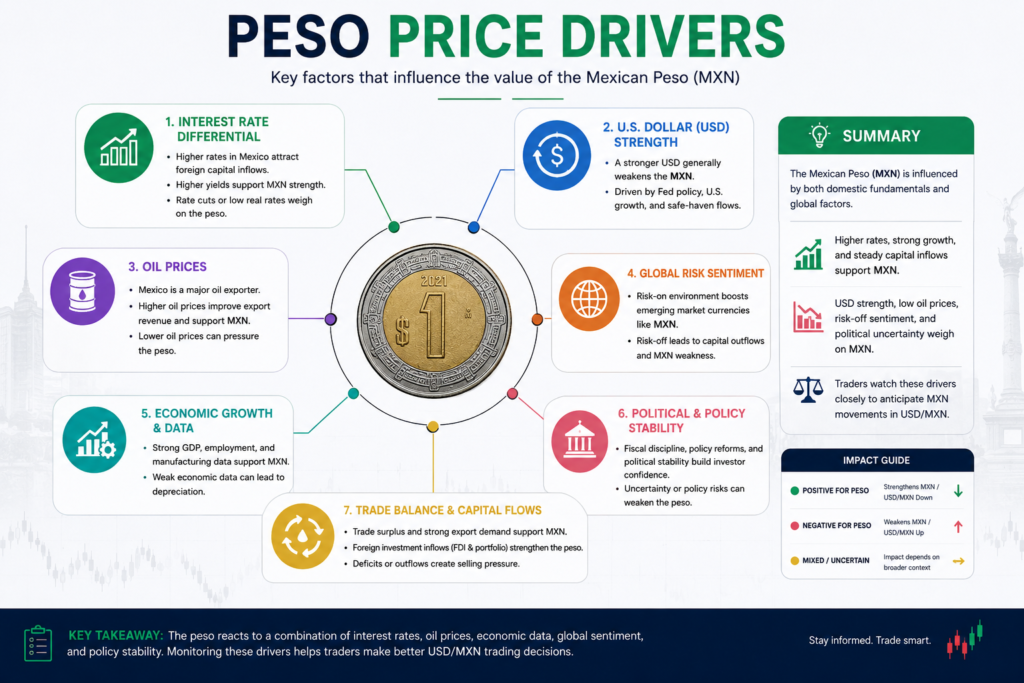
Risk sentiment is the third force, and it can override everything else in a crisis. The peso is liquid and freely traded, so global funds use it as a proxy for emerging-market risk. When markets panic, traders sell pesos fast and the pair spikes higher in what feels like an elevator with the cables cut. When confidence returns, the peso recovers just as quickly. Finally, US-Mexico trade ties and political headlines, from tariff threats to nearshoring trends, can move the pair on a single tweet or announcement. No serious signal ignores this backdrop.
How to Read and Validate a Signal Before Acting
A disciplined trader never accepts a signal at face value. The first check is alignment with the higher timeframe trend. If the daily chart is clearly trending up and the signal says buy, the odds improve. If the signal fights the dominant trend, demand a stronger reason. The second check is the economic calendar. USD/MXN can be quiet for hours and then explode around a Banxico decision, a Fed meeting, or US inflation data. Entering a signal minutes before a major release is gambling, not trading.
The third check is the spread and session timing. The peso trades most actively during the overlap of the London and New York sessions, when liquidity is deep and spreads tighten. Outside those hours, spreads can widen and stop-hunting becomes more likely, which can quietly erode the edge a signal offers. The fourth check is confluence. A signal carries more weight when several independent factors agree, such as a support level, an oversold reading, and a bullish candlestick pattern all lining up at the same price.
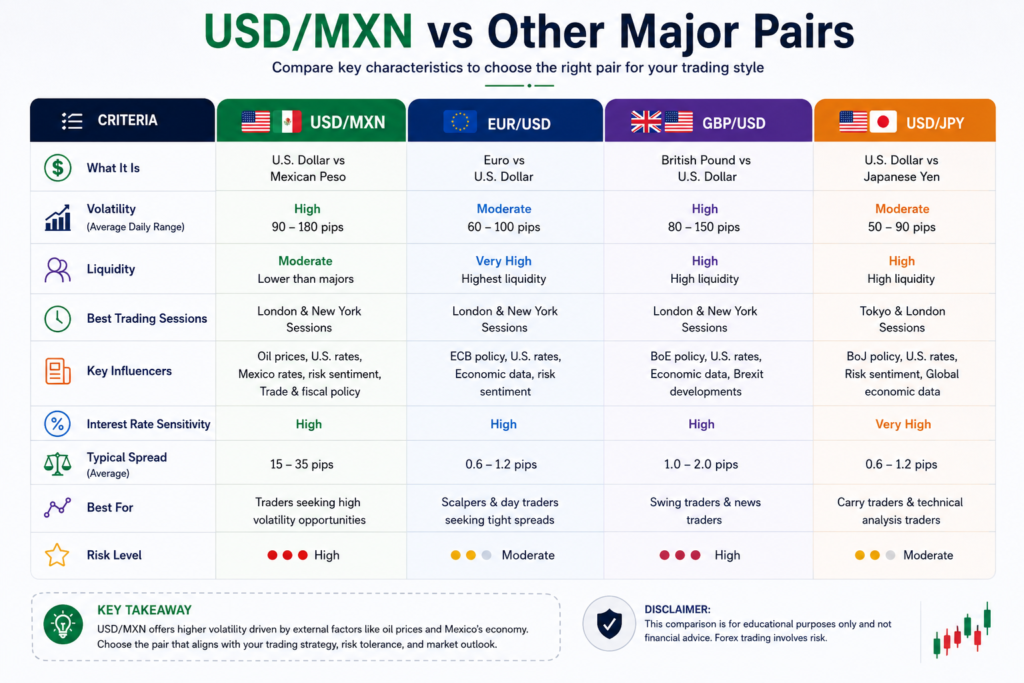
This is also where comparison helps. Reviewing eur usd signals forex alongside a peso signal reveals how much extra volatility you are accepting with USD/MXN. The euro-dollar pair moves in tighter, more orderly ranges, so its signals often carry smaller stops and smaller targets. The peso, by contrast, can run hundreds of pips in a session. Knowing this difference lets you size positions appropriately rather than treating every signal the same way.
Technical Levels and Indicators That Matter for USD/MXN
Technical analysis gives structure to the chaos. For USD/MXN, the most reliable starting points are horizontal support and resistance, drawn from prior swing highs and lows where price has reacted before. Round numbers like 17.00, 18.00, and 19.00 act as psychological magnets and frequently anchor signal levels. Above these, traders watch the 50-day and 200-day moving averages, whose slopes describe the medium-term trend and whose crossovers often trigger signals.
Momentum tools add timing. The Relative Strength Index flags when the pair is stretched, helping you avoid chasing a move that is already exhausted. The MACD highlights shifts in momentum through its crossovers, which can confirm or contradict a signal’s direction. Fibonacci retracements map likely pullback zones after a strong move, giving patient traders better entries than buying at the top of a candle. None of these tools is magic on its own, but together they build a weight-of-evidence case.
It is worth comparing approaches across pairs. Many traders search for gbp/usd forex technical indicators november 2025 to study how cable behaved during a specific stretch, then apply the same indicator toolkit to USD/MXN. The principles transfer cleanly: moving averages define trend, oscillators define timing, and structure defines targets. What changes is the calibration. Because the peso is more volatile, indicator settings and stop distances often need widening, and signals tied to GBP/USD or EUR/USD cannot be copied tick-for-tick onto the peso without adjustment.
A short checklist can help you sanity-check any technical setup:
- Trend agreement: Does the signal match the daily chart direction?
- Key level: Is price near meaningful support, resistance, or a round number?
- Momentum: Does RSI or MACD confirm rather than contradict?
- Event risk: Is a Banxico, Fed, or US data release imminent?
Comparing USD/MXN Signals with EUR/USD and GBP/USD
Not all signals are built the same, and the underlying pair shapes everything. EUR/USD is the most traded pair on earth, with razor-thin spreads and deep liquidity. Its signals tend to be precise, with modest stops and frequent setups, making it a favorite for beginners learning to read eur usd signals forex without getting whipsawed by violent moves. The trade-off is that the euro-dollar can grind sideways for long stretches, testing patience.
GBP/USD, or cable, is livelier. Sterling reacts sharply to Bank of England policy, UK data, and political headlines, producing larger intraday swings than the euro. Traders studying gbp/usd forex technical indicators november 2025 often note how breakout signals on cable can deliver bigger moves but also more false starts. The pair rewards a trader who respects volatility and uses slightly wider stops.
USD/MXN sits in a different category altogether as an emerging-market pair. Its moves can dwarf both majors during risk events, and it carries the added dimension of carry-trade flows and oil sensitivity. A peso signal therefore demands more context, wider stops, and tighter attention to the calendar. The reward is that when a macro theme aligns, USD/MXN can trend powerfully and cleanly. Understanding these personality differences keeps you from over-trusting any single usd/mxn forex signal simply because a similar setup worked on a quieter major.
The Carry Trade Angle of the Mexican Peso
No discussion of the peso is complete without the carry trade, because it explains much of the currency’s long-run behavior. The carry trade involves borrowing in a low-yielding currency, such as the US dollar or Japanese yen during easy-money eras, and investing in a high-yielding one like the peso. As long as the peso’s higher interest rate compensates for any depreciation, the trader pockets the difference. This flow of yield-hunting capital can keep the peso strong for extended periods, which is why USD/MXN sometimes drifts lower even when the dollar is broadly firm elsewhere.
The catch is asymmetry. Carry trades earn slowly and unwind violently. When global volatility spikes or risk appetite collapses, investors rush to close peso positions and repay their dollar borrowings, sending USD/MXN sharply higher in a matter of hours. This is why the peso is described as a currency that “goes up by the stairs and down by the elevator.” A signal that ignores the carry backdrop can look attractive on a chart yet sit on a powder keg of crowded positioning.
For a signal reader, the practical takeaway is to know which side of the carry you are leaning on. A short USD/MXN signal is, in effect, a bet that the carry environment stays calm. A long USD/MXN signal often profits from carry unwinds and risk-off shocks. Recognizing this helps you judge whether a signal fits the current macro mood or fights it.
What Top Traders and Research Say
Serious traders lean on serious sources rather than hunches. A cornerstone text is John J. Murphy’s Technical Analysis of the Financial Markets, which lays out the trend, support-resistance, and indicator concepts that underpin nearly every modern forex signal, including those built for USD/MXN. For currency-specific tactics, Kathy Lien’s Day Trading and Swing Trading the Currency Market connects fundamental drivers like interest-rate differentials to practical trade setups, which maps directly onto the Banxico-versus-Fed dynamic that powers the peso.
On the research side, the carry trade has been studied extensively in academic finance. The well-documented “forward premium puzzle,” explored in work by economists such as Eugene Fama, shows that high-interest-rate currencies do not depreciate as much as interest-rate parity would predict, which is precisely why carry strategies in currencies like the peso have historically earned returns. This body of research gives genuine grounding to why USD/MXN behaves as it does, rather than relying on folklore.
As for mindset, a line often attributed to trader Paul Tudor Jones captures the right attitude: “The most important rule is to play great defense.” That defensive philosophy is exactly what separates traders who use a usd/mxn forex signal wisely from those who blow up chasing it.
Frequently Asked Questions (FAQs)
1. Is a usd/mxn forex signal a guaranteed trade?
No signal is guaranteed. A usd/mxn forex signal is an educated suggestion based on technical and fundamental analysis, not a promise of profit. Markets shift on news, sentiment, and oil moves that no analyst can perfectly predict. Always validate a signal against your own bias, timeframe, and risk plan. Treat it as one input among several rather than an instruction to follow blindly.
2. How is a peso signal different from eur usd signals forex?
The peso is an emerging-market currency, so its moves are larger and more news-driven than the orderly euro-dollar. Compared with eur usd signals forex, USD/MXN signals usually need wider stops, careful session timing, and attention to the carry trade. The euro-dollar offers tighter spreads and smaller swings, which can suit beginners. Knowing the difference helps you size positions correctly for each pair.
3. Which technical indicators work best for USD/MXN?
Moving averages define the trend, RSI flags overbought and oversold conditions, MACD confirms momentum shifts, and Fibonacci maps pullback entries. Traders who study gbp/usd forex technical indicators november 2025 can apply the same toolkit to the peso, but they should recalibrate for higher volatility. Combining several indicators with key support and resistance produces stronger confluence than any single tool used alone.
4. What time of day should I trade USD/MXN signals?
Liquidity peaks during the London and New York session overlap, when spreads tighten and price action is cleanest. Outside those hours, spreads widen and false moves become more common. Many high-impact peso catalysts, such as Banxico decisions and US data, also land during US hours. Aligning your signal entries with these active windows improves execution quality and reduces slippage.
5. How does the carry trade affect USD/MXN signals?
The peso is a popular carry-trade currency because of its high interest rate. Calm markets reward holding pesos, which can keep USD/MXN low, while risk-off shocks trigger fast carry unwinds that send the pair sharply higher. A signal that ignores this backdrop can misjudge the real risk. Always ask whether a setup leans with or against the prevailing carry environment.
Final Thoughts
A usd/mxn forex signal can be a genuinely useful tool, but only when you understand the machinery behind it. The peso is shaped by the Banxico-Fed rate gap, oil prices, global risk sentiment, and crowded carry-trade positioning, and any worthwhile signal respects all of these forces. Reading a signal well means decoding its entry, stop, and target, weighing its risk-reward, checking the calendar, and confirming the technical picture before you ever click buy or sell. Comparing peso setups with calmer eur usd signals forex and livelier cable trades keeps your expectations realistic and your position sizing honest. Above all, no signal replaces your own judgment and disciplined risk management. Use signals to sharpen your edge, never to outsource your responsibility. For more practical, trustworthy forex education and analysis, visit forexmarkettrendss.com and trade with clarity.