
Introduction
Ask experienced traders how they read charts, and many will mention the same foundation: what is price action trading and why it underpins almost every method. Price action trading means making decisions based on the raw movement of price itself — candlesticks, support and resistance, and chart patterns — rather than relying on a stack of lagging indicators. It is the closest thing to reading the market’s own language, stripped of clutter. For beginners, this purity is both appealing and slightly intimidating, because a clean chart offers fewer hand-holding signals and demands genuine skill. Many newcomers simply want price action trading explained in plain terms before committing time to it, while others are hunting for practical price action trading strategies for beginners. In this guide you will learn exactly what price action trading is, why it works, the core concepts, simple strategies to start with, and the mistakes to avoid.
Want it offline? Grab our free price-action scalping PDF guide.
What Is Price Action Trading, Exactly?
What is price action trading at its core? It is a method of analysing and trading markets based purely on the movement of price — how candles form, where price reacts at key levels, and what patterns emerge — rather than on lagging indicators calculated from past data. The chart itself becomes the primary tool, and the trader reads the ongoing battle between buyers and sellers directly.
This approach rests on a simple premise: every indicator is ultimately derived from price, so price is the original and most timely source of information. Instead of waiting for a moving average or oscillator to confirm a move after the fact, a price action trader reacts to what the candles are doing right now. Understanding what is price action trading therefore means embracing the idea that a clean chart, read with skill, often tells you more than a screen cluttered with indicators ever could.
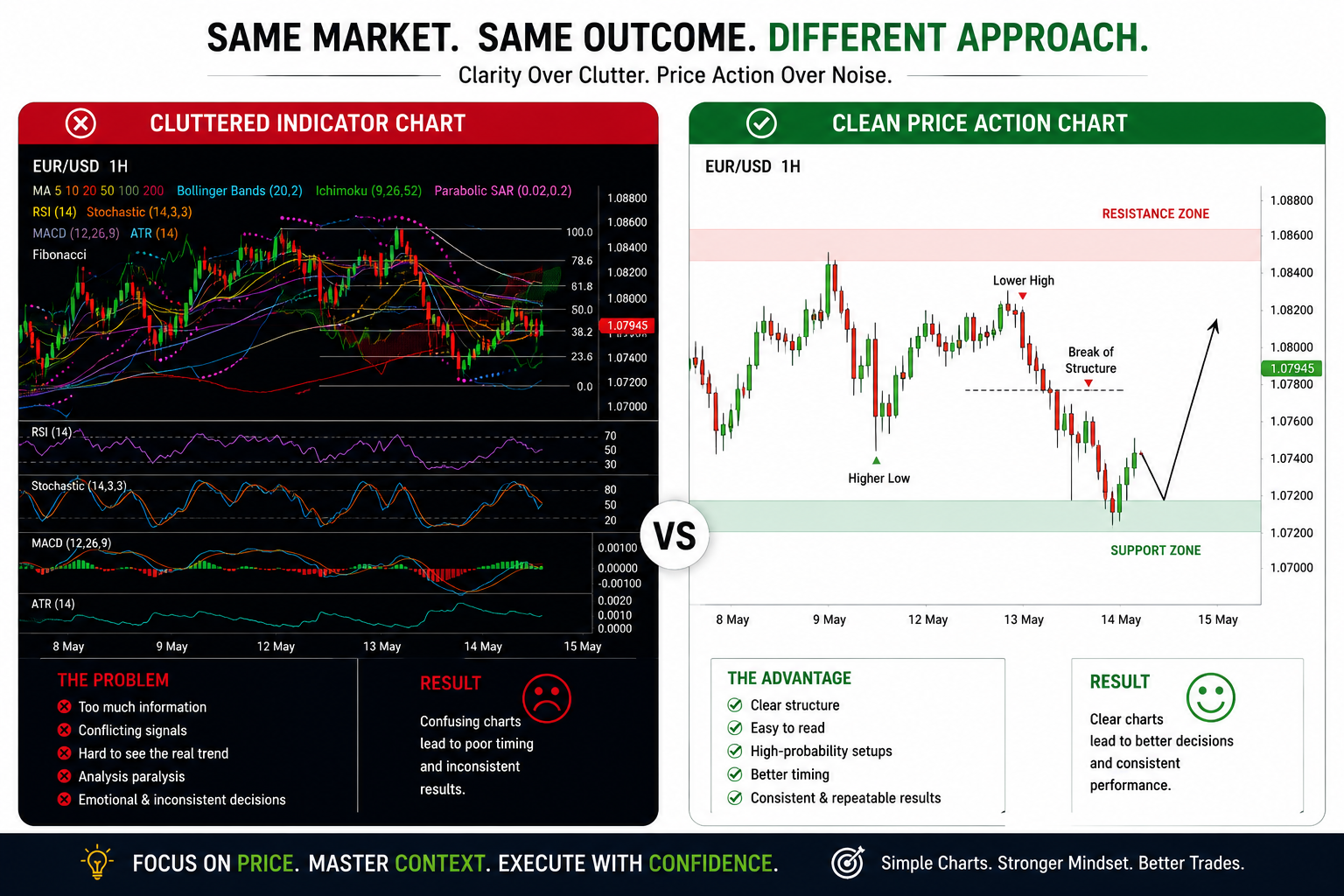
Fig 1.1 What is price action trading
Why Price Action Trading Works
To appreciate price action trading explained properly, it helps to understand why reading raw price is so effective. Markets move because of supply and demand — the collective decisions of every participant — and those decisions show up first in price itself. Indicators lag because they average past prices, so by the time they signal, the move is often already underway.
Price action also adapts to any market condition. The same skills that read a trending chart work on a ranging one, on forex, stocks, gold, or indices, because the underlying behaviour of buyers and sellers is universal. This flexibility is a major reason experienced traders lean on it. A clean chart, free of conflicting indicator signals, lets you make faster, clearer decisions. Once you grasp why raw price leads and indicators follow, the appeal of building skill in price action trading strategies for beginners becomes obvious.
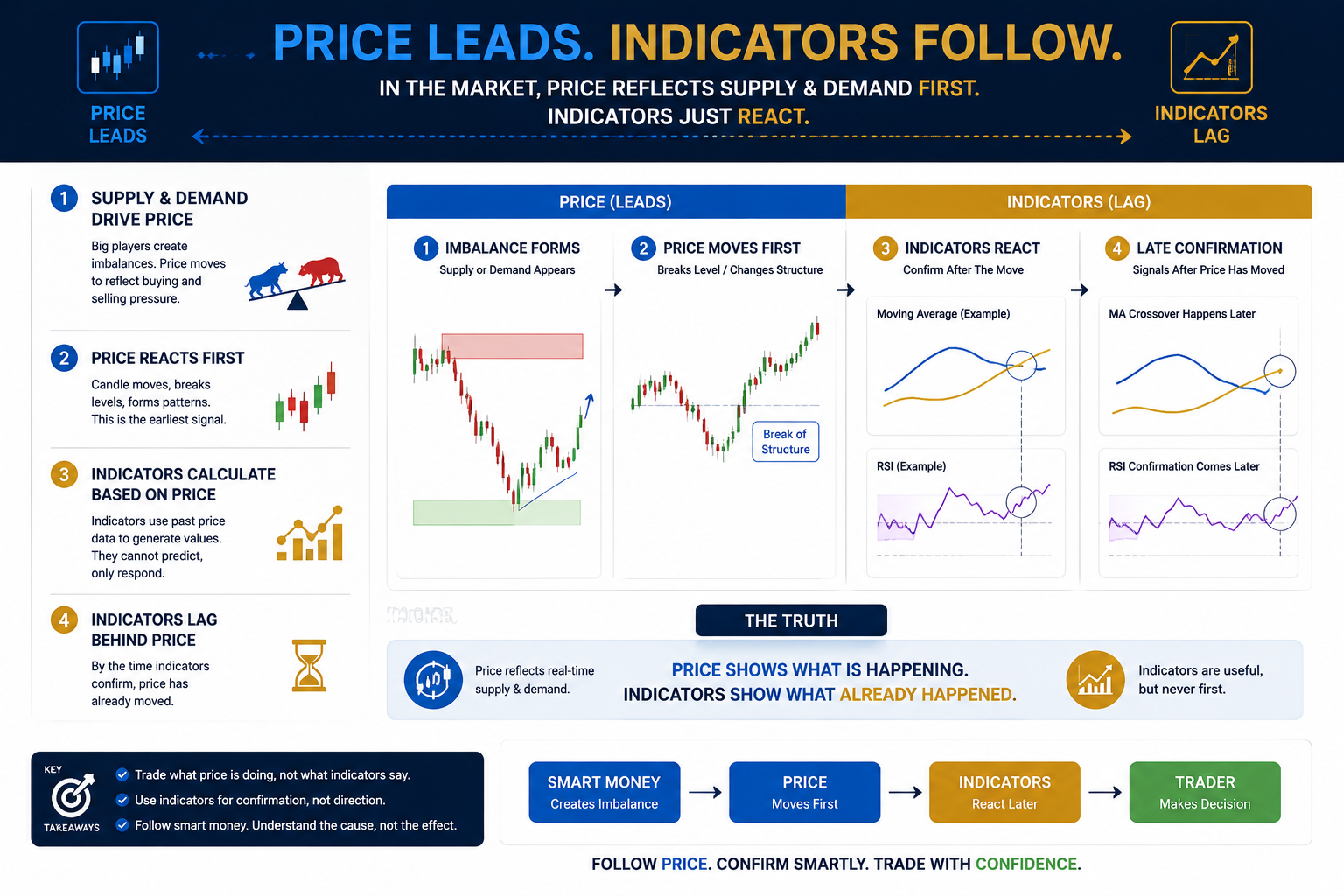
Fig 1.2 Price action trading explained
Core Concepts Every Beginner Must Know
Before trading the method, you need a firm grasp of its building blocks, because the concepts behind what is price action trading all connect. The first is support and resistance — the key levels where price has repeatedly reacted, marking zones where buyers or sellers are likely to step in again. These levels are the map on which every setup is read.
The second is candlestick reading. Individual candles and small clusters reveal momentum and hesitation: long wicks show rejection, strong bodies show conviction. The third is market structure — the sequence of higher highs and lows in an uptrend, or lower highs and lows in a downtrend — which defines the trend and your bias. Together, support and resistance, candlesticks, and market structure form the foundation of every reliable price action approach, and mastering them is the real first step in any price action trading strategies for beginners journey.
| Concept | What It Shows | Why It Matters |
|---|---|---|
| Support & resistance | Key reaction levels | Where setups form |
| Candlesticks | Momentum and rejection | Timing of entries |
| Market structure | Trend direction | Sets your bias |
| Confluence | Multiple signals aligning | Higher-probability trades |
Simple Price Action Strategies for Beginners
The best way to start is with a few clean, repeatable setups rather than trying to read everything at once. One of the most reliable price action trading strategies for beginners is the support-and-resistance bounce: wait for price to reach a clearly established level, then look for a rejection candle — such as a pin bar with a long wick — signalling that the level is holding. Enter on confirmation, place your stop beyond the level, and target the next zone.
A second beginner-friendly setup is the pullback entry in a trend. In an uptrend, wait for price to dip toward support or a prior breakout level, then enter when a bullish candle confirms buyers returning. This keeps you trading with the dominant momentum rather than against it. A third is the breakout-and-retest, where price breaks a key level, returns to test it as new support or resistance, and continues. Mastering just these few setups gives a solid, practical foundation in what is price action trading.
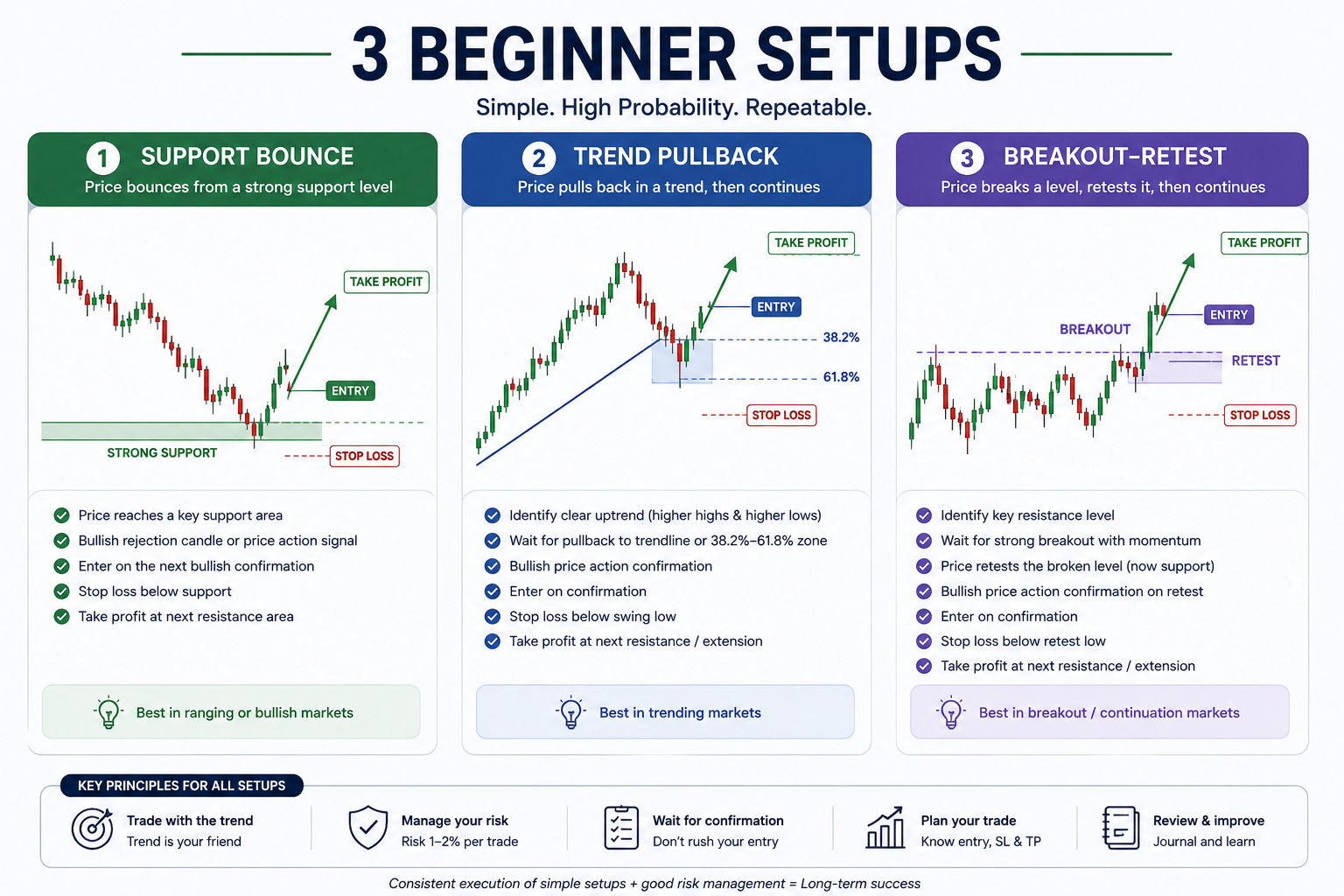
Fig 1.3 Price action trading strategies
What Top Traders and Research Say
Sound execution matters more than any single setup, and the literature supports the price action emphasis on reading raw markets. In Technical Analysis of the Financial Markets, John Murphy stresses that support, resistance, and chart structure are the foundation of all analysis — exactly what price action trading focuses on. For the discipline to wait for clean setups rather than forcing trades, Mark Douglas’s Trading in the Zone remains essential reading.
Academic research keeps any method grounded. The widely cited Barber and Odean study, “Trading Is Hazardous to Your Wealth,” found that the most active retail traders underperformed largely because of overtrading and costs — a direct caution for beginners tempted to trade every candle. As Jesse Livermore observed, “The big money is made in the waiting.” That patience is exactly what disciplined price action trading strategies for beginners are meant to encourage: take only the clean, high-probability setups and ignore the noise in between.
Common Mistakes Beginners Make
Even with a clean method, beginners stumble in predictable ways, and recognising them protects your account. The most common mistake is seeing setups everywhere — treating every candle and level as a signal. Without patience and a clear bias from market structure, price action becomes a hindsight game where any move can be justified after the fact.
A second mistake is ignoring the higher timeframe, trading a tiny pin bar on a low timeframe against a powerful trend on the daily chart. Many beginners also abandon their stop-loss, convinced a level “must” hold, when no level guarantees anything. Finally, overtrading out of boredom destroys accounts that a disciplined approach would protect. Avoiding these traps is the unglamorous core of applying what is price action trading successfully — wait for clean setups, respect the bigger picture, and protect every trade with a defined stop.
Frequently Asked Questions
What is price action trading in simple terms?
What is price action trading? In simple terms, it is reading and trading markets based purely on the movement of price — candlesticks, support and resistance, and chart patterns — rather than relying on lagging indicators. The chart itself becomes the main tool, and you interpret the ongoing battle between buyers and sellers directly. Because every indicator is derived from price, price is the original and most timely source of information. A clean chart read with skill often reveals more than a screen cluttered with indicators.
Is price action trading good for beginners?
Yes, price action can suit beginners well, because it teaches you to read the market’s own language rather than depend on lagging tools. The learning curve comes from developing patience and pattern recognition, but the core concepts — support and resistance, candlesticks, and market structure — are intuitive once practised. Starting with a few simple price action trading strategies for beginners, such as support bounces and trend pullbacks, builds confidence steadily. With demo practice and discipline, beginners often find a clean chart easier to read than a cluttered one.
Is price action trading profitable?
Like any approach, price action can be profitable for disciplined traders, but it is not a guaranteed system. Profitability depends on reading market structure for a clear bias, taking only clean, high-probability setups, and managing risk tightly. Traders who see setups everywhere or trade against the trend usually struggle. The method’s strength lies in reacting to timely information directly from price rather than waiting for lagging signals. As with all strategies, consistent results come from execution and discipline, not the concepts alone.
How do I learn price action trading strategies for beginners?
Start by mastering the core concepts — support and resistance, candlestick reading, and market structure — before attempting live trades. Then learn a few simple price action trading strategies for beginners, such as the support-and-resistance bounce, the trend pullback, and the breakout-retest. Practise each on a demo account, journal the results, and add complexity only once the basics feel natural. Focusing on one or two setups and one market at a time prevents overwhelm and builds reliable pattern recognition far faster than trying to learn everything at once.
Is price action better than using indicators?
Neither is strictly superior; they are different philosophies. Indicators can confirm and filter, but they lag because they average past price. Price action reacts to the market directly and adapts to any condition, which is why many experienced traders favour it. Understanding what is price action trading does not mean abandoning indicators entirely — some traders use one or two for confluence. The key advantage of price action is timeliness and clarity, letting you make faster decisions from a clean chart rather than waiting for delayed confirmation.
Can I use price action on any market?
Yes, one of the great strengths revealed when price action trading explained properly is its universality. Because it reads supply and demand through price itself, the same skills work on forex, stocks, gold, indices, and crypto. Support and resistance, candlestick behaviour, and market structure are universal across liquid markets. As always, align entries with the higher-timeframe trend and respect a defined stop-loss. The method’s adaptability is a major reason traders invest in mastering it, since the skill transfers directly across instruments.
Final Thoughts
So, what is price action trading? It is the practice of reading markets through their most honest source — the movement of price itself — rather than through lagging indicators derived from that same data. By focusing on support and resistance, candlestick behaviour, and market structure, a price action trader interprets the ongoing battle between buyers and sellers directly, making faster and clearer decisions from a clean chart. The approach works because price reflects supply and demand first, and it adapts to any market because that behaviour is universal. For newcomers, the path is straightforward: master the core concepts, learn a few simple price action trading strategies for beginners like support bounces, trend pullbacks, and breakout-retests, and practise them patiently on a demo account while journaling every trade. The real edge never comes from the setups alone; it comes from discipline — waiting for clean, high-probability opportunities, respecting the higher-timeframe trend, and protecting every position with a defined stop. Embrace that patience, and price action trading explained simply becomes one of the most durable, transferable skills you can build as a trader.